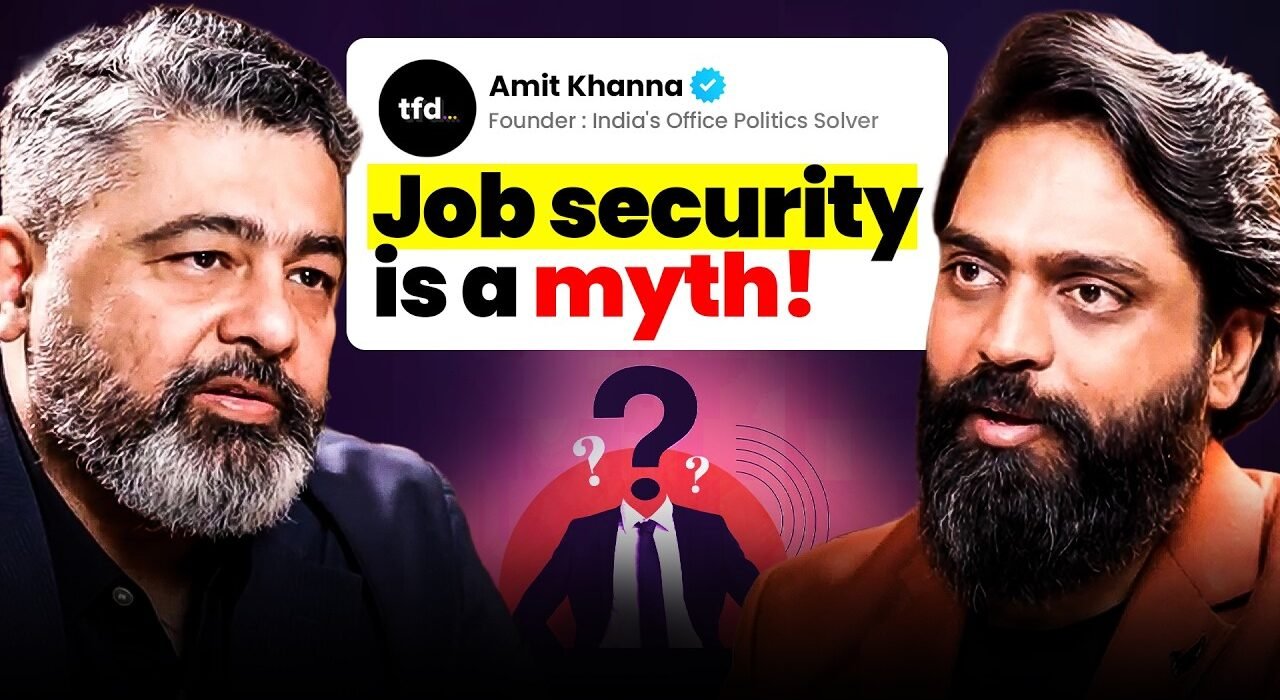
Is job security real, or is it a story we tell ourselves to feel safe? On this episode of The Founder’s Dream podcast, host Abhishek Vyas sits down with Amit Khanna — international director, TEDx speaker, author and executive leadership mentor — to take that question apart. Amit’s answer is direct: real protection doesn’t come from a designation or a long tenure, it comes from an entrepreneur mindset, whether you’re running a company or sitting inside one, because the person who thinks like an owner is the one who survives the next round of cuts.
Amit’s own life backs up the argument. He lost his father at 15, started working the same year, watched his mother fight cancer, and went through facial paralysis four separate times while still showing up for client meetings. None of that came with a safety net. What he built instead was a mindset for entrepreneurs that he now teaches to the professionals he coaches.
From ₹33 a Day to Seven Countries
Amit was born and raised in Mumbai, an only child, by his own admission “very pampered” as a late-born kid. That changed fast. At 15, his father passed away, and the family discovered the house was mortgaged — the police arrived asking them to clear roughly ₹18-19 lakh or vacate. His mother, a homemaker who didn’t speak English and hadn’t studied much, was later diagnosed with breast cancer at a late stage.
He started working at 15 as a cashier at a restaurant in Borivali, then as a bartender, while running two colleges at once — a regular degree in the morning and a textile course in Worli in the evening, because his family’s background was in textiles. In between, he spent a year doing factory labour alongside other workers, 12 hours a day for ₹33.
“I’ve learned from everyone — from the waiter, from the people who washed clothes at my shop. I’ve washed clothes myself, starting from that level.”
He couldn’t speak fluent English until he was 18, despite studying in an English-medium school, simply because nobody around him spoke it at home. A physics tuition teacher once refused to take him into a coaching batch in front of everyone, saying he didn’t want to “waste” his coaching on him. Amit skipped the coaching, sat for the exam anyway, and was one of only 33 out of 73 students who passed — a moment he calls his real turning point.
The Entrepreneur Mindset Behind Amit Khanna’s Self-Belief
Asked whether success or self-belief came first, Amit was clear that belief came first, built on moments like that exam result. This is where his entrepreneur mindset actually took shape — not in a boardroom, but in proving one teacher wrong.
“I didn’t study for 21 years, and after 21 I did everything — a master’s degree, a dozen certifications. I still keep doing something or the other.”
That same mindset shows up in how he frames ambition versus patience in his rapid-fire answers during the episode: he picked experience over ambition, improving yourself over proving yourself, and stability over reinvention — not because reinvention scares him, but because he’s already lived through enough forced reinvention to value a steady base. For anyone exploring their own entrepreneurial journey stories, Amit’s path shows that the mindset usually forms years before the title does.
Why Amit Khanna Calls the Employee a Liability, Not an Asset
This is the part of the conversation that gives the episode its edge. Amit pushes back hard on the standard founder-coach line that “employees are assets.”
“My point is this: the employee is a liability, not an asset. All these gurus who advise founders keep saying employees are assets. What does an employee actually get? CTC — cost to the company. You give your eight hours, the company pays you for it.”
He connects this directly to Oracle’s layoff of 21,000 employees, which he had posted about. His read is not that AI simply replaced those jobs — he’s candid that “AI as a tool hasn’t really come into companies that much yet.” Instead, the infrastructure cost of building AI capability is enormous, running into billions of dollars, and companies need to show a return on that investment quickly. According to Amit, that pressure — needing to free up tens of millions of dollars a year to justify the spend — is often what drives the headcount cuts, with AI used as the stated reason.
His practical takeaway for employees is blunt but useful: stop thinking of your salary as a monthly number and start dividing it by the days you actually work. He still calculates his own pay this way, a habit from the days when a sick leave meant losing ₹33.
- Know your real daily and hourly value to the business, not just your CTC slip.
- Upskill, get certified, build knowledge — not for the resume, but to move from cost to return.
- Remember that shareholders, not employees, carry the actual financial risk in a company.
Office Politics Isn’t What You Think It Is
When Abhishek Vyas asked him to define office politics, Amit rejected the usual picture of backstabbing and flattery. He compares it to writing a brilliant script for an ad that never gets made because it sits in a drawer — the work being good is not the same as the work being seen.
“People should understand that office politics exists. You cannot step outside it. You can keep doing excellent work, and it still happens — someone else has to actually carry your work to the right person.”
He breaks workplace characters into two types: “jokers,” who talk the most or work the most without realising they’re seen as an entertaining character rather than an influential one, and “ringmasters,” the quiet influencers who actually decide outcomes. His advice is to figure out, in any team of five, who influences, who blocks, and who decides — and build a relationship with that person rather than assuming good work speaks for itself.
Diplomacy, Ego and Why Conflict Is Healthy
Amit now mostly teaches diplomacy and leadership skills, built partly on a two-year human psychology diploma he completed in Australia. He traces workplace insecurity in senior leaders back to a basic human need for self-realisation — everyone wants to be seen as valuable, and that need, unmanaged, becomes ego and distrust of your own team.
He’s open about fighting this in himself. After reading Ryan Holiday’s “Ego Is the Enemy” in 2017, he built himself an unusual accountability tool.
“I created an email ID of my own — No Ego Amit, on Gmail — so that it’s always sitting right there in my phone’s inbox: ego doesn’t work, ego doesn’t work, stay calm, stay calm.”
He also argues, somewhat against instinct, that having managers with opposite personalities is a benefit, not a problem — conflict between different ways of thinking is where growth actually happens, as long as people know how to leave the argument in the room and move on with the best outcome. That belief sits squarely in the kind of self growth lessons he now builds his coaching practice around.
What the Episode Leaves You With
Amit’s TEDx talk, “Kill the Soft Skills,” grew out of years of being marked down in vague annual reviews that cost him real money in salary hikes — a frustration that pushed him to question how soft skills get measured at all. His closing philosophy, drawn from reading the Bhagavad Gita through Eknath Easwaran’s writing, is simple: keep taking action, result or no result, because the end date is coming for everyone and there’s no version of life where you get to wait it out safely.
He ended the conversation with a line someone once sent him: “Everyone was waiting for me to break, not knowing that when stars fall, they’re still stars.” It’s a fitting close for a conversation that spent less time on strategy and more on what it actually takes to stay standing.
Watch the full conversation with host Abhishek Vyas on The Founder’s Dream YouTube channel and subscribe for new founder interviews every week.
Frequently asked questions
Who is Amit Khanna?
Amit Khanna is an international director, TEDx speaker, author and executive leadership mentor who has worked across seven countries and now coaches professionals on office politics, diplomacy and leadership.
Why does Amit Khanna say employees are a liability, not an asset?
He explains that employees are paid CTC, cost-to-company, in exchange for their time, and only become true assets once the value they generate exceeds that cost, while shareholders carry the real financial risk.
What does Amit Khanna say about AI and layoffs like Oracle's?
He argues that massive infrastructure spending on AI forces companies to show returns quickly, and cutting human headcount is often used to fund or justify that investment rather than AI directly replacing every job.
What is Amit Khanna's TEDx talk about?
His TEDx talk, ‘Kill the Soft Skills,’ grew out of years of being marked down on vague soft-skills feedback at work, pushing him to challenge how companies measure and reward communication ability.
How did Amit Khanna start his career?
After his father died when Amit was 15 and his mother was later diagnosed with cancer, he started working as a cashier and bartender, studied at two colleges at once, and even worked a factory job for ₹33 a day.