
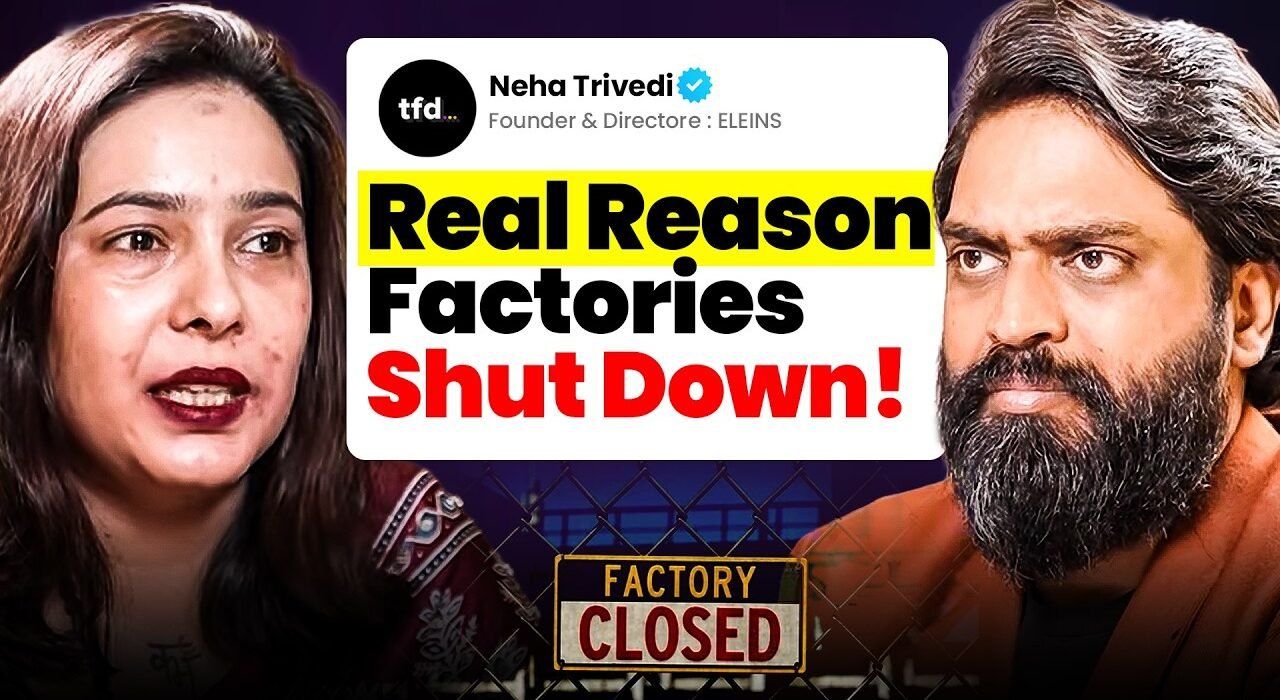
Neha Trivedi walked away from a role in a ₹100 crore organization to join a company worth a fraction of that size, with no guarantee it would work. Four years later, she runs Alens, a company built on turnkey electrical projects, instrumentation and automation work, building panels for warehouses, grain silos and dairy plants across India. Speaking to host Abhishek Vyas on The Founder’s Dream, she lays out an entrepreneur success story India’s manufacturing sector rarely gets to hear in this much operational detail — not just why she started, but exactly where factories go wrong.
From a Five-Year-Old’s Factory Dream to Alens
Neha says the idea of building a factory wasn’t a career decision made in her twenties — it started when she was five years old, growing up around a factory environment. She carried that thought through school, through a finance background and an Inter CA, and later through an MBA in Marketing completed while working a full-time job.
She describes the shift plainly: at some point during her corporate job, she decided enough was enough and it was time to build what she’d wanted since childhood. She formally restarted her career path toward entrepreneurship around 2018, but the company itself, Alens, is only a few years old.
Leaving a ₹100 Crore Career: An Entrepreneur Success Story India Needs to Hear
Before Alens, Neha spent roughly 13 years at an electrical automation company, where she learned how panels are actually built from the ground up. She had been telling her boss for a year that she wanted more — faster growth, bigger scale — and eventually the company she worked for crossed ₹100 crore in revenue. Two months after that milestone, she resigned.
I had put my entire career on the line, to be very frank, because I was leaving a ₹100 crore organization to go back into building something in a five-to-six crore space. It was like betting my career. If it didn’t work out, I don’t know what I would have done — but at the back of my mind there was always this one thing: if it doesn’t work, I’ll just go back to a job.
The first year wasn’t about sales pitches to strangers. Her prior employer’s clients approached her and her co-founder Maulik directly, because the relationships and reputation were already there. When she took her shop floor on lease in January, it was full within a week — a direct result of 12-13 years of visible, reliable work in the industry rather than a cold start.
What Makes Alens Different: The “Full Basket” Approach
Asked what actually wins Alens its projects, Neha doesn’t point to price. She points to scope.
We give the customer a full basket. Other companies don’t.
Most competitors specialize narrowly — some only do electrical automation, some only take EPC contracts for building warehouses and silos, some only handle mechanical work. Alens combines plant engineering, in-house panel manufacturing, industrial automation systems on platforms like Rockwell and Siemens, procurement, MIS and dashboard reporting, and even non-contact temperature measurement solutions under one roof.
That bundling came from a gap she identified by visiting eight to ten companies early on. Every one of them gave the same answer: nobody wanted to touch ₹10-15 crore projects. Big players chase bigger contracts because their teams are built for scale; small contractors can’t handle the complexity. Neha built her 50-person team specifically to own that mid-range gap, and she’s clear that it’s a deliberate strategy, not an accident.
Her two biggest reference clients sit at opposite ends of the same business. The Adani grain silo project — part of a government initiative covering 74 locations to stop grain spoilage during the monsoon — runs on fixed timelines with less ongoing after-sales demand once construction wraps up. Amul and Banas Dairy, by contrast, run continuous processes around the clock.
If I tell you that you didn’t get your morning tea or coffee, you’ll get frustrated — your whole day goes bad. Amul and Banas work 24/7, so if something happens in the plant at 2am, I need my engineer to be there, bringing the system back online right then.
Why Factories Shut Down Despite Strong Market Demand
This is the question Abhishek Vyas pushes on directly — if demand exists for nearly every manufactured product in India, from tables to chips to paper, why do so many factories still fail within two or three years? Neha’s answer isn’t about sales pipelines or machinery.
Factory closures come down to leadership. The thinking of the team and the employees working inside it has to match. If an engineer sees a problem — say a fault in the PLC — he thinks, I’ve resolved it, my job is done. A business leader looks at the same problem and asks whether the customer actually got the result they needed. You have to merge those two ways of thinking.
She’s blunt that buying bigger, more expensive machinery isn’t automatically the fix either. Hardware upgrades help output when they’re matched with cost optimization, but installing ten new machines without addressing how the team actually thinks about the customer’s end result won’t save a factory on its own.
Where AI and Predictive Maintenance Actually Fit
Neha is careful not to oversell automation as a cure-all. Most companies she works with already collect plenty of sensor data — temperature readings, vibration monitoring on motors — but that data alone doesn’t predict failure, it just informs guesswork based on experience.
Feeding that same data into AI tools changes what the plant can see. Instead of waiting for a temperature spike and reacting, teams can tell whether a motor is in a genuinely abnormal state or still performing normally, and keep a backup ready before failure happens. In batch processes like dairy production, she describes building predictive graphs that compare a live batch against the best historical batch, flagging deviation early enough for plant managers to act.
On the fear that automation replaces engineers, her view is straightforward: repetitive tasks — moving material from one point to another — are the ones that disappear. The need for engineers who can interpret data and respond to malfunctions only grows, which means the workforce needs updating, not replacing.
Partnerships, Delegation and the Financial Mistake She Learned to Avoid
Running Alens with multiple co-founders — Maulik, Hemant, and Paresh Prajapati among them — wasn’t a compromise for Neha; it’s deliberate. She and her partners each maintain strict boundaries: she owns sales and marketing, Maulik handles technical delivery, Hemant takes EPC projects, Prajapati owns electrical panels — even when any one of them could technically do another’s job.
We’ve all heard it: if you want to go far, walk with someone. Walking alone isn’t a problem, but you’ll only reach one level. When you walk as a group, through the ups, downs and slow periods, there’s always someone else carrying part of the weight.
On the financial side, she names a specific mistake plainly: making aggressive, emotional decisions under customer pressure — agreeing to air-freight material or compress timelines without properly costing it. Her fix is communication discipline: flag a delay in week one or two of a project, not week four, because customers accept early warnings far more easily than last-minute ones.
Women Entrepreneurs in Manufacturing, and the Message She Wants to Leave
Neha points to a pattern she still sees across India: roughly 80% of working women she references earn salaries treated as “secondary income” to a household, somewhere between ₹15,000 and ₹50,000 a month, regardless of how senior their own fathers or husbands might be professionally. It’s a pattern she found genuinely frustrating, and part of why she talks so openly about her own path — a theme explored further in this profile of women entrepreneurs building businesses in India.
Her message to women considering business for the first time is deliberately unromantic: stop overthinking. She points out that the brain’s negative side will always generate reasons not to act, and the longer someone sits with a decision, the more those thoughts pile up. If failure happens, the fallback is simple — try another business, or go back to a job. On why founders should talk openly about their journeys at all, including on platforms like this one, she connects it to visibility: stories travel, and founders who use podcasts as part of their marketing end up reaching exactly the people who need to hear that a small, uncertain start can still become something real.
Her own five-year vision for Alens isn’t just revenue growth — it’s a company where engineers improve their skills, technology keeps advancing internally, and productivity rises enough that people choose Alens specifically, not just any vendor who can do the job.
Watch the full conversation with host Abhishek Vyas on The Founder’s Dream YouTube channel, part of the TFD podcast, and subscribe for new founder interviews every week.
Frequently asked questions
Who is Neha Trivedi, founder of Alens?
Neha Trivedi is an industrial automation entrepreneur who worked for about 13 years in an electrical automation company before leaving her job to start Alens, a turnkey electrical, instrumentation and automation company.
What does Alens do?
Alens handles turnkey electrical, instrumentation and automation projects, including panel manufacturing, PLC and automation systems, procurement, MIS dashboards, and engineering for facilities like warehouses and grain storage silos.
Why do factories in India shut down despite strong demand?
According to Neha Trivedi, factories shut down not because of lack of demand but because of a mismatch between how employees and business leaders think about problems, where employees stop at fixing a technical issue while leaders need to check if the customer’s actual outcome was delivered.
Does Alens work with companies like Adani and Amul?
Yes, Alens has worked on an Adani grain silo project across multiple locations in India and provides round-the-clock automation support for continuous process plants like Amul and Banas Dairy.
What is Neha Trivedi's advice to women wanting to start a business?
She advises against overthinking, saying that if becoming a business owner is genuinely the dream, people should act instead of letting negative thoughts about failure or judgment take over the decision.
1 Comment