
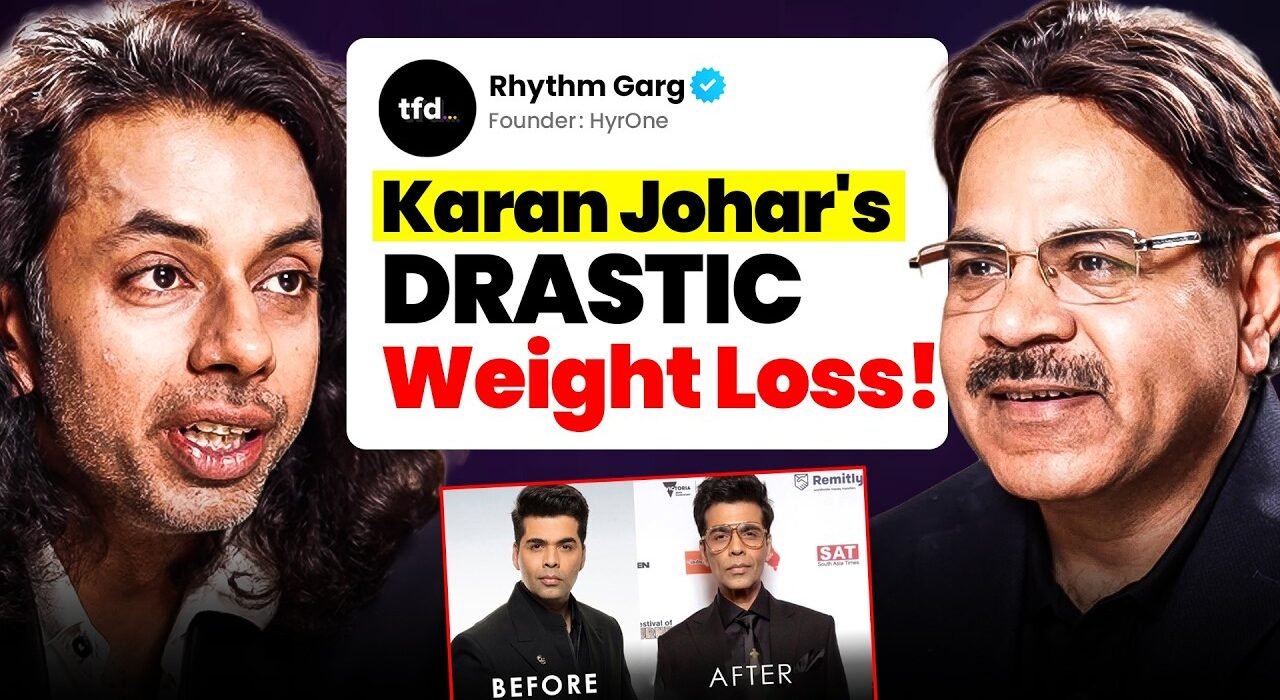
A few months ago, Karan Johar’s sudden transformation into a visibly leaner, thinner version of himself became a talking point everywhere — was it fitness or something else? That question opens this Rhythm Garg interview on The Founder’s Dream, an indian business podcast where host Abhishek Vyas sits down with the fitness entrepreneur, Ironman finisher and founder of the AI nutrition app HigherOne to separate real health from the shortcuts being sold around it.
Rhythm Garg’s own path runs through a family business background, a national-level basketball career, an Ironman finish, a Musclemania physique competition, and finally a brand ambassadorship at Mr India — before all of it fed into building a nutrition platform. This piece pulls apart what he actually said about supplements, celebrity bodies, Ozempic, and the discipline behind lasting results.
Inside the Rhythm Garg Interview: The Karan Johar Question
Abhishek Vyas pushed Rhythm Garg directly on the Karan Johar example, asking whether that kind of rapid physical change should be read as fitness or illness. Garg was careful not to comment on any individual, using the example only because public figures shape what young people believe is achievable.
If there is a shortcut, the faster it gives you results, the higher the chances it will reverse back just as quickly. That is not fitness — fitness is a long-term game, a game of nature, but it gives you results that last.
He pointed to Milind Soman, Akshay Kumar, Shilpa Shetty, Kareena Kapoor and Amitabh Bachchan as examples of fitness that holds up for their age, built the slow way. On weight-loss medication like Ozempic, he drew a clear line: if it is being used strictly under medical supervision, that is a different conversation entirely, but reaching for it purely to skip the work is the same shortcut trap as any fad diet. He summed up the contradiction bluntly.
There is no shortcut being sold as a shortcut — but shortcuts sell.
He also flagged something sharper: even celebrities surrounded by nutritionists, yoga experts and fitness trainers still reach for quick fixes, because the marketing and noise around them makes fast decisions tempting regardless of how much expert support they have.
Why Whole Food Beats the Protein Tub
The conversation’s clearest myth-busting moment was about supplements. Garg estimates that 90–95% of what the wellness and supplement industry talks about should really be happening through a balanced, whole-food plate — not a tub bought off a shelf.
People think buying the box means your physique is built, or that you’ve started your health journey. That’s not right. The supplement industry isn’t wrong — it’s called a supplement because it adds to the main food, it doesn’t complete it.
His reasoning goes deeper than marketing skepticism. He argues that isolated protein, taken in its purified powder or capsule form, can add to the clogging and toxicity load on vital organs like the liver, because nutrients absorb better when eaten in their natural combinations — with the phytonutrients, vitamins and minerals that whole food already carries alongside them. If someone genuinely cannot meet their protein needs through food, his advice is to let a doctor or nutritionist recommend the right supplement rather than self-prescribing from gym-counter recommendations.
He extended the same logic to ghee, calling it a genuinely healthy fat as long as it’s unadulterated and eaten in the right quantity — the issue is never the food group, it’s the proportion and the source.
The Nourishment Recipe: One Complete Plate, Every Meal
Garg’s central nutrition idea came from his Musclemania prep, where he realised “healthy eating” as a vague instruction wasn’t enough. He compares a meal to making tea.
If you make tea by adding the tea leaves in the evening but you’re brewing it in the morning, that tea can never be complete. The same way, your carbs, fats, proteins and vitamins — that whole nourishment platter needs to be complete at every single meal. That’s what makes the right recipe.
He pairs this with a point on mindset: without the right clarity and knowledge, effort alone doesn’t deliver results — you end up working hard like a bullock going in circles, without getting anywhere close to the goal you actually wanted. Knowledge, clarity and the right mindset, he says, still fail without the missing piece most people skip — implementation. All the knowledge and the best entrepreneur mindset in the world does nothing if you keep procrastinating on actually doing it.
Building HigherOne: From Family Business to an Entrepreneur Success Story India Can Learn From
Garg’s own route to entrepreneurship started inside a family business, but he says he always felt pushed, since childhood, to build something of his own. Reading widely convinced him that people need a purpose beyond profit — a way to give something back to society. That instinct, combined with years of structured training, became HigherOne.
The Ironman race was his first real test of discipline and endurance at scale; Musclemania later taught him precision down to controlling fat percentage within 4–5% for a competition stage. Competing at Mr India as its oldest contestant, at 40 among 20-somethings, gave him the final confidence push. Readers following entrepreneurial journey stories on this podcast will recognise the pattern: each physical milestone reshaped how he thought about building a business, not just a body.
HigherOne itself is deliberately simple — tell the app what’s in your fridge, and it builds you a healthy meal in minutes, based on your profile and goals rather than generic advice. It’s priced at ₹99 a week (around ₹299 a month), a decision Garg explains came from one goal only.
We wanted it to reach the masses. It should be pocket-friendly. People shouldn’t feel it’s an expensive product to try.
One feature he’s particularly proud of handles the biggest reason people abandon health goals: cheat meals and celebrations. If someone breaks their plan for a few days, instead of making them feel the whole effort is wasted, the app simply recalculates a new target date — a small design choice meant to stop people from giving up entirely after one off day.
Gym Mistakes, Warm-Ups, and Why Beginners Quit
Asked what a beginner with 30 minutes to train should prioritise, Garg didn’t hesitate — warm-up and cool-down, not the exercise itself. He shared his own bad experience: joining a Delhi gym in 2019, paying a ₹40,000 annual membership, and being pushed into stiff, heavy exercises from day one by a trainer with no warm-up routine. By the fourth day he quit and, by his own account, hasn’t stepped into a gym since.
That story shaped his advice to anyone nervous about starting: find a trainer who actually understands sequencing — body movement first, then gradual progression into muscle and endurance training — rather than blaming the gym itself for one bad coach. It’s a point that connects well with the self growth lessons this podcast often returns to: one setback doesn’t disqualify the whole pursuit.
What This Episode Is Really About
Strip away the Karan Johar reference and the Ozempic debate, and this episode is about one repeated idea: nourishment, movement, sleep and a steady mindset don’t go out of fashion, no matter what new trend arrives next.
- Whole food first — supplements only fill genuine gaps, not shortcuts.
- A meal is a complete recipe of carbs, fats, protein and vitamins together, not isolated healthy choices.
- Quick-result methods reverse as fast as they work — fitness runs on long-term biology, not marketing cycles.
- Warm-up and cool-down prevent the injuries that push beginners out of the gym for good.
- Cheat meals aren’t failure — recalculating and restarting immediately matters more than the slip itself.
Garg closes the conversation with a message he repeats throughout — knowledge, consistency, clarity, discipline, hard work and resilience are, in his words, simply the law of nature for anyone chasing a goal that’s meant to last. That line applies as much to building a company as it does to building a body, which is probably why this episode sits comfortably on a founder podcast rather than a pure fitness channel.
Watch the full conversation with host Abhishek Vyas on The Founder’s Dream YouTube channel and subscribe to the TFD podcast for new founder interviews every week.
Frequently asked questions
Who is Rhythm Garg?
Rhythm Garg is a fitness entrepreneur, Ironman finisher and Musclemania competitor who built the AI-powered nutrition app HigherOne after years of competing in endurance and physique sports.
What does Rhythm Garg say about protein supplements?
He says 95 percent of nutrition should come from whole, balanced meals, and supplements should only add to that foundation rather than replace it, since isolated protein powders can add strain on the liver and vital organs.
What did Rhythm Garg say about Ozempic and celebrity transformations?
He said that outside strict medical need, any quick-result method is a shortcut, and shortcuts that work fast tend to reverse just as fast, unlike fitness which is a long-term, nature-driven process.
What is HigherOne, the app Rhythm Garg built?
HigherOne is an AI-powered nutrition platform priced at about ₹99 a week that tells users what to eat based on their profile and goals, includes a cheat-meal feature, and recalculates goal dates if someone breaks their plan.
What fitness mistake does Rhythm Garg say beginners make most often?
He points to skipping warm-up and cool-down routines before jumping into heavy exercises, calling it an underrated cause of gym injuries and a reason many beginners quit after one bad experience.

1 Comment