
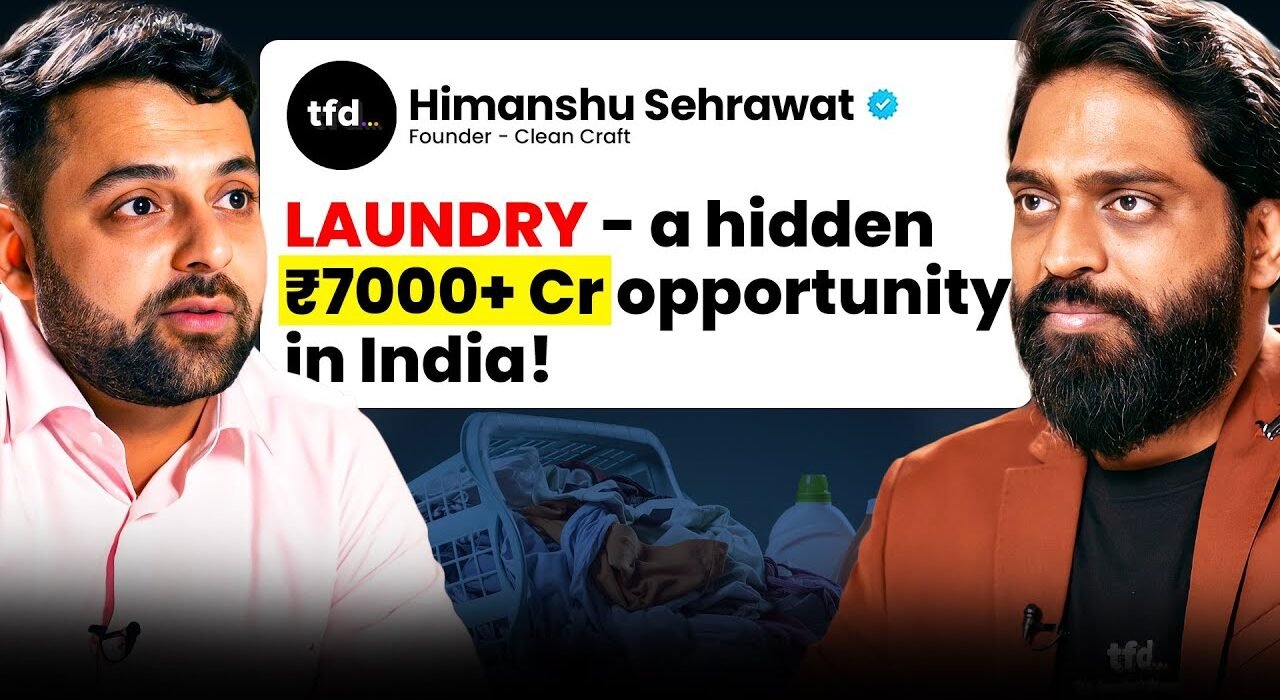
Most people who buy a laundry franchise in India learn the hard way that “dry cleaning” on a signboard rarely means what it should. Himanshu Sehrawat, Director at Clean Craft, spent years inside this unorganised industry before building a franchise model designed to fix exactly that problem. In this episode of The Founder’s Dream, host Abhishek Vyas gets him to lay out the economics, the scams, and the mindset shifts behind his journey — and the Himanshu Sehrawat success story that follows is less about luck and more about a very deliberate, slow build, the kind of Clean Craft founder story that reads more like a case study than a headline.
The Himanshu Sehrawat Success Story: From Government School Teacher to Laundry Entrepreneur
Himanshu comes from a family of teachers — third generation, in fact. His great-grandfather was a headmaster in Daryaganj between 1939 and 1942, his father taught, and both his sisters are vice-principals in government schools. He himself got a government school job in 2017, and by his own admission, money was never flush at home.
A college friend who had done business consultancy work with him pulled him into laundry almost by accident, in 2017, through a partner who wanted to start a venture. Himanshu researched the category and found something that hooked him immediately: the margins.
“This business has a margin of 68%, and a net profit of 32 to 38%. Look at it this way — in ten years, a shirt that cost ₹100 to dry clean is still being dry cleaned for ₹100. How is that possible, when gold has gone from ₹18,000 to ₹1 lakh in the same period?”
His point was simple: when margins on the MRP are fat, prices stay flat because businesses can shrink margins to survive; when margins are thin, prices are forced to climb. Laundry, he realised, sat in the first category — and almost nobody in India understood it well enough to run it properly. That first venture didn’t survive Covid, and his partner eventually stepped back. Himanshu kept teaching for a while, then told his wife he couldn’t keep “carrying a corpse to school” after working on the business till 1 am every night. He resigned, tried financial independence for six months, got pulled back into teaching briefly by his old school, and finally left for good in March 2022 to build what became Clean Craft.
Freelancer, Business Owner, or Business Builder — Which One Are You?
Early in the conversation, Abhishek Vyas pushes Himanshu on a distinction that shapes the rest of the episode: what actually separates someone earning ₹5 lakh a month freelancing from someone who owns a real business. Himanshu’s answer is blunt.
“You can eat outside food your whole life? That’s complicated. But home food, you can eat your whole life — it’s simple. If your decisions and actions have that kind of simplicity and sustainability, you can call yourself a business builder. Otherwise you’ll keep fluctuating — sometimes self-employed, sometimes a business owner, sometimes a business builder. Freelancing is not sustainable.”
He breaks the three down plainly: a freelancer earns money only in bursts, with no stability and no real skill development because work comes and goes. A business owner monetises a skill on a regular basis. A business builder goes further — they build a second line of leadership, training others to do what they once did themselves, so the business keeps running and earning even if the founder steps away. It’s a distinction that captures the entrepreneur mindset Himanshu tries to instill in every franchise owner he trains. Himanshu says he now runs six or seven companies over three years precisely because he built leaders inside each one who only call him when they’re stuck — almost always on finance decisions, rarely on operations.
What Vijay Mallya Taught Him About Identity and Money
Asked directly about Vijay Mallya, Himanshu doesn’t dodge. He frames Mallya’s story as a lesson in identity, not just business failure.
“Vijay Mallya is the person who, after getting caught, says ‘I am not sure.’ At the time his airline was dying, when there was no money left, he was busy celebrating his own birthday party. At that moment he claims he doesn’t remember anything. That lavish life he was showing off — to me, personally, that looks like an identity crisis, a need to prove ‘I still have something.'”
He contrasts this with people who built genuine legacy and stayed in India to face consequences — pointing to loan waivers given to figures like Sonu Nigam’s contemporaries in business, or L&T’s Nitin Gadkari-linked history, arguing that track record and past contribution to the country change how society and government treat a person’s failures. It ties back to a bigger point he makes about middle-class ambition: most young Indians only see real purchasing power around age 30, after years of studying, job-hunting, and family pressure — and that delayed start is exactly why so many want to get rich “today,” which he calls the root of most business mistakes.
“If you get dreams of becoming rich overnight, that means there is a massive lack of knowledge in you.”
Where the Dry-Cleaning Industry Quietly Cheats Customers
This is where the episode turns genuinely useful for anyone who drops clothes at a neighbourhood dry cleaner. Himanshu says the term “dry cleaning” itself is the most misleading phrase in Indian retail.
Real dry cleaning is oil-based — using perchloroethylene or hydrocarbon solvents in machines that cost around ₹27 lakh installed, sourced from only two original manufacturers (Realstar and Fabricare, both Italian, with first copies made in South Korea and China). Himanshu estimates India doesn’t even have 200 genuine dry-cleaning machines running. What actually happens in most shops: clothes go into a steel bucket with Ariel detergent and get scrubbed by hand, which is laundry — not dry cleaning at all. For anyone thinking about starting a dry cleaning business in India, this is exactly the gap Himanshu built Clean Craft to close.
He’s equally direct about ironing damage and detergent quality:
“After 30 to 35 press cycles on an uncontrolled iron, the outer fibre of a shirt is completely worn down — the shirt starts looking old. That’s basically feeding your clothes to be burnt, because there’s no vacuum press control. And the cheapest detergents on the market — with caustic, urea, all sorts of things mixed in — degrade fabric so badly that after 100 washes, a garment tears. We use pH-controlled, enzyme-based detergents instead, so even after 100 cleanings the fabric holds up.”
The honest answer to “am I 100% loyal in my own business, given I know exactly where the scams happen” is that Himanshu leans on written commitments rather than promises — every Clean Craft franchise gets its terms documented in black and white, precisely because he knows how easily trust breaks in this industry.
Building a Franchise Model That Doesn’t Rely on Luck
Himanshu is candid that most laundry franchises in India fail because the franchisor can’t actually teach the franchisee anything — the “servant” ends up telling the “owner” how the work is done, not the other way round. His model tries to close that gap with structured coaching: sorting, spotting, washing, ironing, and packaging as core technical knowledge, alongside sales, marketing, and operations as the softer, business-running skills. This is the core of the Clean Craft business model: pairing technical training with real business operations so franchise owners aren’t left guessing.
He also pushes back on the instinct every new entrepreneur has — the urge to be different rather than better.
“Everyone in India sells gol gappe made from flour and semolina. If I start selling them made from moringa flour to be ‘different,’ it won’t work. The question isn’t how you’re different — it’s how you’re better than the others in the same category. Fix your weaknesses, watch your competitor’s weaknesses, and that gap becomes your USP.”
This is a theme worth sitting with if you’re evaluating any franchise, not just a laundry one — a point that echoes across other entrepreneurial journeys featured on the show, where founders across categories talk about the same trap of chasing novelty instead of execution.
Takeaways for Anyone Considering a Laundry Franchise
- Ask whether you could run this business without any help — if a category has both total failures and billion-rupee winners, execution matters more than the idea itself.
- Real legacy businesses take roughly 7-10 years to reach a “cruising” stage, matching what Himanshu says he’s observed in Zomato, OYO, and other large ventures.
- Verify what “dry cleaning” actually means at any shop or franchise before paying dry-cleaning prices for a plain wash.
- A franchisor who can’t train you technically — only tell you “put this here, put that there” — is not offering real support, whatever the brochure says.
- Check any franchise agreement for the seven disclosures Clean Craft lists on its own site about franchise fees and authority, a habit worth carrying into any franchise negotiation, not just this one.
The Himanshu Sehrawat success story, as told on this episode, is less about a single clever idea and more about treating an unorganised, distrusted industry with the same rigour you’d expect from teaching — which, given his family background, makes a certain kind of sense. It’s also a useful reminder, explored further in our self-growth coverage, that discipline transfers across categories — from a classroom to a laundry counter.
Watch the full conversation with host Abhishek Vyas on The Founder’s Dream YouTube channel and subscribe for new founder interviews every week.
Frequently asked questions
Who is Himanshu Sehrawat?
Himanshu Sehrawat is the Director of Clean Craft, a laundry and dry-cleaning franchise business in India, who left a government school teaching job to build the company full-time.
What is the profit margin in the dry-cleaning business according to Himanshu Sehrawat?
Himanshu Sehrawat says the laundry and dry-cleaning business can run on a 68% margin with a net profit of 32 to 38%, which is what first attracted him to the industry.
Why is 'dry cleaning' a misleading term in India, according to the episode?
Himanshu Sehrawat explains that true oil-based dry cleaning requires machines costing around Rs 27-48 lakh, and India has fewer than 200-300 of these, so most shops using the term ‘dry cleaning’ are actually washing clothes with detergent by hand or in regular machines.
What is the difference between a freelancer, a business owner, and a business builder?
According to Himanshu Sehrawat, a freelancer earns money inconsistently with no stability, a business owner monetizes a skill regularly, and a business builder creates a second line of leadership so the business runs and earns even without the founder actively working in it.
Why do most laundry franchises fail in India?
Himanshu Sehrawat says franchises fail mainly because the franchisor lacks real domain expertise and cannot actually train the franchise owner, leaving the owner to figure out operations on their own instead of receiving structured, expert-led coaching.
1 Comment