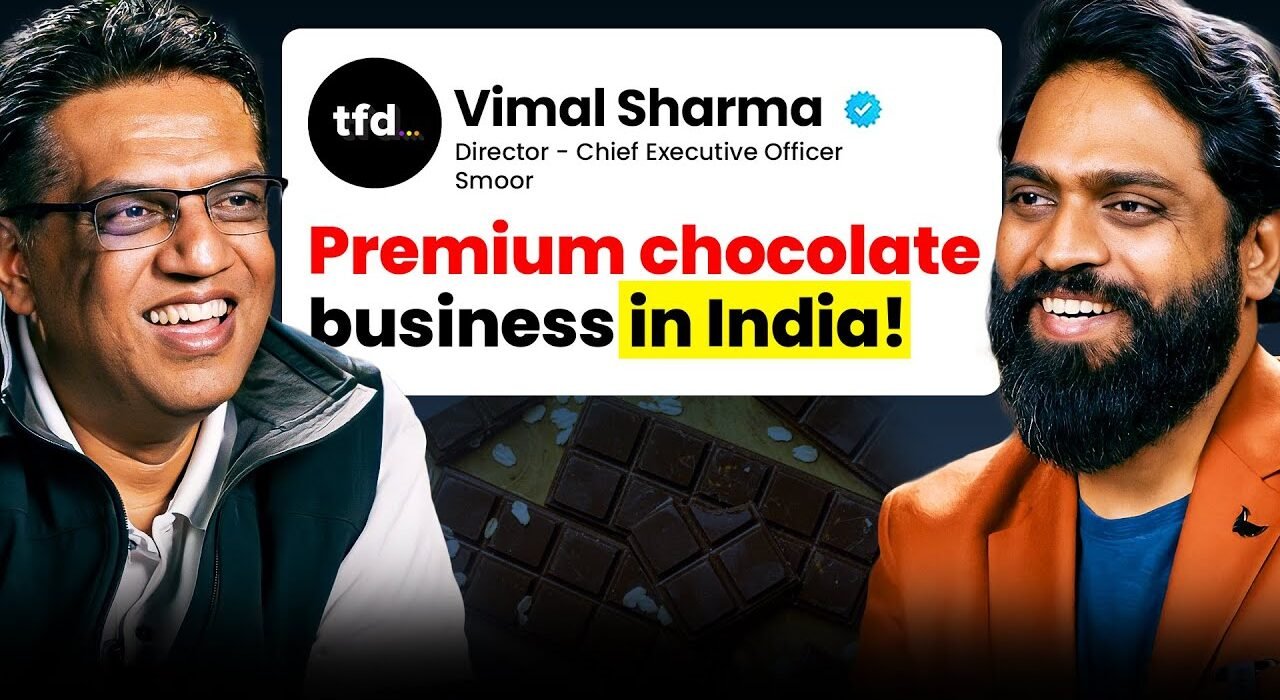
Nine years ago, a trained chef who had built his career in Australian restaurants decided India was missing an entire category of chocolate. The Smoor founder story that follows isn’t about a clever app or a funding round — it’s about identifying a gap, pricing a ₹40 piece of chocolate when that sounded absurd, and betting on offline stores while the rest of the world rushed online. Vimal Sharma, Director & CEO of Smoor, walked host Abhishek Vyas through that journey on The Founder’s Dream, a founder podcast that digs into the operational detail behind Indian brands, and the details are worth sitting with if you’re building anything premium in India.
The Smoor Founder Story: Spotting a Gap Nobody Else Saw
Vimal Sharma’s path to Smoor started in Australia, where he says the restaurant business taught him something beyond cooking.
Australia taught me about consistency and quality, and it taught me that everything you do has to be built around a story — why you’re doing it, not just what you’re putting on the plate.
When he visited India, he noticed two things at once: the sheer scale of the country’s culinary culture, and how narrow the chocolate shelf actually was. Chocolate in India, as he saw it, was treated as a kids’ product sold out of a small box in any corner shop — not as something artisanal that deserved its own category.
That observation became the thesis for Smoor. Rather than compete inside an existing segment, Vimal set out to create one. He’s candid that this kind of bet only works if you’re genuinely convinced, not just hopeful.
If you can identify that gap and then have very strong conviction about it, you can be successful — because you are literally creating a category. But identifying the gap is only the start; after that comes pricing it, packaging it, building the experience, positioning it, choosing locations, and staffing it right.
This is the part of the conversation that functions as a primer on how to grow a company without copying what already exists: the idea is cheap, the execution behind it is the real business.
Pricing a Premium Product When Nobody Believed India Was Ready
Ten years ago, a three-piece box of Smoor chocolate was priced at ₹110 — a number customers openly compared to a full Cadbury bar. Vimal doesn’t dress up how often people pushed back on the price or the unfamiliar taste.
It was very simple — if you believe in your product and you trust it, you just give it to the customer. Let them try.
His read on timing was different from the common wisdom. While most assumed Indian consumers didn’t have disposable income for indulgence, Vimal argued people were underestimating India.
Ten years ago, India was starting to become an aspirational country. Today it’s probably the biggest aspirational country in the world — people weren’t just buying a product anymore, they wanted it to be part of their lifestyle.
He points to young Indians already paying ₹200 for a coffee a decade ago, travelling to Europe, and bringing back duty-free chocolate as early proof the shift was underway. Smoor didn’t just need a good product — it needed to educate customers on what couverture chocolate was, why it was sourced the way it was, and why an Indian brand could match what people used to buy abroad.
Offline First: Why Smoor Didn’t Chase Online Scale Early
The industry logic says online reaches thousands while a single store caps out at a couple hundred visitors a day. Vimal pushed against that logic deliberately, building experiential outlets where staff were trained to make sure every visitor actually sampled the chocolate.
Offline business has its own market, its own chill-out space, its own ambience — and it will continue to grow. Online has given us the ability to use our offline assets better and given us incremental revenue, but it hasn’t replaced the need for touch and feel, especially for a premium brand.
He’s equally clear-eyed about Instagram: it helped, but only as a by-product of a good product, not a substitute for one. Smoor’s margins, he notes, are meaningfully higher offline than online, and marketing spend works differently across the two channels. That balance — building something tactile first and letting digital amplify it — is a theme worth comparing against other founders’ approaches in the entrepreneur mindset behind building a hardware-first brand, where physical product experience also had to come before scale.
Gifting Over Self-Consumption — A Very Indian Insight
One of Vimal’s sharpest observations was cultural, not operational. When he first landed in India, he noticed that customers buying mithai or chocolate almost always wanted it boxed, ribboned, and gift-ready rather than consumed on the spot.
We were up against mithai. So how does chocolate become a preferred gifting option? We invested heavily in packaging — how it’s wrapped, how it’s ribboned, how it’s handed over — because in India, people buy with their eyes.
That insight shaped Smoor’s pack sizes too. The brand started with two- and four-piece boxes and now sells up to 25-piece boxes as its best-seller — a sign, Vimal says, that as Indian incomes grew, so did the willingness to indulge. He also flags a longer cultural shift still in progress: in Switzerland, chocolate consumption per person runs far higher than in India because it’s simply part of daily life there, not reserved for festivals. Smoor’s dark chocolate share moving from roughly 20% of volume nine years ago to around 60% today is, in his telling, early evidence that shift is starting here too.
Culture, Team, and the Myth of the Solo Founder
Vimal shared a recurring pattern inside Smoor: talented chefs who left to start their own chocolate business, assuming the recipe alone would make them successful.
They only realise later it’s not just a product — it’s a recipe, but behind it is your procurement, your packaging, your product placement, your marketing, your sales team, your working capital. It’s a complete thing.
He’s blunt that pure talent without patience for the unglamorous parts of a business rarely survives contact with the market — someone always undercuts on price or finds more efficient machinery. His advice to employees who pitch big ideas isn’t to shut them down but to pressure-test them: who are your thousand other customers, not just the one you’re pitching to?
Culture, in his framing, is less about perks and more about ownership. Several of Smoor’s earliest employees are still with the company, and he treats people as the actual product.
We don’t bring in talent that’s fully experienced — we make sure there’s a gap in their career, an opportunity for them to learn and grow. It’s a win-win.
This is where the conversation turns into more than an entrepreneur success story india readers skim for motivation — it’s a working argument that a company’s culture and its product quality are the same bet, made twice.
Growth Numbers and What Comes Next
Nine years in, Vimal says Smoor has served more than 10 million customers and expects this year’s run rate to touch around ₹200 crore. The brand recently opened a manufacturing plant in Bengaluru, and by November plans to open a chocolate factory to the public — letting customers watch how the chocolate is actually made.
Roughly 80% of Smoor’s chocolate is currently imported as couverture. The longer-term goal is to manufacture at least 70% from scratch using Indian cocoa beans, as fermentation skills and local processing capability keep improving. Vimal is also clear that scaling will involve outside capital at some point, but on his own terms.
My passion for this will be there for many, many years. There will be investors coming and going, but whoever we choose has to believe in what we’re doing — if there isn’t a match, we’ll grow slower rather than take that investment.
Asked what it takes to build a ₹200-crore brand, his answer reads like a short checklist rather than a speech: stay passionate, love what you do, never give up after setbacks, give your team real credit instead of taking it all yourself, and make time to actually stand in your stores and listen to customers.
What Founders Can Take From This
- A visible gap in the market is only the starting point — pricing, packaging, staffing and positioning are where the real work happens.
- Premium products need education, not just distribution — Smoor spent early years training both customers and staff before scaling.
- Offline experience and online reach aren’t competitors; Smoor treats offline as the trust-builder that makes online spend more effective.
- A founder’s product is ultimately their team — recipes and ideas alone rarely survive outside the system that supports them.
This conversation sits well alongside other founder interviews in the entrepreneurial journey and self-growth archives that unpack what it actually takes to build and sustain a product-led business in India, rather than just launch one.
Watch the full conversation with host Abhishek Vyas on The Founder’s Dream YouTube channel — this Indian business podcast publishes new founder interviews every week — and subscribe to catch the next one. You can also explore more conversations on The Founder’s Dream.
Frequently asked questions
Who is Vimal Sharma of Smoor?
Vimal Sharma is the Director and CEO of Smoor, a premium Indian chocolate brand he started around nine years ago after moving to India from Australia, where he had worked in restaurants.
Why did Smoor focus on offline stores instead of going online first?
Vimal Sharma believed a premium, indulgent product needed to be experienced in person, so Smoor invested in experiential outlets and trained staff to let customers sample the chocolate before online scale was added later.
How big is Smoor's business today?
Vimal Sharma said on the podcast that Smoor’s run rate for the year will touch around ₹200 crore, built over nine years and more than 10 million customers served.
What makes Smoor different from mass-market chocolate brands?
Smoor positions itself as an artisanal, premium category rather than a candy-style mass product, with a growing share of dark chocolate, customisable gifting, and chocolate increasingly made from Indian cocoa beans.
What is Smoor's plan for Indian-made chocolate?
Vimal Sharma shared that Smoor recently opened a manufacturing plant in Bengaluru and plans to open a chocolate factory to the public, aiming to eventually produce 70% of its chocolate from scratch using Indian cocoa beans.