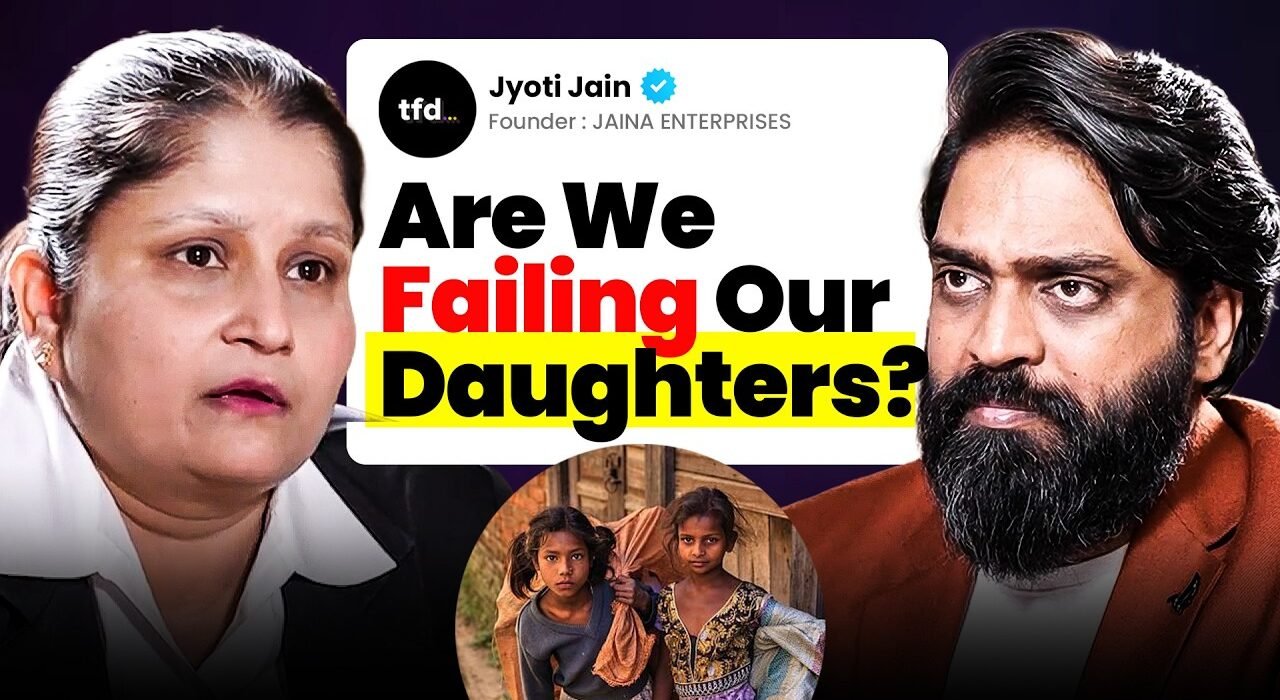
Why does a software engineer get respect by default while a plumber or a delivery worker has to earn it one job at a time? That question sits at the center of Jyoti Jain on The Founder’s Dream, where host Abhishek Vyas speaks with Jyoti Jain, founder of IESR Foundation, about why India’s skilled trades are still overwhelmingly male while women remain boxed into domestic work. This indian business podcast episode doesn’t offer easy answers — it lays out, in Jyoti Jain’s own words, where the system breaks and what she’s done about it over more than a decade of ground-level work.
The IESR Foundation Founder Story: A Defining Indian Business Podcast Moment at a Temple
The IESR Foundation founder story didn’t begin with a business plan — in many ways, the Jyoti Jain success story is proof that big missions often start with small, uncomfortable observations. Jyoti Jain was donating books at a temple located in the middle of a slum when she watched a toddler, no older than two and a half, pick up a book, turn it over without interest, and set it down by a tree before rejoining the line for whatever was actually being handed out.
That moment reframed her entire approach to social work.
I realised a whole section of people has become so used to need that they genuinely don’t know what they need anymore. That day I decided — I don’t want to teach people to beg. I want to teach them to earn.
That line — “maangna nahi sikhana hai, kamana sikhana hai” — became the operating principle for IESR Foundation. It’s also a useful way to think about the broader entrepreneur mindset this episode keeps circling back to: building something that makes people self-reliant rather than dependent.
Why Blue Collar Work Still Carries a Stigma
Jyoti Jain is blunt about where the disrespect for skilled trades comes from — the label itself. She tells Abhishek Vyas that simply renaming the category changes how people treat it.
If we keep calling it “blue collar” again and again, that word stays in the mind — a tradition of thinking blue collar means a useless job. The moment we call the same person a “junior engineer,” the perception shifts entirely.
This isn’t cosmetic to her. IESR Foundation deliberately labels its AC repair, plumbing, carpentry and electrical courses as “Junior Engineering” programs, specifically to push back against the assumption that someone carrying a toolbag and a tiffin box is doing a ₹15,000-a-month throwaway job. She points to a real-world example to make her case: a flight incident where, by her account, a trained plumber on the ground was the one who managed to get a stuck aircraft door open — not a software engineer. Her larger point is about income potential too — she believes AC technicians trained through her programs are already earning close to ₹2 lakh a month, and that plumbers’ earning potential will eventually overtake that of software engineers.
The 18 Skill Tracks IESR Foundation Teaches
- AC and refrigerator repair, along with other technical/camera repair work
- Plumbing and carpentry
- Beauty and hair services — currently the most popular track among students
- 18 total sectors across different vocational and technical skills
Courses are not entirely free. Jyoti Jain explains the reasoning: charging a minimum fee, as low as ₹2,499 for some courses, keeps the industry stable and avoids turning training into an unhealthy competition among the poorest students, some of whom pay other institutes far more — ₹500 to ₹1.5 lakh — for the same skills.
Why Girls Drop Out After Class 8
One of the most concrete data points in this indian business podcast conversation comes from IESR Foundation’s own research across roughly 52 Delhi schools. The finding: a large number of girls leave school right after Class 8.
The reason is that after Class 8, books have to be purchased, and many families don’t have the money. So the girls start going with their mothers into homes — into the same domestic help work.
Jyoti Jain describes this as a cycle that repeats itself generation after generation — girls become maids like their mothers, boys end up driving rickshaws, and the same social circle closes back in on itself. IESR Foundation’s response is to provide free books to Class 8 students on one condition: the child must commit to learning a skill alongside continuing school, with the expectation that once they’re capable, they’ll support someone else the same way.
Women in Skilled Trades: Why Maids Are Women and Technicians Are Men
Abhishek Vyas pushes on an uncomfortable pattern during the conversation — when you call a service provider to your home in a city like Delhi or Gurugram, the maid is almost always a woman, and the AC technician or electrician is almost always a man. Jyoti Jain confirms it and explains why, even though IESR Foundation has trained women in AC repair and RO repair.
There’s a safety concern — women think about whether it’s safe to go into someone’s home for a service call. And the tool bag itself is heavy, which becomes its own barrier. Female safety is the biggest issue here.
She credits e-commerce platforms with slowly breaking this pattern, since structured apps and verified bookings are reducing some of the informal risk women associate with home-service work. But she’s clear that changing this fully will take time — she references the government’s “Amrit Kaal” push toward 2047 as the kind of long horizon this requires.
On the entrepreneurship side, IESR Foundation also backs women directly. When a woman approaches the foundation wanting to start something of her own, Jyoti Jain says they offer financial support, moral support, counselling, and help purchasing tools or machinery needed for the business — a model worth comparing to how service businesses scale, something you can explore across other entrepreneurial journeys featured on The Founder’s Dream.
Parents, Pressure and the Respect Problem
A recurring theme in this Jyoti Jain interview is how deeply parental attitudes shape whether a child even considers a skilled trade. She recounts trying to help her own household help enrol her child in a guaranteed-placement course that could earn the family a confirmed income within three months. The mother refused — insisting her child learn “computer” instead, because a computer job means sitting in an air-conditioned room with no physical pressure and automatic respect.
The problem is only this — that you’d have to carry a bag, carry a tiffin. That’s the actual problem people have with these jobs.
She also describes darker pressure some children face — fathers who drink and demand their daughters keep doing informal cleaning work rather than attend skill training, because the household needs the daily cash. Jyoti Jain’s response has been to start family counselling programs that look at the whole household: which children should be in school, who needs a job, and what can be done for elderly family members, including plans to set up stationary street-vendor stalls so people over 60 don’t need to walk door to door.
Delivery Workers Deserve Training, Not Just Orders
The conversation turns pointed when it reaches delivery and gig workers. Jyoti Jain argues that e-commerce companies provide uniforms but almost no training on hygiene, behavior, or customer interaction — and then customers judge delivery workers harshly based on appearance alone.
If we don’t train the delivery boy on how he should behave with someone, how is this supposed to work? Companies want the delivery to happen, but they don’t want to invest in the person’s skill development.
She suggests delivery workers — who often have idle hours between drop-offs — could use two hours a day for skill training, and that respectful treatment from customers and proper training from companies would change behavior on both sides. With over 2 lakh delivery riders on the road by her estimate, she argues unnecessary pressure on this workforce is also a road-safety issue, not just a dignity issue.
What a Young Person Should Do Right Now
Asked what a first step looks like for someone who wants to become skilled, Jyoti Jain’s advice is straightforward:
- Decide for yourself — don’t wait for family permission to explore a skill
- Pursue a degree if you want to, but never end up unemployed because you only chased a degree
- Look at government platforms like MSME, NSIC and Pradhan Mantri Kaushal Vikas Yojana, which offer funding support
- Connect with an NGO like IESR Foundation, which says it connects people to government schemes at no charge
Her pitch to parents is equally direct: let your child aim to become an IAS officer or an engineer if they want, but make sure they walk away with one skill in hand regardless — because, as she puts it, the country needs “junior engineers” on every street, in every building, more urgently than it needs more unemployed degree-holders.
Watch the full conversation between Jyoti Jain and host Abhishek Vyas on The Founder’s Dream YouTube channel, and subscribe for new founder interviews every week.
Frequently asked questions
Who is Jyoti Jain?
Jyoti Jain is a social entrepreneur, education reformer and women’s empowerment leader who founded IESR Foundation, an organisation that trains young people in vocational skills and connects them to employment.
What does IESR Foundation do?
IESR Foundation trains children and young adults in blue collar and technical skills such as AC repair, plumbing, carpentry and beauty services, and it also runs free counselling and book support programmes in government schools.
Why do girls drop out of school after Class 8 according to Jyoti Jain?
Jyoti Jain says data from around 52 Delhi schools showed many girls leave school after Class 8 because books become costlier to purchase at that stage, and families without the money pull girls out to work alongside their mothers as domestic help.
Why are skilled trades like plumbing and AC repair mostly done by men?
Jyoti Jain says women hesitate to take up home-service skilled jobs mainly due to safety concerns about entering unfamiliar homes and because the tool bags used in these trades are physically heavy, though she notes awareness is slowly changing.
Can a plumber or AC technician earn more than a software engineer in India?
Jyoti Jain believes skilled trades like plumbing will eventually out-earn software engineering roles, and she cites AC technicians from her programs already earning around ₹2 lakh a month.