
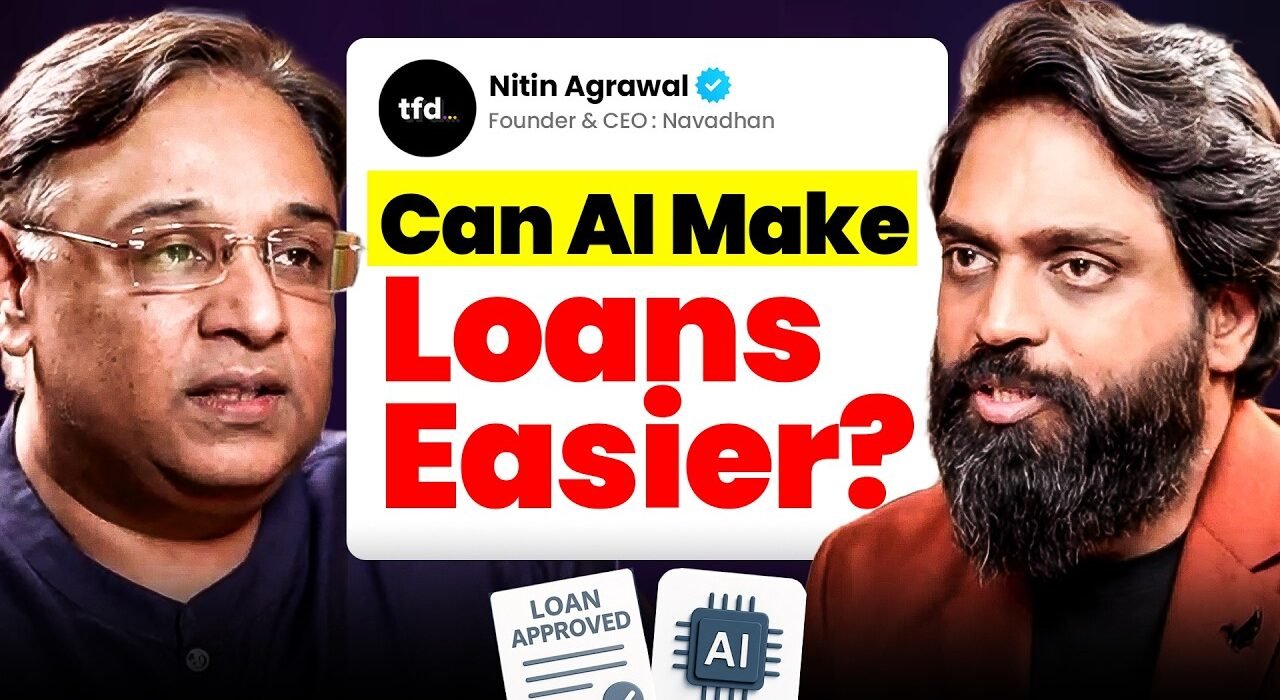
Millions of Indian entrepreneurs run real, cash-generating businesses and still can’t walk into a bank and get business loans. Not because the business doesn’t work, but because there’s no ITR, no GST return, no salary slip to prove it. In this Nitin Agarwal interview on The Founder’s Dream, host Abhishek Vyas sat down with the Founder and CEO of Navadhan to unpack exactly how the Navadhan business model solves this problem for rural MSMEs and nano entrepreneurs across India.
Why Millions of Indians Can’t Get a Business Loan
Agarwal’s starting point is simple: loans exist for two reasons — to meet an urgent need or to fund growth. But most loan products are built around a specific kind of paperwork.
As he put it in the conversation:
If you’re buying a car, a car loan is available. If you’re buying a two-wheeler, a two-wheeler loan is available — but you’ll need to show a salary slip. If you’re a business, you’ll need to provide an income tax return, a GST return. Not every type of customer, not every type of business, has those documents available. That’s the problem that keeps credit out of reach for so many.
This isn’t a rural-only issue, he clarifies — it’s a documentation issue that happens to hit rural and informal businesses hardest, because that’s where cash transactions and informal record-keeping are most common.
The Navadhan Business Model: Lending Without ITR or Salary Slips
So how does an RBI-regulated NBFC underwrite someone with no formal paper trail? Agarwal breaks the process into layers. First, Navadhan checks the applicant’s credit score and past borrowing record through credit bureaus. Second, it looks at their social standing — how they’re regarded within their business relationships and community. Third, it tracks physical assets: house, warehouse, stock, and whether these have grown over the last two years, which acts as a proxy for wealth creation.
Only after these checks does the team underwrite the actual business itself, using templates built specifically for informal-market assessment. In his words, the mission is direct:
We are able to underwrite informal businesses in informal markets, and that’s how we turn an under-banked customer into a bankable one.
Navadhan doesn’t operate as a loan app where a customer logs in and a decision gets spat out automatically. Technology is used for underwriting, for co-lending integration with banks and NBFCs, and for strengthening internal processes — but the customer journey isn’t a fully automated, download-and-apply experience. That distinction matters, especially given how many unregulated lending apps have flooded the market. Navadhan works as a facilitator, sourcing and assessing customers against the credit norms of its bank and NBFC partners.
It’s also worth noting what Navadhan deliberately avoids. There’s a list of roughly 23 industries it won’t lend to on environmental grounds — polluting businesses, for instance — and a separate filter based purely on credit risk. A farmer running two rental cars with a driver is a good candidate; the same person scaling to eight cars signals a behavioral shift that makes recovery harder, so Navadhan steps back.
Emergency Loans vs Growth Loans — Where People Get It Wrong
One of the clearest points Agarwal makes is about a mismatch most borrowers don’t even realize they’re making. There are two distinct kinds of loans: emergency loans, taken to survive a crisis like sudden illness, and growth loans, taken because the borrower expects future income to rise — through education, or by putting money into a business.
The trouble starts when the two get mixed up:
The problem comes when you use a growth loan for an emergency, or an emergency loan for growth. That’s where the confusion in perception sets in.
This framing matters for anyone exploring business ideas for 2026 — knowing which type of credit actually fits your situation avoids a debt trap before it starts.
Why Rural India Is the Real Fintech Opportunity
Agarwal pushes back on the popular narrative that Tier 2 and Tier 3 cities are where the next wave of rural fintech growth lives. Rural India, he argues, is still home to more than half the country’s population and remains comparatively underserved.
His evidence is about growth rates, not just headline adoption numbers: internet penetration in urban areas is growing at roughly 4% a year, while in rural areas it’s growing at around 10% — simply because the base is smaller and urban markets are already saturated. That gap is where the opportunity sits.
He also doesn’t shy away from the structural reason the cash economy persists. Deposit friction is a big part of it — a farmer selling onions in cash at the mandi has no easy mechanism to push that cash into the banking system, which means no digital trail, which means no easy credit later. Demonetisation briefly shifted the cash-to-digital ratio, but as Agarwal notes, cash in the economy has since grown back.
He’s equally candid about where Digital Public Infrastructure still falls short. Aadhaar exists as a unique identity, but courts have ruled it optional for many purposes, and multiple government arms still require separate IDs — driving licenses, passports — rather than treating Aadhaar as the single source of truth it was designed to be. Jan Dhan accounts and UPI, built on NPCI rails, have helped — but the identity layer, in his view, is still unfinished work.
Farmers, Household Income, and Who Navadhan Actually Lends To
A detail that stands out in the conversation: Navadhan doesn’t lend for farming itself — that’s the government’s Kisan Credit Card territory. Instead, it lends to farming households looking to diversify income. Agarwal splits rural households into roughly three groups: a tiny slice of genuinely rich farmers who don’t need loans, and the rest split between those whose farm income is so low they migrate to cities for work, and those whose landholding is large enough that migration isn’t the answer — they need to grow income locally instead, often through dairy, livestock, or a small side business.
That second group is who Navadhan targets — someone running an auto-repair shop who needs spare parts to expand, or a household wanting to add a few more buffaloes to an existing herd. Interestingly, Navadhan evaluates the whole household, not just one applicant, checking how many income sources a family has and how many people are actually contributing to earnings versus how many are dependents.
Weather data and satellite imagery also feed into this picture. Navadhan monitors rainfall, soil moisture, and reservoir levels released by the meteorological department to decide where credit exposure should expand or pull back — tracking drought-sensitive geographies during an El Niño year, for instance, and adjusting underwriting in response.
AI, Human Trust, and the Navadhan Business Model in Practice
On AI, Agarwal is specific rather than hyped. Coding and automation that once took a team of engineers several days now takes a single engineer a few hours — that’s where AI has genuinely compressed timelines. Testing, stress-testing, and rollout, however, remain largely manual. Voice AI for rural conversations is still maturing, though he expects more sophisticated models within a year or two.
What doesn’t get automated away is trust. Asked whether building the technology or winning a rural customer’s trust is harder, Agarwal’s answer was blunt:
Both are equally hard and equally easy. What’s genuinely difficult is earning the trust of a rural customer who may view everything with suspicion — and building technology that actually helps in their daily work, not just in ours.
In Navadhan’s case, that trust gets built when automation — OCR for documents, voice-to-text for information gathering — removes paperwork friction the customer actually feels. The technology effort only converts into trust once the customer experiences it as easier, not just faster for the lender.
Why Collection Efficiency Beats Disbursal Speed
If there’s one myth Agarwal wants to kill, it’s the industry’s obsession with CAC (customer acquisition cost) and TAT (turnaround time) — how fast and cheaply a lender can disburse. His view is unambiguous:
Giving a loan is very easy. Recovering a loan is difficult. Ultimately, what matters is whether that last rupee comes back onto your balance sheet. However fast or cheap you disburse, if the money doesn’t return, whatever shortfall exists is a straight loss.
This is the lens Navadhan applies before anything else — lend to customers who have both capability and willingness to repay, then build the systems that make repayment easy rather than chasing defaulters later. CAC and TAT come after that foundation, never before it. It’s a useful reminder for anyone studying founder conversations on building sustainable companies rather than vanity-metric-driven ones.
Looking ahead to 2035, Agarwal expects financial inclusion to deepen and the gap between urban and rural facilities to shrink considerably if fintechs like Navadhan keep expanding penetration — not because rural India will mirror any other country’s model, but because the basic problems of food, clothing, and shelter are largely solved, and the next decade is about incremental income and incremental dignity.
Watch the full conversation with host Abhishek Vyas on The Founder’s Dream YouTube channel and subscribe for new founder interviews every week.
Frequently asked questions
What is Navadhan?
Navadhan is an RBI-regulated non-banking finance company founded by Nitin Agarwal that provides credit to rural MSMEs and nano entrepreneurs who lack formal documents like ITR, GST returns, or bank statements.
How does Navadhan decide who gets a loan without ITR or salary slips?
Navadhan checks past borrowing record through credit bureaus, the applicant’s social standing in their community and business relationships, and growth in household assets like home, warehouse, or stock, then underwrites the actual business using technology-driven templates.
What is the maximum loan amount Navadhan provides?
Nitin Agarwal says Navadhan currently provides loans up to five lakh rupees and treats the individual and their household as a single unit when assessing a loan.
Which states does Navadhan operate in?
Navadhan currently operates in six states — Madhya Pradesh, Rajasthan, Gujarat, Uttar Pradesh, Karnataka, and Odisha — with Madhya Pradesh being its largest market since that is where the company started.
Why is loan recovery harder than loan disbursal according to Nitin Agarwal?
Nitin Agarwal explains that disbursing a loan is easy regardless of cost, but if the last rupee of a disbursed loan does not come back, that shortfall is a direct loss, which is why Navadhan prioritizes collection efficiency over disbursal speed or acquisition cost.

1 Comment