
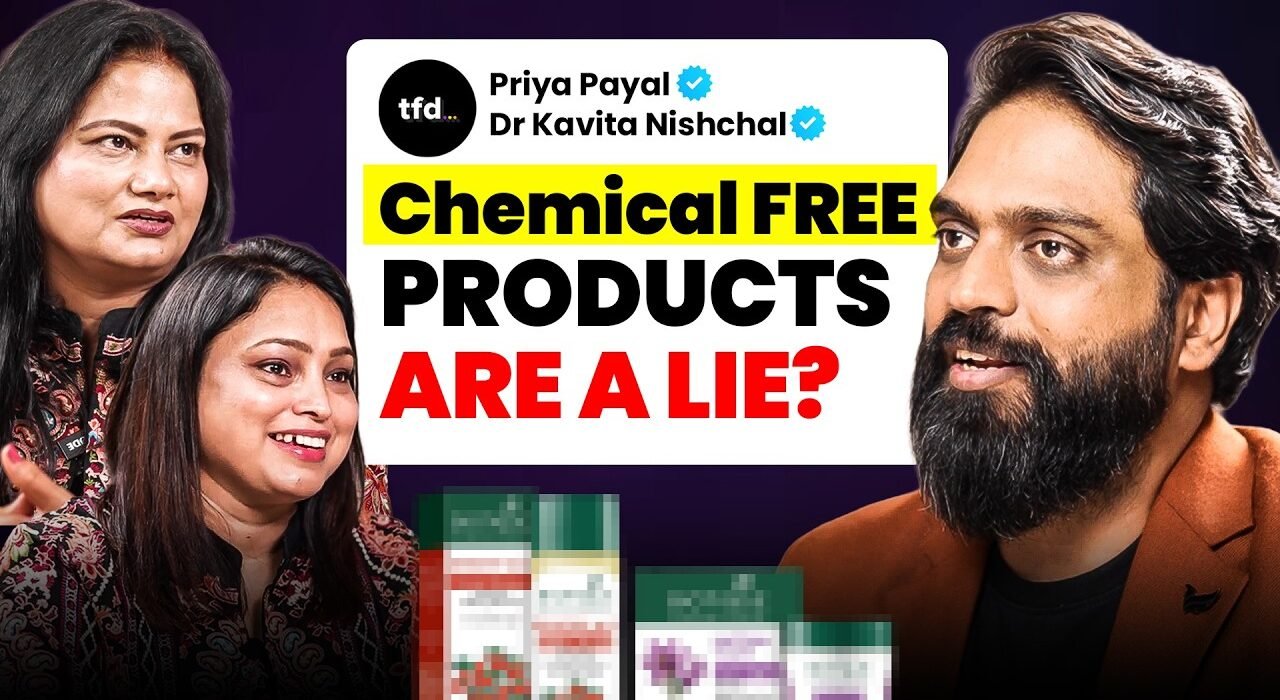
Most skincare shelves in India are crowded with labels screaming “100% chemical-free” and “completely organic.” On The Founder’s Dream, a founder podcast where host Abhishek Vyas sat down with Priya Payal and Dr. Kavita Nishchal, founders of PNK Beauty, to take that claim apart — and along the way, the conversation turned into one of the more honest success stories of women entrepreneurs in India: two women building a formulation-first beauty brand from scratch, fighting courier companies as much as competitors.
The Chemical-Free Myth Indian Consumers Still Believe
The episode opens with a question Abhishek Vyas puts directly to Dr. Kavita Nishchal: what is the biggest chemical lie the beauty industry sells to Indian consumers? Her answer is blunt.
There is nothing on this earth that is chemical-free. Water itself is a chemical — we call it H2O. Chemical-free is not a scientific fact, it’s a marketing prop. You cannot formulate any product without chemicals.
She pushes the point further when Abhishek asks if brands that claim “100% organic” or “99% natural” are lying. Her view: those are fake claims, pure marketing propaganda, because formulation without chemical molecules is simply not possible. What actually matters, she says, is whether the chemicals used are safe and whether their long-term health impact has been tested — not whether a label promising chemical free skincare says “free” of something that can’t be removed from any product on earth.
Why Indian Skin Doesn’t Need Korean-Style Fixes
A recurring thread in the conversation is the gap between imported skincare trends and what Indian skin actually needs. Dr. Kavita Nishchal argues that Indian skin is structurally different — and better protected — than the skin types many global routines are designed for.
Indian skin is the healthiest skin because your melanin is so high that it gives you more protection. So mostly you don’t even have a skin problem. Skin problems are more with fair skin — the more fair, the more the problem.
She connects this directly to why fairness-focused products keep selling: an inferiority complex built around skin tone, often targeted at women who are under-privileged, less exposed, or under social pressure to look a certain way. Her position is that skincare should be about caring for the epidermis daily and building confidence in your own tone — not chasing a Korean or Western complexion that was never built for Indian weather or Indian melanin levels in the first place.
Success Stories of Women Entrepreneurs in India: Building PNK Beauty
Priya Payal is asked whether being a woman entrepreneur brought a specific kind of challenge to building PNK Beauty. Her answer separates two different battles — one inside the business, one outside it.
As a woman entrepreneur, I don’t see that kind of challenge. The challenge is of another type. Whether it’s at work or at home, you have to prove yourself more — that’s a given.
She adds that visiting manufacturing units as a woman founder still carries the weight of operating in what she calls a male-dominant society, though she credits her nearly 60% women workforce with running operations without extra friction. The harder story, she says, belongs to women who spent 15-16 years as homemakers before starting a business — getting family and friends to accept that she’s now busy, that her availability has changed, is often the bigger fight than any investor pitch or product launch. If you’re mapping out founder journeys worth studying, the founders on this show follow a similar pattern: the personal battle usually comes before the business one.
The brand’s name carries the same philosophy. PNK, Priya explains, stands for Passion, Nature and Knowledge — driven by passion, drawn from nature, and developed with knowledge. It’s also where the founders locate the real driver of skincare purchases. Asked whether Indian women buy based on science or emotional insecurity, Priya doesn’t hedge.
Psychology says emotion wins first, and science comes after to justify it. People almost always make their first purchase in emotion — fear, insecurity, the promise of overnight glow, or FOMO around a trend. But when they place a repeat order, that’s when they look at science and actual results.
That’s why, she says, PNK’s marketing agenda deliberately avoids selling fear or insecurity — the goal is to educate first and earn repeat customers through results, not first-time panic buys.
The Real Fight: Last-Mile Delivery for D2C Brands
If there’s one section of this episode that surprises listeners expecting a pure skincare-science conversation, it’s the detailed breakdown of courier problems. Priya is candid that formulation was never the hardest part of the journey.
Building the formula in the lab isn’t the hardest part — it’s in your hands. The biggest challenge is getting the order to the customer. Courier partners give fake remarks, RTOs are high, and sometimes they call the customer from the delivery hub and tell them to cancel.
She describes a pattern she says her team has recorded directly from customers: delivery agents calling buyers to say a Facebook or Instagram-store purchase “might not be genuine” and asking them to cancel, or telling customers falsely that returns won’t be honoured even though PNK’s own return policy is active and its team follows up with every customer personally. To manage this, PNK built a dedicated post-dispatch team whose only job is chasing delivery status, managing RTOs and following up on cancellations — an extra cost that exists purely because of third-party logistics opacity. As she puts it, sellers get almost no visibility once a package leaves the warehouse; only a vague remark like “customer refused” shows up on the portal, with no courier name, number, or proof of an actual delivery attempt.
This is a challenge every early-stage founder will recognise, and it’s worth hearing in full if you’re building a D2C brand — the kind of operational reality that rarely makes it into a founder’s highlight reel but shapes daily decisions far more than any product launch does.
Inside the Formulation: Cold-Press Oils, Papaya, Gold and Saffron
Dr. Kavita Nishchal, who holds a PhD in Botany and grew up in a farming family, leads PNK’s R&D. She explains why the brand insists on cold-press extraction over high-heat processing: high heat destroys volatile compounds like polyphenols, flavonoids and carotenoids, along with the enzymes responsible for a product’s efficacy and safety. Cold-pressing is slower and costlier, but it preserves the elements that actually make a difference on skin.
That philosophy shows up across PNK’s four facial oil variants — Luminous with 24-karat gold flakes for an immediate glow, Infinity for pigmentation and acne-prone skin, Firm-Lift built around olive and almond oils for mature skin needing lymphatic massage, and Renew, a night oil with saffron, sandalwood and wild turmeric for overnight repair. The brand’s under-eye product — its best-seller, sold out within three to four months of launch — combines papaya and potato extract for pigmentation with four small jade rollers built into the packaging to boost lymphatic drainage, which the founders argue works on puffiness longer-term than the caffeine-based under-eye products that only temporarily constrict blood vessels.
- Cold-press extraction preserves enzymes and antioxidants that high-heat processing destroys
- Oily or acne-prone skin doesn’t need to avoid oil — it needs a lighter, fast-absorbing oil like jojoba or grapeseed instead of harsh, drying face washes
- PNK’s premium 30ml oil costs ₹499 because cold-pressed, unadulterated ingredients cost more to source and process
- The formulation took a year and a half to finalise, with 36 sample batches rejected along the way
What This Episode Means If You’re Building a Brand
Beyond the skincare science, this episode works as a grounded entrepreneur success story india founders can actually learn from — not a highlight-reel narrative but a working list of what a beauty D2C brand deals with daily: courier disputes, formulation trade-offs, and a market conditioned by trend-chasing rather than ingredient literacy. Priya’s closing advice to women thinking of starting in their 40s and 50s borrows a line from her father — “Naadha toh aadha,” meaning once you start, you’re already halfway there. Her point is that experience gained from running a household or managing a family is itself a business skill rooted in self-growth, and starting doesn’t require ten steps of planning first.
For anyone following Indian founder journeys on an indian business podcast, this conversation is a reminder that the hardest problems in a beauty brand often aren’t about the product at all — they’re about logistics, trust, and educating a customer patient enough to wait for real results instead of overnight ones.
Watch the full conversation with host Abhishek Vyas on The Founder’s Dream YouTube channel and subscribe for new founder interviews every week.
Frequently asked questions
Is chemical-free skincare actually possible?
No. According to Dr. Kavita Nishchal on The Founder’s Dream, nothing on earth is chemical-free since even water is a chemical, H2O — chemical-free is a marketing claim, not a scientific fact.
Is Indian skin worse than Korean or Western skin?
No, the founders explain that higher melanin in Indian skin gives it more natural protection, so most of the skin problems associated with fairness products are actually more common in fair-skinned people.
What is the biggest challenge for D2C beauty brands in India?
Last-mile delivery. The founders describe courier partners giving fake delivery remarks, high RTOs, and even calls asking customers to cancel genuine orders.
What does the PNK Beauty name stand for?
PNK stands for Passion, Nature and Knowledge — driven by passion, sourced from nature, and developed with knowledge.
What challenges do women entrepreneurs face while building a business in India?
The founders say women often have to prove themselves more than men in business settings, and women transitioning from homemaking to entrepreneurship face a harder battle getting family and friends to accept their new availability and priorities.

1 Comment