
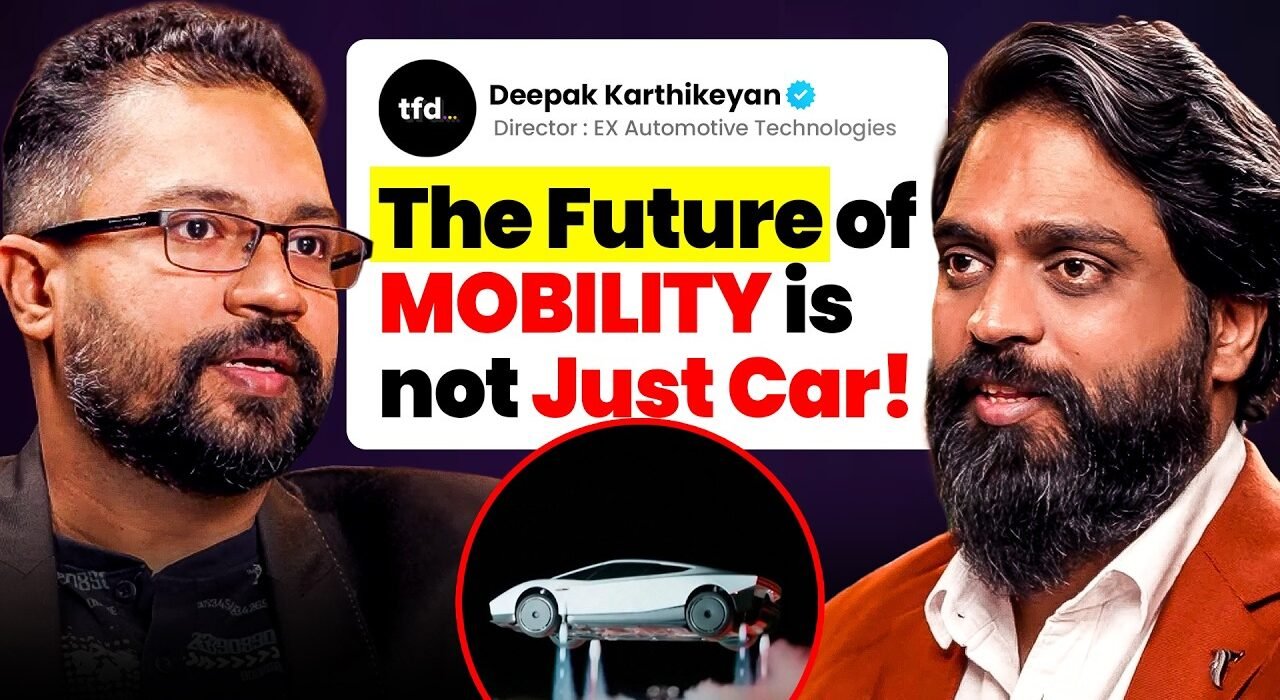
Most people see traffic and complain about it. Deepak Karthikeyan saw it and built a business around the idea that people will eventually abandon their cars for something simpler. On this episode of The Founder’s Dream, a founder podcast hosted by Abhishek Vyas, he sits down with Deepak, founder of an omnichannel electric mobility retail platform, to talk about electric bicycles, the economics of EV manufacturing, and the entrepreneur mindset required to survive an industry where most founders quietly disappear within a few years.
Deepak isn’t selling a dream of overnight success. He spent close to eight years figuring out which industry would matter two decades from now before settling on electric mobility with renewable energy. What follows in the conversation is a grounded look at why electric bicycles might be the most realistic entry point into India’s EV future, and why patience, not funding, is the real currency for founders in this space.
Why Electric Bicycles Could Replace the Motorcycle
Deepak doesn’t treat the electric bicycle as a niche fitness product. He sees it as a direct challenger to the motorcycle, once the frame, motor, and battery scale up to match.
Two things do the exact same job and you have more value on one thing, people naturally shift to the one that they will get the same value.
His own research trail explains the logic. He first priced out building electric two-wheelers and four-wheelers, found the capital requirement — at least 5 to 10 crore just to start, with far more needed to scale — too steep, and worked backward to the simplest electrified vehicle: a bicycle. That decision shaped the entire business.
The customer base backs up his thesis in ways he didn’t fully expect. Parents of school-going children form one of his strongest segments — paying around ₹35,000 for an electric bicycle once instead of ₹40,000–₹50,000 a year in bus fees — while IT workers buy them to dodge traffic and fit a workout into the commute, throttling in the morning and pedaling back in the evening.
Building an Omnichannel Retail Business, Not a Single-Brand Shop
Deepak isn’t a manufacturer. He describes himself as “an entrepreneur trying to become a businessman,” running an omnichannel platform that aggregates and resells electric bicycles, hoverboards, kick scooters, and electric mopeds from roughly ten brands across cities like Mumbai, Pune, Delhi, and Ahmedabad.
The multi-brand model wasn’t an accident — it was a risk-reduction strategy. Since he started around 2021, four or five of the brands he once worked with have shut down or are struggling, because, as he puts it, building the product and selling it are two entirely different difficult problems, and few companies survive trying to do both.
- Online store for discovery and research, offline stores for trust, test rides, and service
- One physical store today, with a goal of ten across Bangalore to cover the whole city as destination points
- Long-term plan: use distribution scale to eventually manufacture their own products
He estimates each retail store costs roughly a crore to set up — a serious capital ask for a vision that eventually aims at a thousand stores nationwide. It’s an ambitious number, and he’s upfront that it will take real patience to get there.
The Real Challenges: Battery, Trust, and Service
Ask any potential buyer why they hesitate on an EV, and the answer is almost always the same: will the battery survive, and what happens when it doesn’t? Deepak says electric bicycles are lower-risk here than full electric two-wheelers because the battery capacity is far smaller, which removes the thermal runaway concerns associated with bigger EV batteries.
But cost still bites. A replacement battery for an electric bicycle runs ₹6,000–₹20,000, and most components are imported from China, so a defect means waiting on a supplier rather than a quick local fix. Deepak frames the customer expectation plainly — people who buy a refrigerator or a two-wheeler expect it to last five, ten, even twenty years without major reinvestment, and EVs are being judged against that exact bar.
Component reliability isn’t the only trust gap. Many potential riders are simply scared of sharing the road with buses and trucks on an electric bicycle, which is why Deepak’s strongest adoption so far comes from controlled-use cases like school commutes rather than open-road city travel.
Why Startup Funding India Struggles With Physical Products
Deepak is direct about why raising startup funding india for hardware and mobility ventures is so much harder than it was for software a decade ago. Software scales by copying code across a million machines at near-zero extra cost. A physical product scales by literally building a million units, each one eating fresh capital.
Higher the risk, higher the return is law of economics.
He pushes back on the venture capital benchmark of 100x returns within seven to eight years, pointing out that every mature industry — computing, software, the internet — took twenty to twenty-five years of unglamorous work before becoming mainstream. Investors chasing software-era timelines on hardware businesses, he argues, are setting themselves up to misjudge risk rather than manage it.
He also points to India’s position globally with blunt honesty — roughly thirty to forty years behind the US on EV technology and behind China on manufacturing scale, where suppliers can brand and ship a hundred units in 45 days for products Indian founders think they’re inventing from scratch.
The Entrepreneur Mindset That Outlasts the Hype
If there’s one thread running through the entire conversation, it’s that Deepak’s entrepreneur mindset was shaped more by patience than by ambition for quick wins. He’s met entrepreneurs, by his own account, who are comfortable just making enough money and never push past that ceiling — and plenty who chase wealth and burn out within a few years.
If they think, I want to become rich in 5 years, so I’ll get into this business. It’s a guaranteed version of going up to level zero.
His reasoning is almost mechanical: founders who optimize purely for money stop putting in effort the moment they hit a comfort level, because their mind was never built around a mission beyond the number. He’s blunt that this is also why many founders fail right after raising capital — the moment money arrives, the focus that got them there evaporates.
He ties the timeline to something concrete — a successful entrepreneur’s average age tends to sit north of sixty, meaning anyone starting in their twenties or thirties should expect to invest two to three decades before calling the business a success. It’s a sobering number for anyone expecting fast outcomes, and one worth sitting with before chasing a trend.
Books and Long-Term Thinking
Deepak credits three books with shaping how he reads markets: The Protestant Ethic and the Spirit of Capitalism by Max Weber, for its lesson on reinvesting profit and treating work as a continuous mission rather than a means to comfort; The Wealth of Nations by Adam Smith, for its framework on free markets and the importance of extracting human talent rather than relying only on natural resources; and The Bitcoin Standard, for its distinction between hard and easy money.
You just keep working, working, working thinking that picking it as God’s work and keep doing it.
He connects this directly to entrepreneurship — founders who don’t understand basic demand-and-supply economics risk building something nobody wants and losing their capital before the market catches up, pointing to Ola and Uber building India’s ride-sharing market only to watch Rapido become the app most people open today.
Listeners interested in more founders unpacking economics and long-term thinking in plain language can find similar conversations in The Founder’s Dream’s roundup of Hindi business podcasts, and founders curious about what it takes to sit on the other side of the mic can read more in why every founder should consider becoming a podcast guest.
What Founders Can Take From Deepak’s Approach
- Pick the smallest viable entry point into a capital-heavy industry, as Deepak did by starting with bicycles instead of two-wheelers
- Spread brand risk rather than betting everything on one manufacturer, especially in a market where several brands fail within a few years
- Treat battery, service, and reliability concerns as the real product, not an afterthought to the sale
- Study how venture capital actually measures risk and return before assuming funding will arrive on your timeline
- Build for a horizon measured in decades, not funding rounds
Deepak’s story is less about a dramatic pivot and more about a founder willing to sit with a slow-moving, capital-intensive industry and build piece by piece. That patience, more than any single tactic, is what this conversation on an indian business podcast like The Founder’s Dream keeps coming back to.
Watch the full conversation with host Abhishek Vyas on The Founder’s Dream YouTube channel and subscribe for new founder interviews every week.
Frequently asked questions
Why does Deepak Karthikeyan believe electric bicycles could replace motorcycles?
He argues that once an electric bicycle can carry a bigger motor and battery, it does the exact same job as a motorcycle at lower cost, and people naturally shift to whichever option gives them equal value for less.
What is the biggest challenge in raising startup funding india for EV ventures?
Deepak explains that venture capital is built for fast, low-cost-to-replicate software returns, while physical products need capital for every single unit built, which stretches the return-on-investment timeline far beyond what most investors expect.
What business model does Deepak Karthikeyan use for his electric mobility company?
He runs an omnichannel, multi-brand retail platform combining online discovery with offline stores, covering the full customer journey from research to after-sales service, and working with around ten brands instead of manufacturing a single one.
What is the main customer hesitation around buying electric bicycles?
Buyers worry about reliability and long-term costs, especially whether they will need to replace an expensive battery within a few years, the same concern people have historically had with electric two-wheelers.
What mindset does Deepak say entrepreneurs need to succeed long-term?
He says founders need patience and a mission bigger than money, since chasing wealth too early limits effort once some comfort is reached, and most successful entrepreneurs only see real results after two to three decades of work.
1 Comment