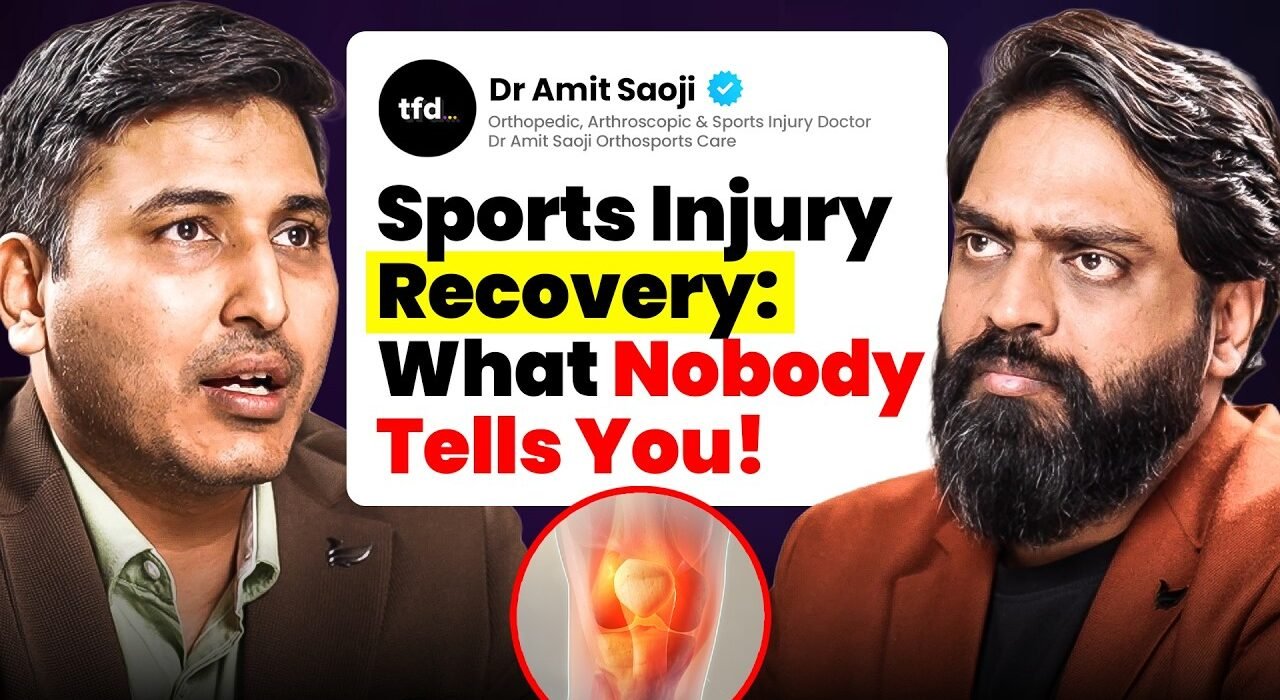
Why does a casual football match on a weekend turf end in a knee that gives way months later? In this Dr. Amit Saoji interview on The Founder’s Dream, an Indian business podcast where host Abhishek Vyas sits down with the Nagpur-based orthopedic consultant and sports injury specialist, the two unpack why ACL tears, shoulder dislocations, and turf football injuries have become so common among young Indians who play sport for fitness, not just competition.
Dr. Saoji treats ligament injuries of the knee and shoulder as his core practice, and his answer to the opening question sets the tone for the whole conversation: sport in India has changed faster than people’s preparation for it.
Why Sports Injuries Are Rising in India
Dr. Saoji points out that twenty years ago, organised sport largely meant eleven-a-side games. Today, people are playing kho-kho, kabaddi, running marathons, going to the gym, and joining local tournaments at a scale that didn’t exist before.
As sports culture grows and more people play, injuries are bound to increase alongside it. The bigger issue is that most people prepare their schedule for the match but not their body — they skip proper strengthening, warm-up, and correct footwear.
He names two specific gaps: people treat sport as a once-a-week activity squeezed between work, and they rarely invest in recovery or the right gear, including footwear suited to the surface they’re playing on.
Turf vs Ground: The Hidden Knee Risk
Turf has made sport accessible — an hour booked after office hours, in a small enclosed space close to home. But Dr. Saoji is clear that convenience comes with a biomechanical cost, and turf injuries follow a predictable pattern:
- Turf surfaces are highly frictional; natural ground is not.
- Natural ground absorbs shock far better than turf.
- On turf, the foot sticks to the surface while the body rotates around the knee joint during a pivot, cut, or sudden stop — exactly the motion that tears the ACL.
- Small turf dimensions force frequent sudden stops and direction changes, loading the knee repeatedly in a short time.
He also notes a pattern specific to working professionals: sitting through a desk job all day and then playing an intense hour of turf football at night, often in the same shoes, without any warm-up — a combination he sees repeatedly in his clinic.
What Really Happens When You Tear Your ACL
The ACL is one of four ligaments stabilising the knee, working alongside the PCL, MCL, LCL, and the meniscus cartilage. Dr. Saoji’s explanation of its job is the simplest way to understand the injury.
The ACL is like a seatbelt for your knee. It gives the joint stability, prevents it from rotating out of control, and stops it from sliding forward. Without it, the knee can become unstable.
ACL tears in India come from two main sources: sports injuries involving sudden stops, jumps, or bad landings, and road traffic accidents where a fall or twist damages the knee without any visible fracture. Symptoms split into acute and chronic. Acute signs include heavy swelling, inability to bear weight, and sometimes an audible pop at the moment of injury. Chronic symptoms show up later as a “giving way” sensation.
If it’s a complete ACL tear, the knee becomes unstable. Walking down stairs, running, or any activity where the brain isn’t consciously controlling the knee — the knee will twist, and the patient feels like they’re going to fall. That giving-way feeling is the key symptom.
A common misconception, Dr. Saoji says, is that if a patient can still walk normally, the tear must not be serious. But normal movement is possible because the ACL’s job is stability during specific loads, not basic walking — so the absence of pain while walking doesn’t rule out the injury’s long-term damage.
Key Takeaways from the Dr. Amit Saoji Interview on ACL Surgery and Recovery
One of the most useful parts of this Dr. Amit Saoji interview is how directly he dismantles the assumption that every ACL tear needs surgery. According to him, 80 to 90 percent of ACL tears are managed without an operation — only around 10 percent of patients actually require ACL reconstruction.
The decision depends on whether the tear is partial or complete, whether the knee shows real instability on examination, and what the patient needs from their body — a competitive athlete chasing a return to sport is treated differently from someone who just wants to walk and work comfortably. Partial tears or sprains often recover fully with rehabilitation, and in some partial cases, Dr. Saoji uses PRP (platelet-rich plasma) therapy, drawing growth factors from the patient’s own blood to speed healing alongside rehab.
When surgery is needed, it’s reconstruction, not repair — the torn ligament can’t be stitched back together, so surgeons take a graft from elsewhere in the body (commonly hamstring, peroneus longus, patellar, or quadriceps tendon) and fix it in place of the original ACL using an arthroscopic, keyhole technique. For high-level athletes or patients undergoing revision surgery after a failed first attempt, Dr. Saoji sometimes adds a procedure called LET (lateral extra-articular tenodesis) for extra rotational stability — he mentions treating a national-level MMA fighter from Nagpur this way, who returned to competitive fighting within seven to eight months.
But across every technique, Dr. Saoji returns to one point repeatedly: rehabilitation decides the outcome, not the surgery alone.
If you just get the surgery done and leave it there, the chances of the surgery failing are very high. I’d say it’s 30 percent surgery and 70 percent rehab. Even a well-done surgery can fail without proper rehabilitation, and sometimes a good rehab can still deliver excellent results even after a technically simpler surgery.
He lays out why the three-to-six-month mark after surgery is the most dangerous window — the new ligament graft is biologically at its weakest as it fuses with the bone, even though patients often feel “normal” by then and start resuming activity too early, which raises the risk of re-tear and repeat surgery. Full return to sport typically needs nine months to a year, not weeks.
Shoulder Dislocation, Rotator Cuff Tears and Frozen Shoulder
Dr. Saoji explains the shoulder as a ball-and-socket joint surrounded by a bony wall that keeps the ball in place. When a dislocation happens, that wall can chip or break, and once it’s deficient, the shoulder has far less holding it in position.
About half of people who dislocate a shoulder once never experience it again, often because surrounding muscles compensate. The other half develop recurrent dislocation. Dr. Saoji is direct about one dangerous normalisation he sees among patients who’ve learned to pop their own shoulder back into place.
It is not good. People see it happen and think they can do the same thing themselves. That is not a good practice — it increases joint damage over time, and that’s exactly where keyhole surgery becomes necessary.
He distinguishes this from rotator cuff tears, a separate shoulder problem common after age 50 as the four stabilising muscles weaken with age, sometimes tearing from something as minor as lifting a bag. A torn cuff limits active movement — the patient can’t lift or rotate the arm themselves — while passive movement, where someone else moves the arm for them, stays intact. Frozen shoulder, by contrast, restricts both active and passive movement equally, is strongly linked to diabetes, and in Dr. Saoji’s experience resolves in the vast majority of cases through exercise and mobility work rather than surgery, with surgical release needed in only about 1 percent of cases where everything else fails.
How to Prevent Sports Injuries
Closing the conversation, Dr. Saoji keeps his prevention advice simple and repeatable:
- Build awareness of why these injuries happen before they happen to you.
- Do proper strength training, not just the sport itself.
- Never skip the warm-up.
- Use the right footwear and gear for the surface you’re playing on.
- If symptoms like instability or giving-way appear, get examined early rather than waiting years.
This episode is a reminder that the The Founder’s Dream podcast isn’t only about business models and funding — it also covers the practical, physical side of building a sustainable life, which fits naturally alongside its self growth lessons for anyone balancing ambition with an active lifestyle.
Watch the full conversation with host Abhishek Vyas on The Founder’s Dream YouTube channel and subscribe for new founder podcast episodes every week.
Frequently asked questions
Is ACL surgery always necessary after a tear?
No. Dr. Amit Saoji explains that 80 to 90 percent of ACL tears are managed without surgery through rehabilitation, and only around 10 percent of patients actually need ACL reconstruction.
Can an athlete return to sports after ACL surgery?
Yes. Dr. Saoji says it is 100 percent possible to return to sport after ACL reconstruction, but it typically takes nine months to a year of structured rehabilitation before a full return.
Why does playing football on turf increase knee injury risk?
Turf has more friction and far less shock absorption than natural ground, so the foot sticks while the body rotates around the knee joint during pivoting or sudden stops, raising the risk of ACL and other knee injuries.
What is the difference between frozen shoulder and a rotator cuff tear?
In frozen shoulder, both active and passive movement of the arm are restricted, while in a rotator cuff tear active movement is lost but passive movement, where someone else lifts the arm, remains full.
Why do shoulder dislocations keep repeating in some people?
A first dislocation can damage the bony socket wall that normally keeps the shoulder in place; once that wall is deficient, the joint has much less to hold it, so repeat dislocations become far more likely.