
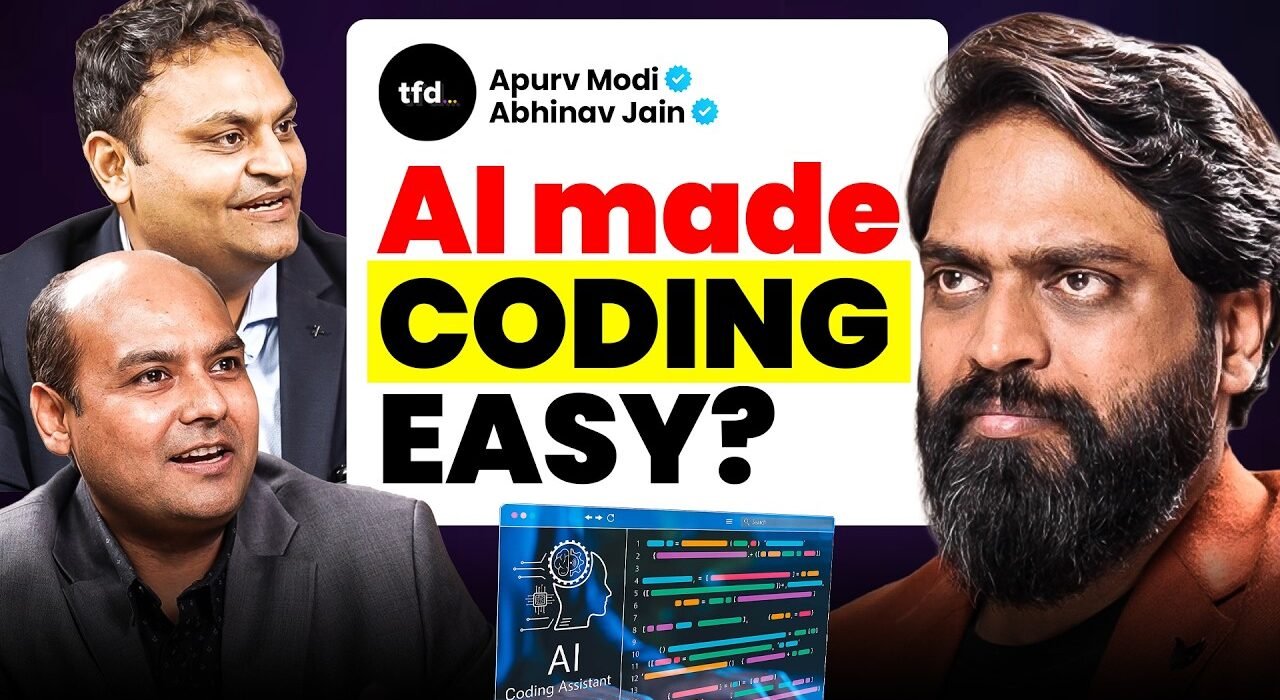
A business that starts with ₹1 lakh in a founder’s pocket and ends up discussing global expansion sounds like a pitch deck exaggeration. On this episode of The Founder’s Dream, an indian business podcast, host Abhishek Vyas sits down with Apurv Modi and Abhinav Jain, co-founders of Almonds.ai, for an interview that unpacks exactly how that happened — and the Almonds.ai business model turns out to be less about flashy technology and more about something far harder to fake: trust at the retail counter.
Both founders come from trading families, not tech backgrounds, and that shapes everything they say about growth, software, and why the smallest shopkeeper in a small town often decides whether a big brand succeeds or fails. This Apurv Modi & Abhinav Jain interview doubles as an entrepreneur success story india readers will recognize — a founder journey built on trust, not funding rounds.
From a ₹1 Lakh Shop Floor to the Almonds.ai Business Model
Abhinav Jain’s father still runs a cloth shop and once drove a truck for a living. That background, he says, is where the company’s entire philosophy comes from, and it’s the starting point of the Almonds.ai founder story itself. When he and Apurv started the company in 2017 with ₹1 lakh, the goal was never a revenue target — it was about how many customers would stand behind them.
Whether it’s a shop, a factory, or a big business — if the customer stands with you, nothing can stop you from growing big.
That single idea — customer trust as the real growth engine — is the backbone of the Almonds.ai business model today. The founders argue that in a country of over a hundred crore people, even a 1% conversion on a low-priced product builds a ₹100 crore business, which is why they keep repeating that scale in India is “not about the business, it’s about doing it, and the people who do it.” That same logic applies to Almonds.ai revenue, which grew from a ₹1 lakh starting point to a business now serving over a crore channel partners.
Why Customer Trust Decides Who Wins the Counter
The clearest illustration in the episode is almost absurdly simple. Ask for a cold drink at a local shop and most people don’t name a brand.
At a shop, if you want a cold drink, you won’t ask for Coke — you’ll say ‘give me one cold drink,’ and the retailer hands you whichever one suits him, or whichever one gives him an extra 2%.
This is the exact gap Almonds.ai was built to close. Big brands can run national ad campaigns, but the final decision at millions of counters across India happens between a customer and a retailer who may be influenced by margin, familiarity, or a personal relationship built over 20 years. Apurv narrates a field visit where a retailer flatly refused to sell a specific fan brand to a loyal customer, insisting on another brand instead — and the customer trusted him over the product’s own reputation. That “moment of truth at the counter,” as the founders call it, is what every brand is really fighting to own.
The Painter, the Shopkeeper, and the 8 Lakh Influencers
The founders use the example of a paint brand trying to influence India’s roughly 8 lakh painters. A painter recommends a brand either because of a reward or because the product genuinely performs well — and Almonds.ai built its platform, ChannelVerse, to formalize that influence through structured rewards, training modules, and gamified engagement instead of leaving it to informal commissions.
How Almonds.ai Turns Retailers and Painters into Brand Loyalists
Instead of every brand building its own app — something Coca-Cola, Pepsi, and ITC have all tried — Almonds.ai launched Counter, a single loyalty marketplace where multiple brands, even direct competitors, run their reward programs on one platform. The founders admit they expected rival brands to avoid sharing a platform, but the opposite happened.
- Retailers get one app instead of ten, which removes friction for the last-mile influencer.
- Brands get access to a channel network built over years rather than starting from zero.
- Rewards range from instant cash and digital vouchers to training content and gamified recognition.
One story stands out: a brand built a program called “Grah Lakshmi” for the wives of retailers, who often run the household above the shop while their husbands work late. The brand hosted around 500 DIY classes, and thousands of these women earned certification as official trainers.
That woman will praise that brand for the rest of her life, remember it, and recommend it — because it made her a trainer.
This is the emotional layer the founders insist most loyalty programs miss. Points and cash matter, but a program tied to something personal — a child’s laptop, a wife’s skill certificate — builds the kind of loyalty that outlasts any single discount scheme. If you enjoy frameworks like this, The Founder’s Dream has more founder wisdom on self-growth worth revisiting.
Can AI Really Replace Software Development?
Given the company’s name, Abhishek Vyas pushes the founders on whether AI tools could now build what took them years to create. Apurv doesn’t dodge the question but reframes it.
Today building software is easy. But whether that software actually works for the right people — finding that out is the real problem.
His point is that AI can generate ideas endlessly — ask for ten podcast ideas and it hands back thousands — but it cannot guarantee the outcome lands with an audience. Almonds.ai’s real asset, he argues, isn’t code; it’s the experience of managing over a crore channel partners, five Guinness World Records for platform participation, and the trust of competing brands who let Almonds.ai handle their retailer data side by side. That kind of relationship capital, built over years, is what a freshly coded app cannot replicate overnight.
Why Legacy Brands Are Having a Harder Time Today
One of the sharper observations in the conversation is about how much tougher the market has become for established names.
It’s getting tougher for legacy brands. New entrepreneurs are coming in — someone’s making a new fan, someone’s launching a new paint.
The founders point to three forces behind this: shrinking margins on fixed price points, like a ₹10 snack pack that keeps getting smaller instead of pricier; an explosion of new brands giving retailers endless choice; and the growing pressure from quick commerce and D2C channels. Retailers no longer care whose logo is on the box — they care who pays them better and whose product doesn’t come back for returns. That shift also explains why Almonds.ai expanded into the UAE with a product called insideAI, built for in-store promoters rather than India’s deep distributor network, since Dubai’s retail structure runs on organized modern trade instead of general trade shops. For founders exploring that market themselves, explore more entrepreneurial journey stories on The Founder’s Dream.
The Founder vs Trader Mindset — and the Profit Lesson from Ratan Tata
Toward the end, the conversation turns to mindset. Abhinav draws a distinction between a trader, who thinks in terms of this year’s sales, and a founder, who is trying to build something that lasts fifty years. Both are chasing sales, he says, but the trader’s horizon is short and the founder’s horizon is long — and the trouble starts when those roles get reversed.
Apurv brings up a story his father told him about Ratan Tata speaking at Harvard, where an interviewer asked how many businesses he was really in — tea, cars, steel.
I am only in one business, and in fact every businessman in the world is in one business — and that business is making profits.
For the founders, that’s the real lesson for anyone chasing a growth story in India: hypergrowth without a path to profit is fragile. Abhinav recalls a friend who raised funding, grew fast, and still ran out of money mid-journey — a reminder that, as they put it, you cannot run a long-term business purely on investor capital in a country with no built-in safety net for founders or companies.
What This Means If You’re Building a Business in India
- Win the retailer or last-mile influencer first — advertising alone doesn’t decide what gets sold at the counter.
- Build loyalty programs around real financial reward, not just campaign-based schemes that disappear after a quarter.
- Treat AI as a tool for ideas and execution speed, not as a replacement for the trust built through years of relationships.
- Chase profitability alongside growth from early on, rather than assuming scale will fix the math later.
The Almonds.ai story is a reminder that in a market as fragmented as India’s, the business that wins is rarely the one with the loudest ad campaign — it’s the one that earns the shopkeeper’s trust first.
Watch the full conversation with host Abhishek Vyas on The Founder’s Dream YouTube channel and subscribe for new founder interviews every week.
Frequently asked questions
What is the Almonds.ai business model?
Almonds.ai runs a channel loyalty and rewards platform called ChannelVerse, where brands reward dealers, distributors, retailers and influencers like painters and electricians for choosing their products, and it charges the enterprise brands rather than the retailers who use it for free.
How did Apurv Modi and Abhinav Jain start Almonds.ai?
The company started in 2017 with ₹1 lakh under the name Tech Almond Solutions, and was renamed Almonds.ai around 2019 once the founders saw how automated, data-driven systems could improve decisions at scale.
Why do retailers matter more than brand advertising?
The founders explain that when a customer asks for a cold drink at a shop, they rarely name a brand, and the retailer hands over whichever product suits them or earns them a better margin, which is why winning the retailer’s trust matters more than the ad itself.
Can AI replace traditional software development according to this episode?
Apurv Modi argues that building software is easy today, but making it work correctly for the right people at scale, like their 1 crore-plus channel partner network, is the real problem AI alone cannot solve.
What challenge do legacy brands face from new entrepreneurs?
The guests say new entrepreneurs are constantly launching competing products in categories like fans and paint, making it tougher for older, established brands to hold their market position without earning retailer trust.

1 Comment