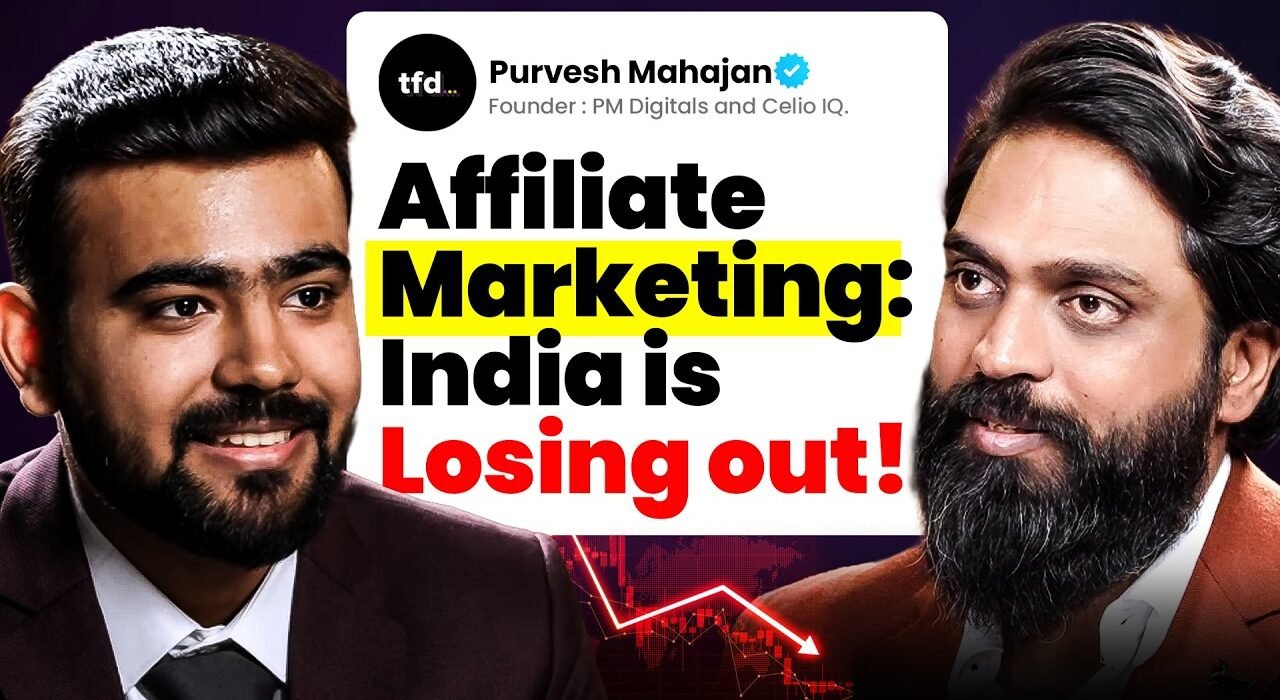
Can a commission structure alone explain why some affiliate marketers in India are stuck earning small amounts while others abroad are taking home far bigger payouts for similar work? That’s the question host Abhishek Vyas put to Purvesh Mahajan, founder of SellU IQ and PM Digitals, in this Purvesh Mahajan interview on The Founder’s Dream. Known online as the Blue Cap Marketer, Purvesh has spent the last several years building high-converting funnels and teaching affiliate marketing to thousands of students — and his answer on this Indian business podcast is blunt about where the real money sits.
Why International Affiliate Commissions Beat India’s Market
Abhishek opened with the comparison that frames the whole conversation: how different is India’s affiliate market from the international one? Purvesh didn’t soften it.
To be honest, there’s a huge difference. In India you literally get paid peanuts in commission, while internationally you can take home suitcases full of commission.
His own numbers back the claim. He points out that platforms like Flipkart and Amazon cap affiliate commissions at around 5%, while digital product platforms internationally pay 50-60%. The gap isn’t about effort — it’s about what kind of product you’re promoting and in which market.
Digital Products vs Physical Products: An Indian Business Podcast Lesson
Abhishek pushed further: why did Purvesh specifically choose digital products over physical ones? The reasoning he gave is worth sitting with if you’re weighing where to start.
If you go into physical products, the chances of fraud are highest. Second, you sell the product only once and get commission only once — and that too very little. With digital products, you get 50-60% commission, and as long as the customer keeps renewing, you keep earning commission too.
He illustrated this with a personal example. In 2022 he referred someone to a ClickFunnels subscription worth $500.
I sold a ClickFunnels subscription worth $500 in 2022 — I still get that $500 commission every year, because the person I referred keeps renewing it. It’s like passive income for you.
That renewal-based recurring commission is the core argument for digital products in this entire conversation. If you’re exploring business models and want to see how this compares with other options, The Founder’s Dream has also covered the broader landscape in its entrepreneurial journey coverage.
From 100 Failed YouTube Videos to a Global Income Stream
Purvesh’s own entry into online income wasn’t smooth. In 2019, during college, he started a YouTube channel after hearing that people were earning lakhs from it. He uploaded more than 100 videos over six months and got zero results. He also tried freelance web design on the side, but the income stayed small.
The turning point came when he attended a workshop where the speaker mentioned earning more than $1,000 in a single month through digital marketing. Purvesh began learning digital marketing seriously in 2022 — three years after his first attempt at YouTube. Progress was slow: first $10, then $50, eventually reaching $1,000 a month once he discovered international affiliate marketing specifically, which is when his income actually multiplied. His first dollar, he says, took three months to arrive, and even after that it took another full month before sales became consistent, because there wasn’t much structured knowledge available on selling international products at the time.
Inside SellU IQ: How Affiliates and Vendors Get Paid
The SellU IQ founder story is simple at its core: Purvesh built the platform — SellU IQ, short for “selling with intelligence” — to connect affiliates with vendors selling digital products. Vendors list a product; the platform’s network of affiliates, currently more than 200 international and over 100 in India, promotes it. More than 200 SaaS brands have been onboarded so far.
The mechanics matter here. Every affiliate gets a unique tracking link, and the tracking itself works through cookies embedded in the browser — similar to how ads follow you around the internet after a single search. If someone clicks your link today and purchases 30 days later, you still get the commission. In cases where multiple affiliates reach the same audience and all get clicked, the commission goes to whichever affiliate’s link was clicked last — a last-click attribution model.
Payouts are another differentiator Purvesh highlights. Because physical products involve delivery, returns, and payment collection logistics that typically take 30-60 days to settle, SellU IQ’s fully digital setup — with integrated payment gateways — lets it pay out within seven days, assuming there’s no refund involved.
For someone starting completely fresh on the platform, Purvesh describes a two-month mentorship built into the process: training from scratch on ads, funnel-building, and promotion, followed by practical implementation, and then live selling through the platform. He estimates a beginner with some aptitude can realistically start making around $100 a day, which works out to roughly $3,000 a month.
Starting From Zero: What a Beginner Should Actually Do
Abhishek asked a practical question many listeners would have: how does someone with no audience and no brand make their first $1,000 internationally? Purvesh laid out a simple sequence rather than a vague promise.
- Buy a domain name and build a single landing page around whichever affiliate offer is selling well in the market.
- Write your own honest opinion of that product on the page — not generic copy, but something that communicates clearly.
- Run solo ads through a marketplace of solo-ad vendors to send direct traffic to that landing page.
- Aim for two to three sales a day; at roughly $50 per sale, that’s already close to $100 a day, compounding toward $1,000 a month.
He also stressed that copywriting — writing the landing page word for word so it communicates exactly what the product does — is what separates a page that converts from one that confuses visitors. On reaching the right audience versus just any audience, Purvesh was direct: a creator with 5,000 highly relevant followers (he used the example of a CXO-heavy audience) will out-earn one with a much larger but passive following. He also pointed to email marketing as underrated — an email list built years ago, he said, still converts well, because social followers tend to drift away or unfollow within a few months, whereas an email address stays reachable.
AI, Performance Marketing and the One Skill That Can’t Be Automated
Purvesh initially thought performance marketing was close to gambling — put in money, sometimes get wildly outsized returns. Once he implemented it himself, he saw it work more predictably: put in one rupee, pull out four or five. Tools have also changed what a solo marketer can do alone. He mentioned FlexiFunnels as an example — a tool where you can describe a funnel and get a complete website with a payment system ready to launch, work that used to require hiring developers and running studio shoots for ad creatives.
Even so, he’s firm that AI hasn’t made performance marketers less necessary — if anything, demand is rising because D2C and B2B marketing are both at a peak, and someone still has to decide strategy.
Strategy and making the smart move in the market — only a human brain can do that. I know how to build funnels, run ads, handle the whole technical setup, but without the right strategy, which audience to target, which product to pick, I still won’t earn a single rupee. That’s the human skill AI will never replace.
This is also where Purvesh’s personal brand name comes in. When he started reaching the US market in 2019, he realized his real name was hard for international clients to pronounce or remember, so he adopted “Blue Cap Marketer” as a catchy, memorable identity — one that’s now recognized among B2B software founders he’s worked with for years. If you’re thinking about how branding and positioning play into personal and professional growth more broadly, it’s worth exploring The Founder’s Dream’s self-growth coverage.
On working across markets, Purvesh was candid about why he prefers US clients despite Indian clients having the money too.
If someone in the US market pays me one lakh rupees, he’s very calm about it — he’ll just say fine, do well until the project ends. An Indian client who pays the same amount keeps asking where’s my product, why aren’t I getting results — that constant back and forth doesn’t let you actually work.
He closed the episode with a line that sums up the entire conversation’s bias toward action over overthinking: start early, make the decision today instead of tomorrow, and let failure and success both play out inside the journey rather than waiting for certainty first. Watch the full conversation with host Abhishek Vyas on The Founder’s Dream YouTube channel and subscribe for new founder interviews every week.
Frequently asked questions
Why do digital products pay higher affiliate commissions than physical products?
Purvesh Mahajan explains that physical products carry higher fraud risk and pay a one-time, small commission, while digital products pay 50-60% commission and keep paying every time the customer renews their subscription.
What is SellU IQ?
SellU IQ is a platform founded by Purvesh Mahajan that connects affiliates with vendors selling digital products, offering commissions up to 50-60% and a seven-day payout cycle.
How much more do international affiliate commissions pay compared to India?
Purvesh says Indian affiliate commissions are very small by comparison, while international markets allow affiliates to earn far larger payouts on the same effort, partly because digital product commissions run as high as 50-60% versus roughly 5% on platforms like Amazon or Flipkart.
Why does Purvesh Mahajan go by the name Blue Cap Marketer?
He built the personal brand name Blue Cap Marketer because international clients, especially in the US, found his real name hard to pronounce and remember, so a catchy English name made branding easier.
Can a beginner with no audience start affiliate marketing?
Yes — Purvesh outlines a starting path of buying a domain, building a landing page around a popular affiliate offer, writing an honest opinion of the product, and running solo ads to get initial daily sales before scaling further.