
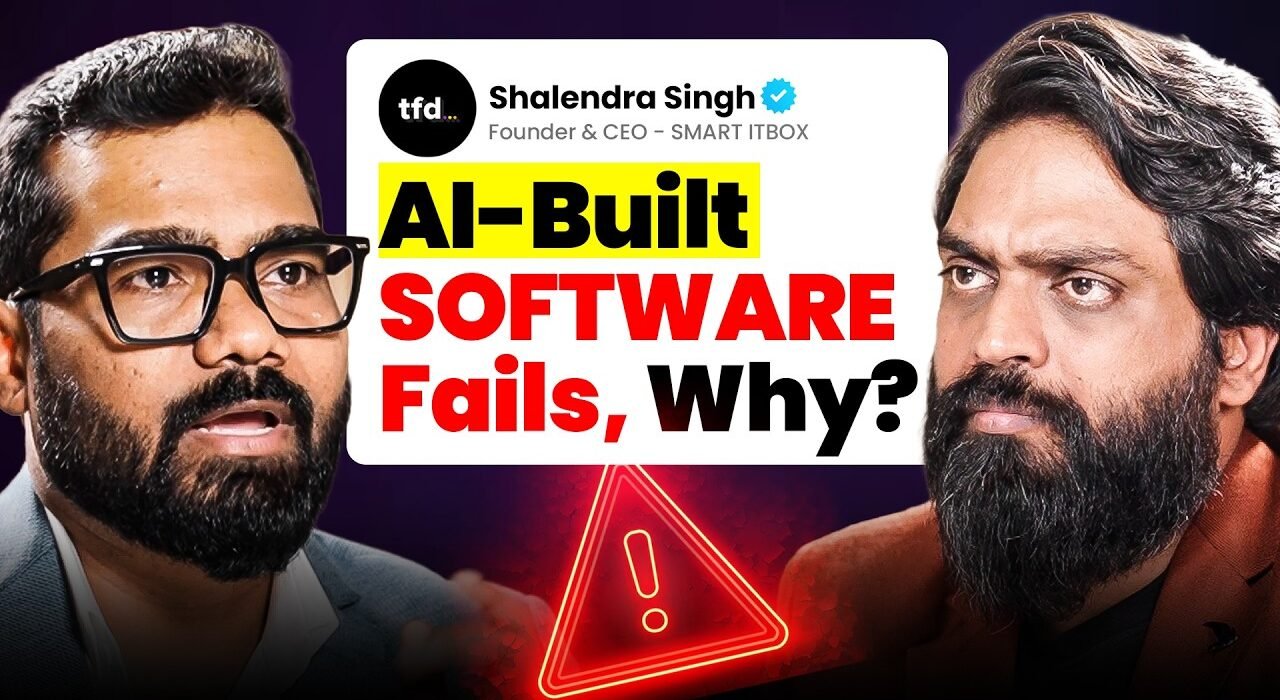
Most entrepreneurship stories skip the part where the founder is still figuring out how the business even works. The Shalender Singh success story — which is really the Smart IT Box founder story — doesn’t skip that part. It starts with a ₹10,000-a-month data entry job and ends with a founder warning other business owners not to trust AI-built applications blindly. In this episode of The Founder’s Dream, host Abhishek Vyas sits down with Shalender Singh, founder of Smart IT Box, to trace that entire arc.
The Shalender Singh Success Story Starts With a Data Entry Job
Shalender Singh completed his BCA and spent three months searching for a job without success through campus placements. His break came through a chance meeting during an evening walk, when a neighbour, Mr. P.S. Tiwari, connected him to Bhupendra Kaushik, an Associate Vice President at Jay Shree Rasayan Udyog Limited, a pesticide manufacturing company.
Kaushik hired him without discussing salary first, giving him a one-month trial to convert raw sales data into material requisitions and production projections inside Microsoft Dynamics AX, the company’s ERP system. Shalender finished the 30-day target in about 20 days, and when a second target of 10 days was given to verify his accuracy, he completed it in 7.
He told me — never come to me asking for salary. Your work will decide your salary.
His salary turned out to be ₹18,146 on paper, with only ₹1,000 in hand after deductions. He later moved to a district as an IT officer, rolled out a full ERP system for a production unit, and worked across several companies including a store-in-charge role and a laminate manufacturing firm — deliberately chasing roles that taught him the full operational picture rather than chasing designations. That pattern of choosing exposure over titles is a big part of the entrepreneur mindset he later carried into building his own company.
How Shalender Singh Built Smart IT Box During the COVID-19 Lockdown
The turning point came during the COVID-19 lockdown. His employer’s owner was networking on Zoom calls where other business owners showed off systems they had built on Google Sheets. Shalender’s own Sheets-based systems, built for his employer, were noticeably better — and people started noticing.
People said — your systems look very smart. Can you build something like this for us too?
That comment triggered the idea. In April 2020, he resigned, submitted his laptop and company accessories, and bought a new laptop on a credit card since he had nothing left to work with. His first client came through a referral from someone who had seen his work on that same Zoom call — and that client is still with him today.
The first assignment paid ₹35,000 for a one-month trial to build an order-to-delivery system. Word of mouth from that single client brought in 17 new clients in the same month, even though Smart IT Box had no website, no branding, and wasn’t even registered yet. The company was formally registered in September 2020, once invoices and tax filings needed to start.
Smart IT Box Revenue: ₹19 Lakh in Year One and a Steady Climb
Calculating from July to the following March, Smart IT Box generated approximately ₹19 lakh in revenue in its first year while Shalender worked completely solo. Revenue then climbed to around ₹37 lakh in year two, ₹43 lakh in year three, and ₹56 lakh in year four. Only after four years of working alone did he hire his first employee, who is still with the company today.
Readers exploring other entrepreneurial journeys will find a common thread here: Smart IT Box wasn’t a pre-planned venture with a business plan. It started because one person’s Google Sheets setup impressed a room full of business owners on a lockdown video call.
Google Sheets vs. ERP: Matching the Tool to the Business
The Smart IT Box business model now runs on two tracks — Google Sheets for smaller businesses, and a modern tech stack for those ready to scale beyond spreadsheet dependency. Shalender’s advice is to start on Sheets, let the systems run for six months to a year, and only then move to a heavier platform.
He pushed back on the idea that Google Sheets is only for small operations.
We have automated businesses on Google Sheets with revenue of ₹25-30 lakh, and we have also automated businesses on Google Sheets with revenue of ₹300 crore. It’s a very flexible tool.
He groups clients into three types: those running a business with no formal process knowledge who just want an affordable solution, those who’ve already spent ₹15-20 lakh on business coaching programs without real implementation, and those who are confused and under-resourced. For the last group, his advice is blunt — don’t chase 10 or 20 systems, build two or three modules, track them consistently, and put the rest of the energy into the market itself.
The Hidden Risk Behind AI-Generated Applications
This is where the conversation turns into a caution rather than a success story. Shalender described a client, a business owner based in Pune, who spent six months building an application entirely through an AI tool.
When they tried to make changes in a later step, the AI generated code so large that it had to read the entire codebase first before it could even process the request. Eventually it stopped being able to read its own code properly.
The business owner ended up needing to rebuild the application from zero with a proper development team — after months and money already spent. In a separate conversation Shalender had on another podcast, a person told him they built a full site and application using AI and it took two months but cost around ₹1 lakh, undercutting the “AI builds it free and fast” narrative that gets sold online.
He also pointed to his own frustrating experience with a travel platform’s AI chatbot when trying to change a flight seat — the bot cycled through “technical error” messages, took 15-20 minutes to understand a simple request, and then handed him off to a human agent who said the issue needed to be resolved on a different platform entirely. His conclusion: an AI tool can be an output-generation engine or a customer-service layer, but it can’t replace the judgment of someone who actually understands the system underneath it.
If you haven’t used AI, people tell you your company will shut down in two months. That fear pushes you to spend lakhs on tools before you’ve even asked whether you genuinely need them.
Why Technical Expertise Still Wins
Shalender was direct about what AI has actually changed inside his own company: work that used to take 25 days on a product now takes a day or two of prompting plus testing, which can bring a go-live timeline down to about five days. But he insisted this speed only works in the hands of someone experienced enough to catch wrong outputs.
Ten donkeys are worse than two horses. If you want expertise, you have to hire freshers and train them alongside experienced people — AI doesn’t remove that requirement.
He pointed out the contradiction many business owners fall into — posting job ads for freshers, then rejecting freshers in interviews because “we don’t hire freshers,” without realizing that practical expertise has to be built through exactly that kind of hands-on training. Smart IT Box grew from around 12 people by training the existing team on where AI genuinely helps — easing manual coding work — rather than replacing judgment altogether.
On personal branding, Shalender’s view is that customers today trust a face more than a brand name, citing how Sam Altman had to become the public face of ChatGPT and Elon Musk became the face people trust over SpaceX itself. For founders weighing when to focus on branding versus building, that’s a useful signal — and readers working on their own self-growth as founders may find it worth revisiting alongside other episodes of this show.
His closing advice to anyone starting out: be honest about your own level of expertise before you hire anyone else, and trust yourself more than you trust the team you’re building. When a client once asked him what he’d do if his entire six-person team quit overnight, his answer was simple — he’d still be able to code the work himself, because that’s the skill he never stopped practicing. That willingness to stay hands-on, he says, is the real entrepreneur mindset behind Smart IT Box.
Watch the full conversation with host Abhishek Vyas on The Founder’s Dream YouTube channel and subscribe for new founder interviews every week, or explore more stories at The Founder’s Dream.
Frequently asked questions
Who is Shalender Singh of Smart IT Box?
Shalender Singh is a systems engineer and business process automation architect who founded Smart IT Box, a company that builds custom workflow and automation solutions for businesses in India and the Gulf.
How much revenue did Smart IT Box make in its first year?
Shalender Singh said Smart IT Box generated approximately ₹19 lakh in revenue in its first year, calculated from July to the following March, while he was working solo.
Should small businesses use Google Sheets or an ERP system?
Shalender Singh recommends small businesses start with well-designed Google Sheets systems before moving to a more advanced tech stack once their processes are stable, since Google Sheets can scale even for businesses with revenue in hundreds of crores.
What is the risk of building an app entirely with AI tools?
Shalender Singh shared a case where a client spent six months building an application using AI generation tools, but once changes were needed, the AI could not reliably read or edit its own generated code, making the output unusable in production.
Why does Shalender Singh say technical expertise still matters?
He argues that AI tools help speed up coding and testing, but only a person with real technical expertise can judge whether the output is correct, debug errors, and prevent a product from crashing after it goes live.

1 Comment