
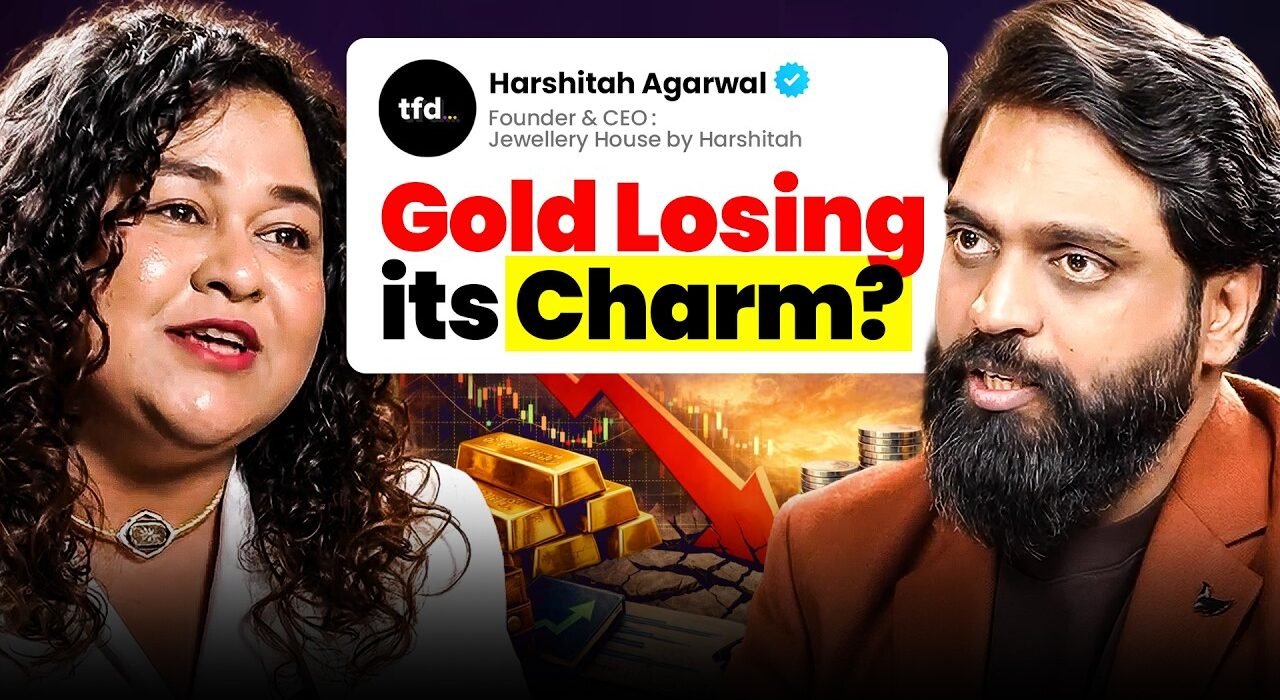
A wedding shopping trip is an odd place to find a business idea, but that is exactly where the JHBH founder story begins. Harshita Agarwal, founder of the fine jewellery brand JHBH, sat down with host Abhishek Vyas on The Founder’s Dream, a founder podcast built around real entrepreneurial journeys, to talk about building a jewellery label from Guwahati without outside funding, without a celebrity face, and without a family legacy in the jewellery trade itself. What she did have was a gap she couldn’t unsee, and five years later, a brand that educates customers before it sells to them.
The JHBH Founder Story: From an Alumina Family to Fine Jewellery
Harshita’s family has been in the aluminium trade for roughly 60-70 years, running a nearly century-old business out of Guwahati, Assam. Jewellery was never the obvious path. The shift happened while she was shopping for her own wedding and started comparing diamond rates and designs against what she knew was available elsewhere.
She noticed that the price a normal consumer in Guwahati was paying could, at the same amount, buy far better design and far better diamond quality elsewhere. That gap, not a grand plan to build a brand, was the actual starting point.
At that time there was no thought of opening a store or building a brand. The only thought was that this gap needed to be filled.
Her father, she says, gave her two options rather than a push in either direction: a path already laid out in Guwahati, or whatever route she wanted to build herself. She chose to build, and the family’s existing reputation in business became the platform she launched from.
An Entrepreneur Mindset Built on Delegation, Not Control
One of the more candid parts of this Harshita Agarwal interview is about what it actually costs to run a company day to day. She admits that five years in, there were moments she genuinely did not want to be a founder in her own company anymore, not because the business was failing, but because of how much she had taken on herself.
When you start, everything looks great, there’s energy around you, and you think, yes, I have to become this. But once you actually become the founder, there are days you feel — I don’t want to be a founder.
She traces a recent shift to stepping away from her flagship store city for a few months and realising how many tasks she was holding onto that could have gone to someone else.
I was taking on so many jobs as a founder that if I had simply delegated them, my life would have been much easier. There was a strange sense of control — a fear that if I handed it to someone else, they wouldn’t execute it as well.
Her conclusion is a useful one for any founder wrestling with the same instinct: the vision belongs to the founder, but the execution doesn’t have to. If you want a broader look at what founders across industries in India struggle with beyond the glamour, this episode pairs well with Biggest Business Challenges in India, another conversation on this channel that digs into the same pressure points.
Earning Trust Without a Celebrity Face or Jewellery Legacy
Jewellery in India runs on legacy. Customers tend to trust the shop their family has always gone to, which made JHBH’s early days harder than most. Harshita is direct about the bias she faced on the vendor side as a new, unestablished jeweller.
When you are a new jeweller with no background built up, there are difficulties in a lot of things. They keep assuming there must be a man behind the scenes making the decisions — someone putting in the money.
She says the same bias showed up with end customers too, especially once purchase amounts crossed the ten to twelve lakh range, where people instinctively feel more comfortable if a male figure is involved in the transaction. Building past that took time, consistent relationships, and letting vendors and clients see the capability for themselves.
Her advice to any founder trying to go direct-to-consumer without a legacy name is simple and specific:
If you want to connect directly with the consumer and you have a good product, start with a brick-and-mortar model in your own state, your own city — because your parents and your surroundings already have so much built there that your starting movement becomes much easier.
None of this came free of cost. Harshita speaks openly about the mental and physical toll of those early years, including a PCOS diagnosis, a difficult weight struggle, and two miscarriages, before arriving at an acceptance that building something lasting often means giving something up along the way.
Knowledge-Led Branding: Teaching Customers the 4Cs
The core of the JHBH business model isn’t a showroom experience — it’s an education session. Harshita describes the traditional Guwahati jewellery experience as a box of solitaires pushed across the counter with a scanner to check the price, with little explanation of what customers were actually paying for.
She found clients in Guwahati paying the same price for a weak-colour diamond that was internally very clean as they would for a far whiter stone of lower clarity, simply because they didn’t understand the 4Cs — colour, clarity, carat, and cut — or the newer 6C framework that now includes conscious sourcing for lab-grown stones.
My problem wasn’t with the diamond itself. My problem was that my client should know that at the same rate, a different diamond and a different quality is available.
To launch this approach, JHBH ran a campaign using seven long-time, trusted clients as the actual faces of hoardings around the flagship store opening — a risk in an industry with a stigma around showing buyers publicly, but one that paid off when a fellow legacy jeweller personally called to acknowledge the campaign.
- JHBH designs are engineered for shorter Indian necklines and chunky chokers, with length and breadth pre-decided by the design rather than left to chance.
- Pricing is treated as secondary to the value a piece holds for the specific client wearing it.
- Designs made for one client are often kept off social media entirely, protected by client sign-offs on sketches, to preserve their uniqueness.
Gender-Neutral Jewellery and the Lachit Collection
JHBH’s Instagram presence is built around a single idea: jewellery has no gender. Harshita says men are now picking up pieces across the board, with brooches proving especially popular among millennial buyers rather than Gen Z specifically.
The brand’s most-commented design is a piece called “Ba,” Assamese for bamboo, tied to prosperity and the way both raw and finished bamboo are used in traditional home construction in Assam. It’s part of the Lachit Collection, inspired by Assamese heritage and named for the historical figure Lachit, built around motifs like the state flower and the rhino.
We were sure that day that we needed to create some rooted designs. Right now I’ve only touched one state — Assam. I want to create heritage designs for every state in India eventually.
For context on how other founders have carved out a niche in India’s gold and jewellery trade from a very different starting point, it’s worth reading Archit Jain Success Story: From Gold Shop to Sarafa Bazar India, which covers similar ground from the bazaar side of the business.
Gold Prices in India, Natural vs Lab-Grown, and The Golden Ledger
Asked directly whether rising gold prices in India are cooling down jewellery purchases, Harshita pushed back on the idea that demand is disappearing. What’s changing, she says, is the form the demand takes.
People are taking out their old gold — designs that have gone out of style, or pieces kept as investment or as an asset. The question becomes: can this be revamped, reimagined, redesigned? And exchange schemes are making that a bit easier.
Her blunt line on the category: it isn’t possible for jewellery to simply stop selling in India, because gold here isn’t just an asset, it’s identity and occasion.
On natural versus lab-grown diamonds, she’s equally pragmatic. The two are optically, physically, and thermally identical, and no untrained eye can tell them apart.
The question is, what’s your goal in buying? Colour, clarity, carat — these are what the decision should be based on. Lab-grown diamonds will find their own niche over time, the same way artificial jewellery eventually did, while natural diamonds have become ultra-premium.
JHBH’s answer for everyday gold buyers who still want a plan is a scheme called The Golden Ledger, a savings-style structure with no hard minimum but a suggestion to invest at least one gram at a time, which can later be taken as product or retained for its value.
What This Founder Story Leaves You With
The Harshita Agarwal success story carries a message to other founders that isn’t about jewellery at all — it’s about giving yourself time before expecting a legacy to show up.
- A real gap, not a generic business plan, started JHBH — she acted on something she personally experienced as a customer.
- Delegation, not control, is what let the business actually scale past the founder’s own bandwidth.
- Trust in a legacy-driven industry was built through education and consistency, not through funding or celebrity backing.
- Heritage-rooted design work, starting with Assam, is where she sees long-term differentiation for the brand.
Watch the full conversation with host Abhishek Vyas on The Founder’s Dream YouTube channel and subscribe for new founder interviews every week.
Frequently asked questions
Did Harshita Agarwal build JHBH without external funding?
Yes, according to the episode, Harshita Agarwal built JHBH from scratch without external funding or celebrity endorsements, relying instead on her family’s decades-old business reputation in Guwahati to earn early trust.
What is the Lachit Collection by JHBH?
The Lachit Collection is a heritage jewellery line inspired by Assamese culture, built around the strength associated with the historical figure Lachit and featuring motifs like the state flower and the rhino.
What is The Golden Ledger that Harshita Agarwal mentions?
The Golden Ledger is JHBH’s savings-style plan where customers set aside an amount toward gold, with a suggested minimum of one gram, and later choose to redeem it or retain its value.
Should you buy natural or lab-grown diamonds right now?
Harshita Agarwal says the two are optically, physically, and thermally identical, so the real question is your goal in buying; natural diamonds have become ultra-premium while lab-grown is still settling into its own pricing niche.
Are gold purchases actually declining in India despite price rises?
No, Harshita Agarwal says buying isn’t disappearing, people are instead exchanging old gold designs for new ones, and exchange schemes are making that transition easier.

1 Comment