
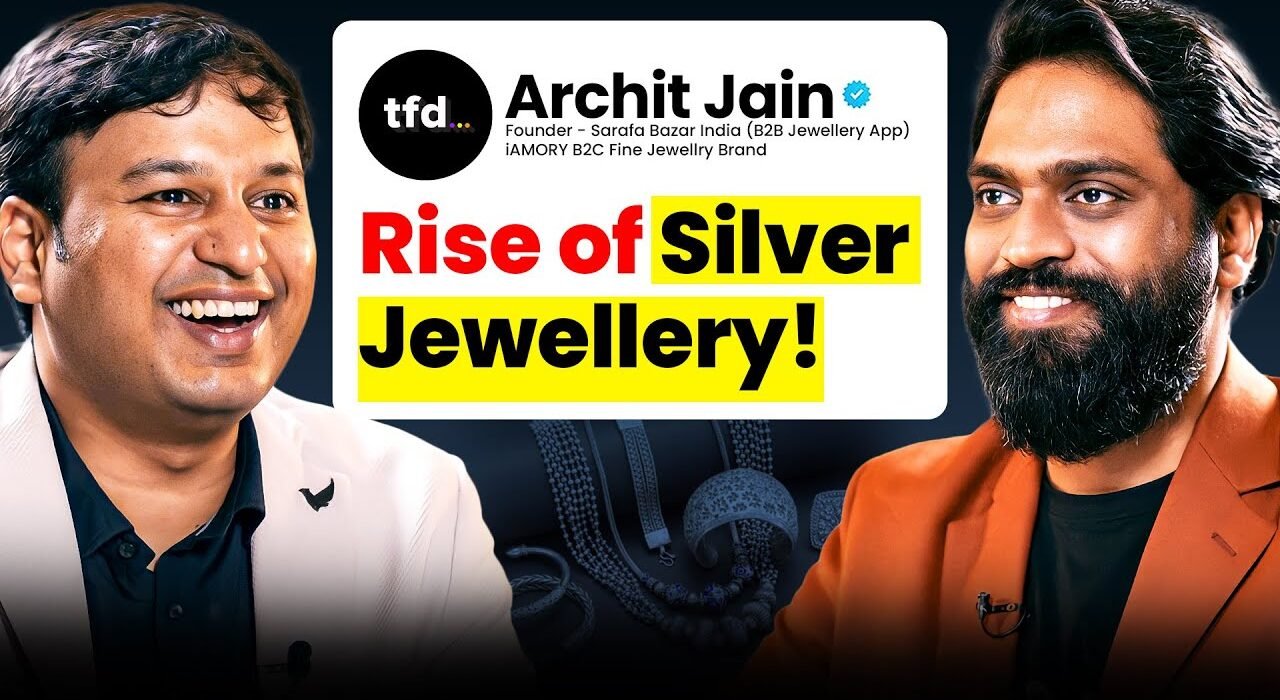
Archit Jain grew up around a gold jewellery shop in Saharanpur, a tier-2 town near Dehradun, in a family that has been in the business for more than 80 years. He could have simply taken his seat behind the counter after his B.Tech. Instead, he built a B2B jewellery platform during COVID that jewellers across India now recognise, then pivoted it into a silver D2C brand almost overnight. This Archit Jain success story — really the Sarafa Bazar India & iAMORY founder story — told to host Abhishek Vyas on The Founder’s Dream, a founder podcast built around how Indian entrepreneurs actually scale, is as much about reinvestment and timing as it is about jewellery.
A Family Legacy Business in a Tier-2 Town
Archit’s family has run jewellery shops in Saharanpur for generations — his grandfather, his uncles, his father all had their own shops under different names. He did his B.Tech in Electronics and Communication from JP College, Noida, in 2014, then spent two years working a job and trying two startups of his own before joining the family business in 2017.
Neither of his earlier ventures — a meme-and-video social platform and a silver e-commerce attempt — survived. He later admitted the second failed simply because he was too early to understand how to actually run a company. But sitting in the family shop after joining in 2017, he started noticing gaps in how the entire jewellery trade functioned.
The Archit Jain Success Story Begins With a COVID-Era Bet
Around 2018-19, Archit realised something simple: a jeweller sitting in Saharanpur had no easy way to contact a manufacturer in Mumbai or Rajkot for fresh stock. He tried Googling a platform — the one he found had a user interface so complicated even he, with some tech background, couldn’t use it. Exhibitions were the other route, but as someone from a small town, he rarely knew when or where they were happening.
Then COVID hit, and exhibitions stopped altogether. That shutdown became his opening, though he carried real doubt about whether he could pull it off.
I was afraid that my connections were only limited to Saharanpur — they didn’t extend beyond it. The major jewellery trade runs out of Mumbai, and my family had no connection to manufacturers there. There was a real inferiority complex about whether I’d be able to do this at all.
He pushed through anyway. Sarafa Bazar — a name borrowed from the Hindi term for a jewellery market — launched in May 2020. He started small, with a borrowed laptop that had three visible dead patches on the screen, a free Shopify trial, and ₹10,000 from his parents that he needed only to open a current bank account. Once the free trial ended, he paid the bill with his own credit card and reinvested whatever revenue came in to keep scaling.
Building Trust in a Traditional Industry
Getting established jewellers to take a young founder seriously was its own battle. In this Archit Jain interview, he is candid about why the industry resists newcomers.
Jewellers have made a lot of money, and once someone has made money a certain way, they believe that’s simply how the world works. Our industry is genuinely full of people like that. Even Mumbai’s jewellers, who are considered the most advanced in the country, used to say jewellery would never sell online.
That resistance eased only once people actually used the platform and the friction of a new habit wore off. Archit points to hallmarking as a live example today: the government’s HUID (Hallmark Unique Identification) system requires a unique code on every piece of jewellery, verifiable through the BIS app, but many jewellers still avoid adopting it because it forces their business into “white” — fully taxed and documented. Those who upgrade and sell HUID-marked jewellery, even at higher making charges, are the ones growing; those clinging to the old way are slowly losing ground.
This tension between comfort and reinvention is a theme that comes up often across founder conversations on the channel — it echoes points made in Akshay Bansal on Building an Entrepreneur Mindset Beyond Design, where adapting an established mindset proved just as hard as building the business itself.
Sarafa Bazar India & iAMORY Business Model: Zero Commission, Membership-Led
Sarafa Bazar runs on a straightforward model: manufacturers pay a listing/membership fee to put their products on the app, and retailers contact them directly — no commission on transactions. Archit estimates there are around 4 lakh jewellery shops in all of India, a surprisingly small, fragmented, niche market, and he claims roughly one in five jewellers either knows about or actively uses Sarafa Bazar, built through deep ground marketing, digital marketing, exhibition stalls, and event sponsorships across the country.
The same manufacturers who supply Sarafa Bazar’s network also supply big names like Tanishq, Malabar, and Kalyan. Archit explained how the big brands actually lock in exclusivity:
A manufacturer might show them 500 designs, and they like only two. They sign a contract and an MOQ for those two pieces — the manufacturer won’t sell that exact piece to anyone else. But there’s no copyright on the design itself, so a similar finish can still be made for someone else by a different manufacturer.
The Pivot: From B2B Gold to a B2C Silver Brand
Sarafa Bazar briefly ran a B2B e-commerce arm to solve a real demand gap — retailers wanted single pieces instead of committing to the ₹20 lakh minimum order quantities manufacturers required. That business ran for a year and a half and reportedly reached a ₹12 crore ARR before Archit pivoted it completely within a week.
Several things converged at once: gold crossed ₹1 lakh and Archit watched demand for gold jewellery drop as buyers shifted toward digital gold and sovereign bonds for investment, leaving actual jewellery feeling like something meant for the locker rather than daily wear. Around the same time, he visited an exhibition and saw silver jewellery that changed his mind entirely.
I told my wife one night, “Anokhi, we are pivoting.” She said, “What?” I told her we’re shutting down B2B and moving into B2C, because people need jewellery for daily wear, and this is the right time to enter the industry.
Not everyone agreed immediately — even his angel investors, most of whom come from the jewellery manufacturing world, struggled to digest a move from gold to silver, carrying the same “downgrade” mindset he’d just described. It took a week of conversations to bring them along. That brand became iAMORY, which deliberately avoids the basic cast CZ jewellery every mass brand stocks, leaning instead into Italian and Bangkok-style fast-fashion silver designs — pieces where, as he put it, 90% of a design won’t be repeated the next time a customer comes back.
Scaling B2B and B2C at the Same Time
Running a marketplace and a consumer brand together means fighting different battles. On the B2B side, Archit says Sarafa Bazar was a market leader from day one because of a simple commitment: charge for 100, deliver 110. On the B2C side with iAMORY, competition from small and established silver brands is genuinely tough, but he leans on deep market connections and sourcing from carefully shortlisted vendors — he personally visited around 100 wholesalers and manufacturers before narrowing down to two.
Asked what strategy every founder should follow to win customers quickly, Archit kept it simple:
First is value for money — the customer must feel that whatever they’re buying is genuinely a good thing. Second, their life should actually feel upgraded after buying it, and that has to be real, because that’s what generates referrals. Referrals are what make a business grow.
iAMORY’s first physical store, a 250 square foot outlet in Powai, Mumbai, was set to launch within a month of the recording. For now, there’s no international expansion plan — the India market alone, in Archit’s view, is still large enough to justify full focus, a point worth noting for anyone studying Industry’s Top Leaders: India’s Most Successful Businesses and how domestic scale often outpaces the pull toward going global too early.
Bridal Jewellery vs. the Shift to Lightweight, Everyday Pieces
Archit doesn’t expect heavy bridal jewellery to disappear quickly, even as lighter, elegant pieces gain ground for daily wear. His reasoning is social, not purely economic:
Bridal jewellery doesn’t go away fast, because the bride and groom themselves aren’t that invested in it — it’s the parents who are, who feel they must give their children this jewellery, otherwise what will society say?
He points to his own life as a counter-example — living on rent in Mumbai with no locker, carrying minimal jewellery, and a cousin who, instead of inherited jewellery, asked for cash or property. Daily-wear demand, by contrast, is converging on one preference regardless of metal: slim, light pieces, whether in gold or silver, replacing the thick chains and heavy sets of a generation ago.
What the Jewellery Industry’s Biggest Pain Point Looks Like Today
Archit’s closing read on the industry is blunt: too many jewellers are racing each other on discounted making charges — some Instagram sellers advertise jewellery at 3-5% making charges — assuming cheaper is the only way to survive. He disagrees, pointing out that branded players like Tanishq and Malabar charge 18-30% making charges on jewellery a local jeweller sells for 10-18%, and still draw crowds, because branding and trust matter more than the race to the bottom.
He’s equally direct about career preparation for the next generation entering family businesses: two years of a job before stepping into the family shop, not to earn, but to learn how digital marketing, websites, and companies actually run — distinct from how a traditional shop runs.
- Value for money and a real, felt upgrade in the customer’s life drive referrals and repeat business.
- Reinvesting early revenue rather than withdrawing it is what let Sarafa Bazar scale from a borrowed laptop.
- Pivoting fast — even against investor hesitation — can be the right call when the market signal is clear.
- A couple of years in a job before joining a family business builds skills a shop floor alone won’t teach.
Watch the full Archit Jain interview with host Abhishek Vyas on The Founder’s Dream YouTube channel and subscribe for new founder interviews every week.
Frequently asked questions
Who is Archit Jain?
Archit Jain is the founder of Sarafa Bazar India, a B2B platform connecting jewellery manufacturers with retailers, and iAMORY, a D2C fine jewellery brand focused on silver. He comes from an 80-year-old family gold jewellery business in Saharanpur, Uttar Pradesh.
What is Sarafa Bazar India?
Sarafa Bazar India is a B2B jewellery marketplace that lets retailers across India contact manufacturers directly, without needing to attend exhibitions in cities like Mumbai. It runs on a membership and listing fee model rather than commission.
Why did Archit Jain shift Sarafa Bazar from B2B to also launch a B2C brand?
Archit Jain noticed gold prices climbing toward ₹1 lakh, a shift in demand toward silver fashion jewellery, and a gap where retailers wanted single pieces instead of large minimum order quantities. He pivoted within a week to launch iAMORY, a silver-focused D2C brand.
What is the HUID in jewellery hallmarking?
HUID stands for Hallmark Unique Identification, a unique number printed alongside the BIS hallmark triangle on every piece of jewellery, verifiable on the BIS app. Archit Jain explains it has been in the market for around five to six years and requires jewellers to operate in white, which some smaller sellers resist.
Does Archit Jain think bridal jewellery demand is declining?
He sees a gradual shift toward lightweight, elegant jewellery for daily wear, but says heavy bridal jewellery will not disappear quickly because parents, more than the bride and groom themselves, still push for it as a social expectation.

2 Comments