
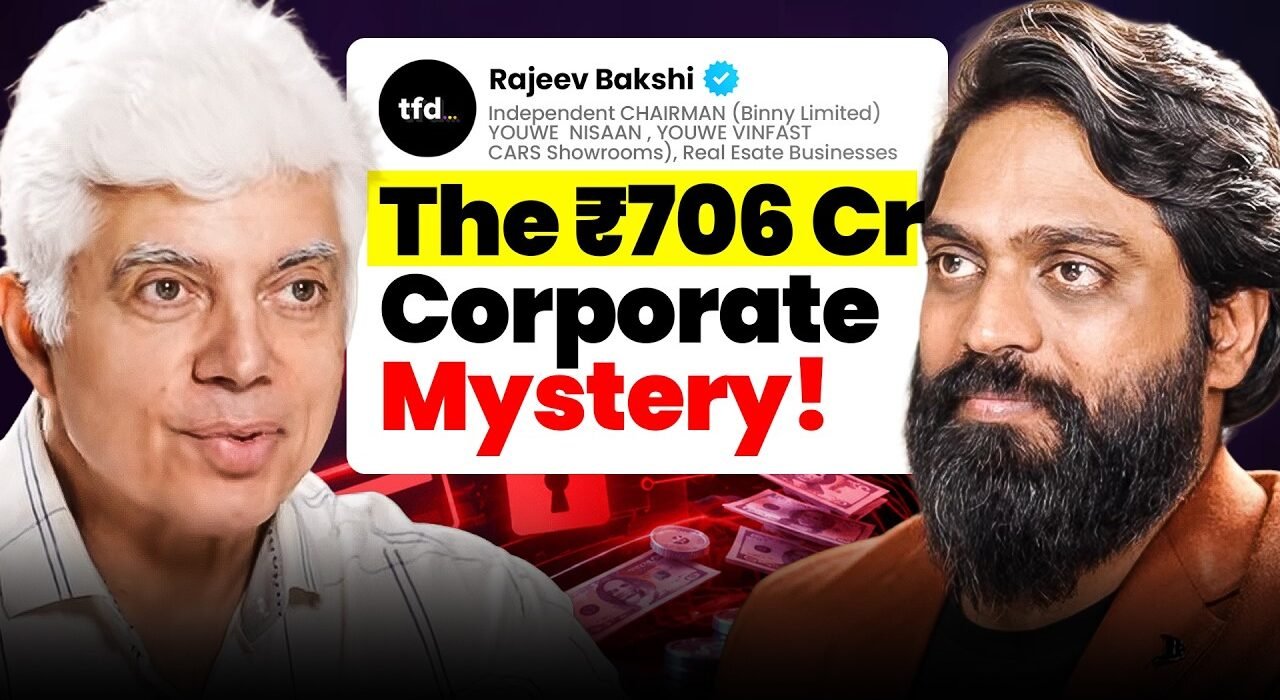
What happens when an independent director walks into a company and finds an alleged ₹800 crore hole in the books, a 20-year dividend drought, and a family tearing itself apart over who gets to run the show? This Rajiv Bakshi interview on The Founder’s Dream, an Indian business podcast hosted by Abhishek Vyas, goes straight into that mess — the Binnies corporate controversy, SEBI proceedings, and a fight that has already cost him three years in court.
Rajiv Bakshi describes himself simply: a business leader, investor and corporate director who has worked across luxury mobility, international real estate and renewable energy before stepping onto Indian corporate boardrooms. But the story that defines this conversation isn’t about building a company — it’s about what he found after he joined one as an Independent Director, and the corporate governance failures he says followed.
How This Rajiv Bakshi Interview Uncovers the ₹800 Crore Binnies Allegation
Bakshi says the trouble surfaced while he was doing routine compliance work at Binnies. He noticed two things that didn’t add up: an alleged ₹800 crore irregularity in the company’s accounts, and shareholders who hadn’t received a dividend in roughly two decades — despite the company sitting on a massive land bank.
He explains the opportunity this land bank represented, comparing it to how real estate majors operate:
The company has so much land that it could do what DLF or Godrej do — hand it over for a joint venture, keep a 60-40 share of the returns, and barely need more than a handful of people to run the operation. Shareholders saw this as a huge opportunity and expected share prices to move accordingly.
Instead of that upside reaching shareholders, Bakshi alleges the company was eventually penalized by SEBI for close to ₹1400 crore — a figure he says followed directly from the ₹800 crore irregularity once it was investigated.
The Family Fight Behind the Binnies Boardroom
Once Bakshi joined the board — elected, he says, with 99% shareholder voting support — the real drama began. He describes an owner with two sons and a daughter, each positioning for control the moment he arrived, in what he frames as a basic breakdown of corporate governance within the family itself:
The younger son says, make me the owner. The elder son steps in and says, make me the owner. The daughter flies in from America with her husband and says we’re going to build this company, make us the chairman. Everybody starts fighting for the seat.
Bakshi says he refused to simply pick a side, pointing out the legal reality of a listed entity:
I can only do this if it’s a private limited company — then do what you please. But this is a public limited company. There has to be a voting system, you have to go to the shareholders. I can’t just decide who gets which seat.
According to Bakshi, that refusal escalated quickly. He describes a board meeting where the elder son and daughter called one meeting while the younger son arrived with the CFO, insisting he vote them in — and an altercation that followed when he declined. He also alleges that shares were eventually signed over within the family, with one son ending up controlling a significant stake, while the daughter maintained the company was hers and no one else’s to touch.
SEBI, SFIO and a Case Stuck in Chennai High Court
Bakshi says the matter hasn’t stayed within the family — it has moved through SEBI, the Serious Fraud Investigation Office (SFIO), and the Chennai High Court, where he and another independent director have filed in a double bench. Three years on, he says the SFIO process has produced little visible movement despite the evidence he claims to have submitted.
He is candid about the pressure that follows whistleblowing in a case like this:
I’m giving SFIO such a large file — go check it. But then a phone call goes out somewhere and the message comes back: cool this case down, cool it down. That’s what keeps happening, and shareholders keep suffering in the middle of it.
He also alleges that a joint venture partner, referred to in the conversation as SVR, used a court-appointed administrator process and a retired Chief Justice brought in to settle matters in a way that left shareholders without the money owed to them — even as SEBI’s own case against the partner for roughly ₹300 crore remained pending.
What Happens to Shareholders When Shares Get Frozen
For Bakshi, the human cost of this fight is the part that matters most. He describes minority shareholders who bought in expecting their investment to double, only to watch their shares get frozen amid the scandal and then get approached with lowball offers:
People invested their money 20 years ago, 15 years ago, 10 years ago. Why do they do it? So their money grows, so they get rewarded. Someone needs to pay for their child’s education, someone needs security in old age. This company has enough strength that the share could go from ₹200 to ₹2000 — but it’s been deliberately kept low.
He says some shareholders travelled to meet him directly, frustrated and desperate, after being pushed toward offline deals at ₹50 or ₹100 a share — a fraction of what their holdings were once worth, and far below what Bakshi believes the stock could be worth if the company were run cleanly.
Why Rajiv Bakshi Keeps Fighting Despite the Risk
Bakshi doesn’t pretend this fight is costless. He talks openly about friends in the police telling him people get “removed” for this kind of whistleblowing, and about the fear that keeps most independent directors quiet:
I can’t fight the system — die fighting the system, and tomorrow they’ll come for me too. That fear is why most people either sign what they’re told to sign or just quietly walk away from the board.
Yet his own answer, repeated through the conversation, stays consistent: there are 14,000 minority shareholders who wrote to him directly, and someone has to stay in the fight long enough to get them a public apology and their money back — not a quiet settlement behind closed doors.
This is the fight between Bakshi and Binny, between Bakshi and SVR. Let’s see who wins.
What Smaller Investors Should Take From This
Bakshi is blunt when asked whether retail investors should put money into smaller, lesser-known companies purely because they look asset-rich:
- A large land bank or asset base doesn’t guarantee the returns reach shareholders — it depends entirely on how the company and its promoters choose to use it.
- A long dividend drought (in this case, around 20 years) is a red flag worth investigating before buying in.
- Ownership disputes within a promoter family can freeze a company’s decision-making and its shareholders’ money for years.
- Regulatory action from SEBI or a referral to SFIO doesn’t guarantee quick resolution — Bakshi’s own case has run three years with the core dispute still unresolved.
Stories like this are exactly why conversations on The Founder’s Dream podcast go beyond the usual founder-success formula. If you want more honest accounts of what builders and operators actually go through, the channel’s entrepreneurial journey stories and its self growth lessons cover the harder, less polished side of business that rarely makes headlines.
What makes this particular Rajiv Bakshi interview worth hearing in full is how plainly he lays out the mechanics of the dispute — the land, the family, the regulators, and the shareholders caught between all three. Watch the full conversation with host Abhishek Vyas on The Founder’s Dream YouTube channel and subscribe for new founder interviews every week.
Frequently asked questions
Who is Rajiv Bakshi?
Rajiv Bakshi is a business leader, investor and corporate director who has worked across luxury mobility, international real estate and renewable energy, and currently serves as an Independent Director at Binnies, where he has raised allegations of an ₹800 crore financial irregularity.
What is the Binnies controversy about?
The controversy involves allegations that Binnies, a company sitting on a large land bank, denied shareholders dividends for around 20 years while an ₹800 crore irregularity allegedly took place, leading to SEBI penalties of roughly ₹1400 crore on the company.
What action has SEBI taken in the Binnies case?
According to Rajiv Bakshi, SEBI has penalized the company, debarred certain individuals, and imposed financial penalties, while the matter has also been referred to the Serious Fraud Investigation Office (SFIO) and is being heard in the Chennai High Court.
Why do minority shareholders matter in this case?
Rajiv Bakshi says around 14,000 shareholders invested money over 10 to 20 years expecting dividends and share price growth, and many have been pressured to sell their shares at low prices while the underlying case remains unresolved.
What should investors learn from the Binnies case before putting money into small companies?
Rajiv Bakshi’s experience suggests investors should scrutinize land banks, dividend history, promoter family structure and ongoing litigation closely before investing in lesser-known public companies, rather than assuming a large asset base alone makes a stock attractive.
1 Comment