

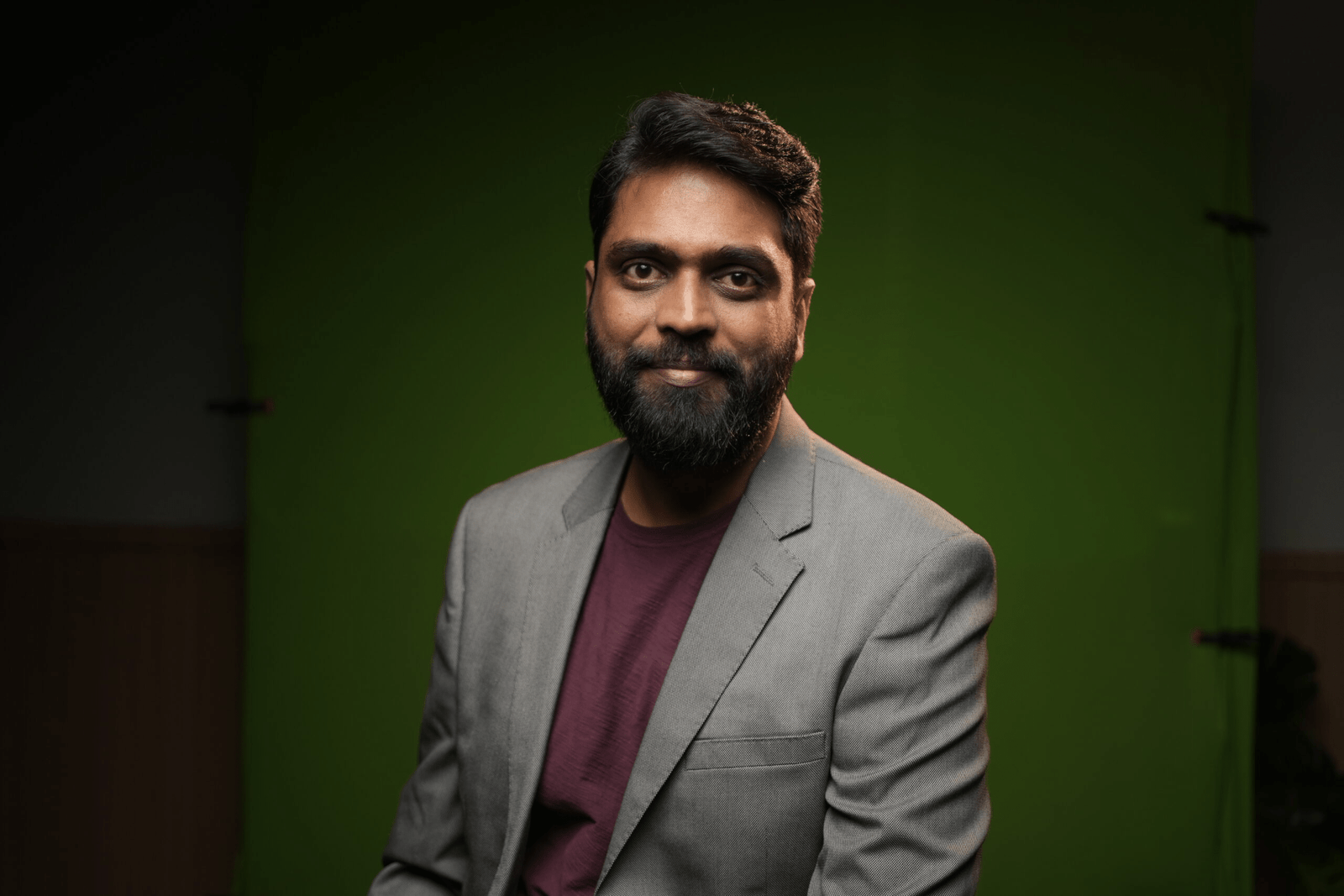
Fifteen lakh students sit for JEE. Twenty lakh sit for medical entrance exams. And somewhere between a nursery admission form and a Class 10 board result, a lot of Indian parents quietly hand their own fear over to their children. That is the uncomfortable starting point of this Bharath Goyal interview on The Founder’s Dream, where host Abhishek Vyas sits down with the founder of Bhartiyam International School to ask whether India’s education system is actually preparing students for the real world — or just for the next exam.
Bharath Goyal isn’t speaking as a critic from the outside. In many ways, this is the Bhartiyam International School founder story in a nutshell: he runs a school in Uttarakhand built specifically so families wouldn’t feel they had to send their children to Kota for coaching. His answer to that pressure was to bring JEE, NEET, robotics and global learning onto one campus instead. What follows is a conversation about why that pressure exists in the first place, and what schools, parents and students can actually do about it.
Why India’s Coaching Culture Starts Before Nursery
Goyal doesn’t frame the coaching boom as a school problem alone. He calls India “a highly aspirational society” where every conversation around people — in the news, in the neighbourhood, at family gatherings — is about competition. NEET paper leaks, lakhs of students competing for limited seats, a growing middle class racing to get ahead: all of it adds up to a particular kind of anxiety.
I think this is India’s biggest fear of missing out — that my child shouldn’t be left behind. Parents want their kids to become engineers, but they end up passing their own fear onto their children without meaning to, and that is what keeps feeding the coaching culture.
He’s careful not to call coaching itself the villain. Humans have always looked for an edge, he says, and that won’t change. What he does flag is the moment when a child’s entire identity narrows down to one exam, one rank, one “extra edge” — because that’s when learning stops being about curiosity and starts being about survival.
Inside the Bharath Goyal Interview: Hard Skills vs Soft Skills
To make his point, Goyal walks through two imagined students. One spends 16-17 hours a day preparing, cracks IIT with a strong rank, but has no real friendships, no stories to tell his own children later, and underdeveloped communication skills. The other becomes head boy, runs events, asks for sponsorships, represents the school — and ends up in a government engineering college, not an IIT.
Most parents, he admits, would call the first child more “successful” because we tend to equate success with money, and IIT with money. His response to that assumption is direct:
Technical skills, hard skills — these only open the door that is your career’s door. To keep that door propped open, your soft skills, your emotional intelligence, your confidence, your communication skills are even more important.
This is a recurring theme in how founders talk about their own journeys too — the entrepreneur mindset that comes up across this podcast’s founder stories is built on exactly this kind of resilience and people skills, not just technical competence. Goyal makes a similar case for students: a narrow, single-track focus on one exam or one “FOMO subject” — JEE, NEET, CA, law — without developing the ability to communicate and lead, leaves students with a credential but not a career.
English Fluency Is Not Intelligence
One specific bias he pushes back on: equating English fluency with intelligence. He argues India is “slowly coming out of a colonial mindset” and that creativity flows more naturally in a child’s mother tongue, because that’s the language the brain actually thinks in. At Bhartiyam, students are taught Punjabi, Sanskrit, English, French and Hindi side by side — English is treated as a global connector language, not a measure of how smart a child is.
Comparison Is the Pressure Parents Don’t Realise They’re Creating
Goyal’s sharpest observation might be about how pressure actually spreads — not through report cards, but through casual conversation. He paints a scene: a group of mothers, one mentions her son’s Olympiad score, and within minutes every other parent in that circle goes home and puts pressure on their own child, often without any bad intention at all.
His suggested fix isn’t complicated: parents should talk to each other first, decide together whether an activity is worth trying, and then ask the child — not announce it to them.
- Two parents discuss an opportunity between themselves first
- They then ask the child, “Do you have interest in this? Can you try it?”
- The child opts in rather than being compared into it
He also offers a replacement for competition-by-comparison: the 1% rule.
Compete not with your friends, compete with yourself. In every next exam or assessment, you just have to do one percent better than your last performance. Nothing more.
Whether a child is scoring 40 or 90, the instruction is the same — beat your own last number, not someone else’s. It’s a small reframe, but Goyal insists it changes what competition feels like for a child day to day.
Student Mental Health and the Teacher’s Changing Role
Goyal is blunt about where he thinks this is heading: “mental health issues are going to be the biggest epidemic of the coming years.” He says schools see this start far earlier than people expect — sometimes in pre-primary, where a stressed home environment shows up as a child reversing their handwriting, much like the scene from the film Taare Zameen Par. Counsellors trace it back to tension at home, not academic failure.
By the senior school years, he says pressure has a tendency to tip into stress, and stress tips into what he calls a “negative zone.” His response to students who feel that pressure becoming unbearable is characteristically direct:
I tell my students — just tell me. I will fight with your parents for you, if needed, because it is important.
He’s not against pressure altogether — he argues growth doesn’t happen without some discomfort. But he pairs it with a rule: high pressure requires high support. Pressure without support burns a child out; support without any pressure makes them careless. Schools, in his view, have to hold both at once, and teachers will increasingly carry the responsibility of noticing when that balance tips.
Finding a Child’s Natural Strength Before Class 10
Asked how a student can figure out where their real strength lies, Goyal doesn’t point to a test. He points to ordinary family moments — a wedding where everyone pitches in and becomes “the washerman, the waiter, everything” to make the day work, or two siblings at the same birthday party, one sitting quietly uninterested, the other organising who’s coming, what games to play, who brings what gift.
He suggests parents and students ask themselves a simple set of questions:
- Which activity made you lose track of time?
- Where were you naturally thinking creatively, without being told to?
- Where did results come easily, almost without deliberate effort?
He shares an example of a boy who wasn’t academically driven at all but who gravitated toward music during a school event, picked up tabla within minutes of informal instruction, and eventually chose not to pursue an engineering degree at all — against what might have been the “safer” family expectation. Goyal’s point is that forcing a child into a predetermined path just because the family has decided on it tends to leave a lifelong resentment, and a habit of blaming others for choices that were never really theirs. It’s a theme that echoes through many founder stories on this show, where following an unconventional path early on ended up mattering more than following the expected one.
What School Could Look Like by 2040
Closing out the episode, Goyal predicts that giving information will stop being a school’s main job altogether — AI tools already do that better. What schools and teachers will own instead is designing each child’s individual learning journey, something he says is already starting in Indian cities through micro-schooling models and is more mature in systems like the US’s Khan Lab School, where students have more say in what and when they learn.
Teachers’ job was never really to teach — it should always have been to show the way. Reading and learning were always meant to be the student’s job.
He expects project-based learning to grow significantly, alongside a sharper focus on vocational and skill-based education introduced much earlier than it currently is — something he says India’s National Education Policy has started nudging toward but hasn’t fully formalised yet. Fields that require hands-on human work, he adds, will stay relevant longer than those that only require recalling information.
The Takeaway
What makes this Bharath Goyal interview worth watching in full isn’t a single big policy idea — and in many ways, that’s the real Bharath Goyal success story here, not a school’s rankings or results — it’s the repeated insistence that success has more than one acceptable shape, and that the habits worth building before Class 10 are simple: learn from mistakes, keep showing up with effort, and never stop asking for help when something feels too big to handle alone.
Watch the full conversation between Abhishek Vyas and Bharath Goyal on The Founder’s Dream and subscribe for new founder and educator interviews every week.
Frequently asked questions
Who is Bharath Goyal?
Bharath Goyal is an education entrepreneur and school innovation leader who founded Bhartiyam International School, a campus that combines academics with JEE and NEET preparation, robotics and global learning under one roof.
What does Bharath Goyal say about India's coaching culture?
He says Indian parents unintentionally pass their own fear of being left behind onto their children, which fuels a coaching culture that often starts as early as nursery.
Does getting into IIT guarantee success according to Bharath Goyal?
No. He argues that hard skills like cracking IIT only open the door to a career, while soft skills, emotional intelligence, confidence and communication are what keep a person successful long term.
How can parents help with student mental health?
Bharath Goyal suggests parents and teachers give high support alongside high pressure, avoid comparing children with others, and let kids try new interests based on their own curiosity rather than fear of missing out.
How will AI change schools according to this episode?
He expects AI to help design a personalised learning journey for every child, turning teachers into mentors and guides rather than information providers, with project-based learning becoming far more common by 2040.
3 Comments