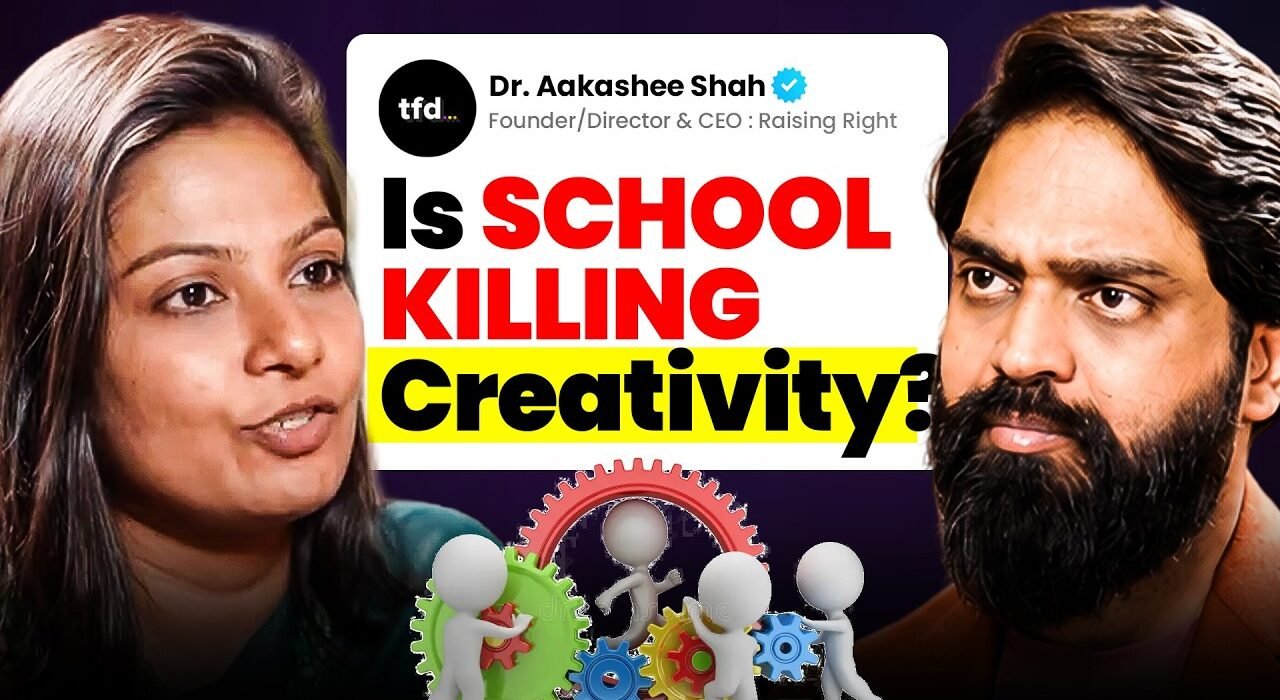
Most conversations about Indian education circle the same complaint — too many exams, too little real learning. This Dr. Aakashee Shah interview on The Founder’s Dream goes a step further and asks what a school would look like if marks were the least important thing happening inside it. Host Abhishek Vyas sits down with Dr. Shah, founder of Raising Right, to unpack why she moved to Singapore to homeschool her daughter, and what she brought back to build a school in Mumbai that looks nothing like the ones most Indian parents grew up with. It’s as much the Raising Right founder story as it is a conversation about Indian education.
The Dr. Aakashee Shah Interview Starts With a Move to Singapore
Dr. Shah didn’t go abroad for a job or a visa — she went for her daughter’s education. She says she had deep problems with the schooling system and curriculum in India, and that the National Education Policy hadn’t even been applied yet at the time. Singapore made practical sense too: three or four hours of flying time, not the distance of the US, with an ecosystem built for early childhood learning that she wasn’t finding at home.
Her homeschooling in Singapore stretched four and a half years, letting her daughter learn at her own pace instead of a classroom’s fixed pace. If a concept took three lectures in a regular school, home-based learning let her compress it to half an hour when it clicked fast, or stretch it to a week of revision when it didn’t. The one gap she didn’t expect was social — her daughter missed the everyday mingling that comes from a room full of other children, which eventually became part of why Dr. Shah rethought her model after returning to India.
Why Raising Right Caps Every Batch at 15 Children
The single detail every parent mentions first about Raising Right, according to Dr. Shah, is the batch size. No class has more than 15 children, regardless of how the school grows.
If you ask any parent randomly, the first thing they’ll tell you is that Raising Right never takes more than 15 children in a batch.
This isn’t a marketing line — it’s central to the Raising Right business model, and she’s turned away the maths that most schools run on. Raising Right sits on a waitlist of 150-200 families every year, yet in four years no single batch has gone from 15 to 16, even when parents have offered to adjust fees for an extra seat. Her reasoning is blunt: two extra children compromise the attention the other 15 get. The school instead multiplies sections — more divisions, more teachers — rather than stretching any one room. She points to what she saw abroad as proof it scales:
I had already seen it in Singapore — if a system there can run with two hundred children done well, why can’t we do the same here?
Experiential Learning, Room by Room
Raising Right doesn’t run as one classroom with one teacher lecturing from 8 am to 2 pm. Children move between dedicated spaces — a proper dance studio with dim lighting, a music room with individual instruments for each child, a garden where math sometimes happens outdoors, and a carpentry corner. Dr. Shah says the aim is for children to feel like they’re in their own space, not sitting through a fixed timetable:
Our children go out and say, we don’t go to school to study, we go to spend our time there.
For younger grades, subjects like textile work start as something as simple as holding a plastic needle, with complexity building year over year — this year’s learning becomes next year’s base before new material is added. This is close in spirit to what Bharath Goyal discusses in his interview on fixing India’s coaching culture trap — the idea that pressure-free doesn’t mean content-free, it means pacing content to the child rather than the clock.
Survival Skills Indian Schools Skip
One of the sharper arguments in this Dr. Aakashee Shah interview is about what parents assume their children already know. Raising Right has a separate room for culinary skills, where children cook lasagna, pasta, tadka and chapati. Her point is that Indian households often outsource repair and domestic work — a call to an app brings a plumber, house help manages the kitchen — so children grow up never learning tasks they’ll eventually need themselves, even if they study abroad.
We think we’ll send our children abroad, give them the best education — but the first thing they’ll need to do there is cook their own chapati. Nobody teaches that survival skill.
She extends this to financial literacy. Her own teachers, she says, don’t know how SIPs work, what percentage returns to expect, or how GST and income tax function — knowledge people will use their entire lives, unlike some of what’s memorized for poetry exams. Communication is treated the same way: taught from preschool, not as an afterthought, because she’s noticed children today struggle with ordinary back-and-forth conversation that her own generation managed without thinking.
Where Academic Pressure Actually Comes From
Dr. Shah is direct about who creates academic pressure on children — and it isn’t always the school. She describes parents turning homes into a second school, assigning homework and drilling children on handwriting repetition even when a three- or four-year-old is visibly bored of it. Her advice to her own teachers and to parents is blunt: stop sending homework home, stop teaching curriculum at home, let children rest in their own space.
Please don’t make them do homework, don’t teach at home. If you keep adding this extra pressure, you end up teaching your child to lie to you instead.
She’s seen parents write worksheets themselves and send them in pretending the child completed them — which only teaches the child that a convincing lie beats an honest “I didn’t finish.” Her broader argument is that children learn by watching their parents, not by being told what to do; a child won’t choose salad because you lectured them about it, but might if that’s what they consistently see at home. This echoes a theme Chitra Garg explores in her conversation on career, language and motherhood — that what parents model matters more than what they instruct.
Boards, Languages and What Should Change
Raising Right is CBSE-affiliated, and Dr. Shah is upfront that she isn’t trying to reinvent the exam system itself. She estimates the combined CBSE-IGCSE framework covers about 70% of what’s taught, with Raising Right adding roughly 30% on top — covering gaps like India’s Emergency period being left out of standard history textbooks, or practical language and skill sessions layered around the mandated syllabus. She keeps the board affiliation because students eventually need a certified 10th-grade result to pursue college, whatever subject they choose after.
On language, her position is simple: the more a child learns early, the stronger their vocabulary and cognitive development, pointing to Singapore where children casually spoke six or seven languages. She’s also seen Indian regional languages thrive abroad in unexpected ways — in Singapore’s Little India, everyday market conversations happen in Hindi, something she says gets taken for granted inside India itself, a disconnect also raised in Soupal Roy’s interview on fixing India’s study-abroad confusion.
Asked what India’s system needs most, her answer is a balanced curriculum — one that teaches nationally and globally relevant content alongside real skill-building, rather than leaving parents stuck choosing a board based on fear of what their child might miss out on.
What This Means If You’re a Parent or an Educator
The practical takeaways from this episode aren’t abstract — they’re things any parent or school can act on without waiting for policy change.
- Let children learn at their own pace rather than a fixed classroom speed — revisit a concept for a week if needed, or move faster if it clicks quickly.
- Treat cooking, repair work and basic household tasks as skills to teach early, not things that sort themselves out later.
- Introduce financial literacy — SIPs, tax basics, how money grows — well before adulthood forces the lesson.
- Stop replicating school at home; let rest time stay rest time.
- Model the behaviour you want instead of only instructing it.
Dr. Shah closes with a set of quick either-or answers that sum up her philosophy — curiosity over marks, freedom over discipline, experience over knowledge, a child’s choice over a parent’s expectation until at least the seventh or eighth grade, after which she believes collaboration with parents becomes necessary because real-world decisions like affordability start to matter.
This episode is a reminder that an indian business podcast conversation about education can stay grounded in specifics — batch sizes, curriculum percentages, actual classroom layouts — rather than vague calls for “better schools.” Watch the full conversation with host Abhishek Vyas on The Founder’s Dream YouTube channel and subscribe for new founder interviews every week.
Frequently asked questions
Who is Dr. Aakashee Shah?
Dr. Aakashee Shah is an educator, early learning innovator and the founder of Raising Right, a school built on experiential learning and life skills after she homeschooled her daughter in Singapore for about four and a half years.
Why did Dr. Aakashee Shah choose Singapore for homeschooling?
She found Singapore’s ecosystem, resources and scope for early childhood education far ahead of India’s curriculum at the time, and it was logistically closer than places like the US.
Why does Raising Right limit batches to 15 children?
She says quality drops the moment a class grows beyond a set number of children, so even with a 150-200 strong waitlist every year, no single batch has crossed 15 students in four years.
What life skills does Raising Right teach besides academics?
The school has a dedicated culinary room for cooking, teaches carpentry and basic repair work, and runs sessions on communication, financial literacy and multiple languages alongside the regular CBSE-aligned curriculum.
Does Raising Right follow a government board?
Yes, the school is CBSE affiliated because students eventually need a recognised board certificate to pursue further education, but Dr. Shah says roughly 30% of the curriculum is added on top of the mandated syllabus.