
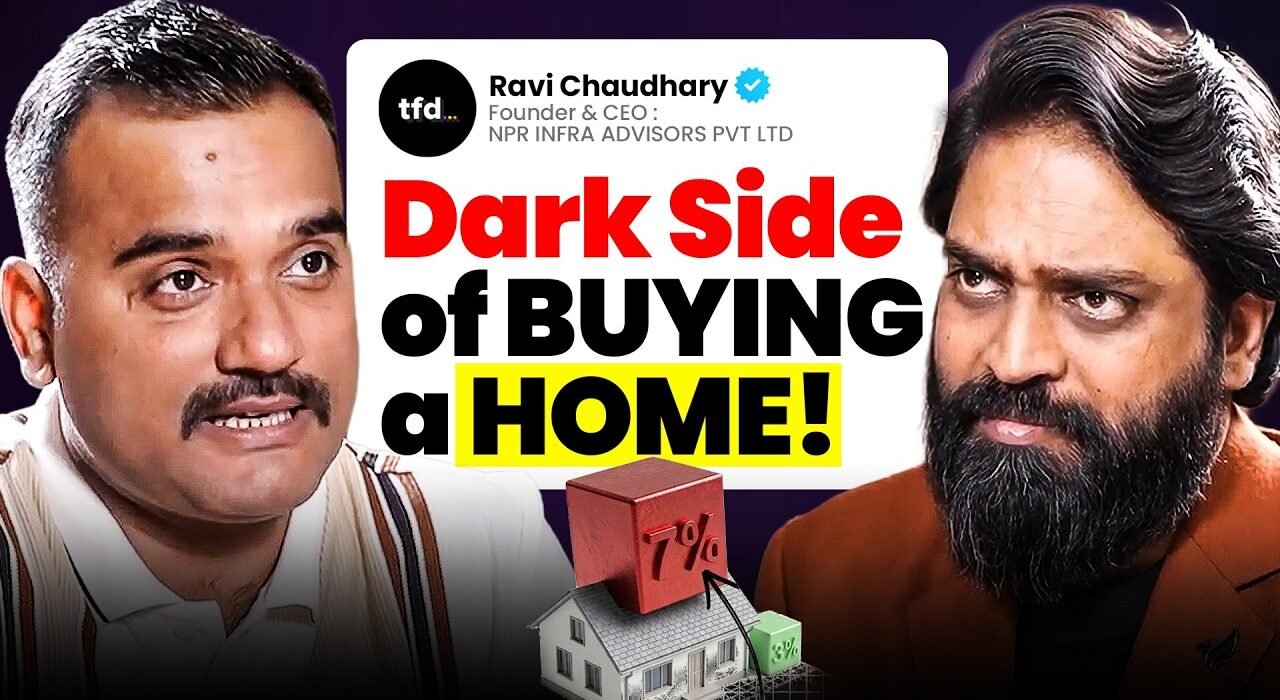
Most people who enter real estate sales in Delhi NCR start with a desk, a phone list and some capital. Ravi Chaudhary started with Rs 1,300 in his pocket, a bag that got stolen on day one, and a mentor who bought him new clothes. His conversation with host Abhishek Vyas on The Founder’s Dream — a founder podcast and business podcast India listeners turn to for real talk from entrepreneurs — is an entrepreneur success story India real estate watchers will find unusually honest — not about how great apartments are, but about why so many of them aren’t worth buying.
Chaudhary is the founder of NPR Infra Advisors and R2B Infra, two channel partner firms operating out of Noida and Gurgaon respectively. Across the episode he walks through what channel partners actually do, why developers miss possession dates, why Noida’s middle class is getting priced out, and why he personally would rather own land than an apartment.
From Rs 1,300 to Two Companies: An Entrepreneur Success Story India Real Estate Needed
Chaudhary entered the industry in 2014, right after finishing his studies, in Gurgaon. He didn’t walk in as a broker in the traditional sense — he started as what the industry calls a “catcher,” someone who physically approaches people in the market to pull in clients.
“It wasn’t zero, but I started with Rs 1,300 — that’s where the career began. My father had given me some money and some clothes when I left with an uncle. But on the very first day, my bag was stolen. The money was gone, the clothes were gone. But the person who brought me there, whom I consider my first guru, helped me — he got me new clothes and a place to stay.”
Within the first month he was selling. Over the next five years with that same company, he moved from catcher to marketing head, watching the team grow from 14-15 people to over 100. That run taught him the foundations he later built NPR Infra Advisors on, and subsequently R2B Infra as a separate venture for the Gurgaon market, run with two other partners under a deliberately fresh name so as not to mix the legacy of NPR with new ambitions.
What a Real Estate Channel Partner Actually Does
A channel partner, in Chaudhary’s description, is the bridge between a developer and a buyer — and the job goes well beyond selling units. Developers who try to handle sales and marketing themselves, he argues, usually end up weakening execution because focus gets split.
- Guiding developers on amenities, location and project design before launch
- Marketing and sales to the right buyer segments
- Documentation support and financing or loan assistance
- After-sales service, including resale and exit support
He points out that a buyer evaluating multiple channel partners offering the same flat should look past the name and marketing. Chaudhary offers clients a 45-day resale commitment and an in-house legal team that checks builder-buyer agreements line by line — he gave an example of a client who lost nearly 15% in a villa deal because a single word, “bare shell,” changed what the final product would actually include.
“A channel partner isn’t just a name — names can be built with marketing at today’s rates. What you need to check is how strong that developer’s grip is on the project, and whether the channel partner is only handing you sales, or after-sales service too.”
Why Developers Delay Possession — And It’s Not Always Bad Intent
Abhishek Vyas pressed Chaudhary on a blunt question: is there any developer in India who has ever delivered possession exactly on the promised date? Chaudhary didn’t defend the industry outright, but he refused to paint every delay as dishonesty.
“It’s not only that developers are bad or have bad intentions. Many developers never wanted this outcome either. But sometimes unforeseen circumstances happen — government or authority schemes offer such lucrative terms that people who don’t have the capability to become developers try anyway. And some developers cut prices so low chasing competition that building at that price was never possible in the first place.”
This is partly why RERA came into existence, according to Chaudhary — he traces its introduction in 2016 directly to the Noida market, where defaults became so common around 2013 that the government had to step in. He now works mostly with developers whose track record and intent he has already vetted, often entering projects at the pre-launch stage where early buyers get better pricing and easier exit windows. Readers who want a longer look at how trust gets built between NCR buyers and developers may also find value in Ram Kumar’s entrepreneur success story India real estate audiences have followed closely, which covers similar ground from a different vantage point.
Noida vs Gurgaon: Why the Middle Class Can No Longer Afford a Fresh Apartment
Chaudhary is direct about who gets squeezed out of today’s Noida market. New apartments now start between Rs 25,000 and Rs 30,000 per square foot, with minimum sizes around 1,500-1,600 square feet — pushing total cost past Rs 3-3.5 crore before anyone talks about registration or interiors.
“I think people earning a lakh, 1.5 lakh, or 2 lakh a month probably cannot buy a fresh apartment in a city like Noida today. In India, that salary bracket is usually seen as comfortably upper-middle class — but they still can’t afford an apartment, let alone land for a villa.”
He ran the math live: an 80% loan on a Rs 3.5 crore apartment means a Rs 3 crore loan, which translates to an EMI of around Rs 6.5 lakh a month — simply not workable for most salaried buyers. He also noted that developers have largely stopped building 2-BHK units in Noida because requirement sizes have grown and the construction economics no longer work at that scale. This affordability gap, he says, is the single biggest reason buyers are now looking an hour to ninety minutes outside the city, where the same budget buys either a much larger apartment or, in some cases, actual land.
Plots vs Apartments: The “Lord and Landlord” Argument
This is where Chaudhary gets most pointed. He argues that apartment buyers in Delhi NCR have convinced themselves they own something permanent, when in fact they own neither the roof nor the land beneath it.
“To be frank, in Delhi NCR we’ve all gotten locked into boxes. We think we’ve bought a great apartment, but what you’ve actually bought is something where neither the roof is yours, nor the land. You’re a shared-community resident forever. You own the home and yet you feel like a tenant.”
He contrasts this with the old idea of property that a grandfather buys and a grandson inherits — a trend he says disappeared for 10-15 years but is now returning post-Covid as buyers rethink what ownership actually means. In his rapid-fire answers at the end of the episode, he was unambiguous: rent over EMI, capital appreciation over cash flow, location over price, practicality over luxury, and plot over apartment, with no hesitation.
“Someone once said there are only two lords in this world — the Lord, and the landlord. If you want to be a landlord, you need to buy land. That’s where you earn not just a good return, but a long-term one.”
The Delhi-Dehradun Expressway and the Rise of Second Homes
Chaudhary’s current project, under the name Elexir Prana, sits near Ganeshpur at the start of the Delhi-Dehradun Economic Corridor, inaugurated in 2026, which cuts travel time between the two capitals from six hours to roughly two and a half. He picked the site deliberately: it borders Rajaji National Park, sits next to a river, and connects directly off the expressway — meaning the air quality, in his view, has a structural reason never to deteriorate the way Delhi’s has.
The project targets 62 acres with only 280 families, plot sizes starting at 500 square yards for most buyers and a smaller early-bird segment at 272 square yards — a deliberate contrast to the dense 2,200-family societies common in NCR high-rises. Chaudhary frames this as part of a broader shift: post-Covid demand for second home investments and out-of-station property has, in his words, seen a “drastic hike” rather than the slump many expected, with roughly 90% of that new demand going toward properties outside Tier-1 cities. For readers tracking this same shift toward weekend and second homes, Manav Kakkar’s farmhouse story on The Founder’s Dream covers a parallel bet on land outside the city.
He also sees a wellness angle shaping the next decade of real estate, pointing to the idea that people spend roughly 95% of their lives indoors and lose years off their health because of it — which is why NPR Infra Advisors and R2B Infra are oriented toward projects built around open space, water bodies and genuine connectivity rather than just unit count.
What This Means If You’re Buying in NCR
- Check a channel partner’s after-sales commitments, not just their sales pitch
- Read the builder-buyer agreement for terms like “bare shell” before comparing prices across partners
- Factor in EMI reality — a 3.5 crore apartment can mean a 6.5 lakh monthly EMI on an 80% loan
- Weigh land ownership against shared-community apartment ownership for long-term, generational value
- Track infrastructure corridors like Delhi-Dehradun early, before developer pricing catches up
Chaudhary closes the episode with a message aimed squarely at parents who discourage daughters from joining real estate, noting that the industry today includes many women running their own channel partner businesses from scratch. It’s a fitting note for an episode that is, underneath the market talk, still about one person betting on himself with Rs 1,300 and very little else.
Watch the full conversation with host Abhishek Vyas on The Founder’s Dream YouTube channel and subscribe for new founder interviews every week.
Frequently asked questions
How did Ravi Chaudhary start his real estate career?
He started in 2014 in Gurgaon with Rs 1,300 in his pocket, working as a catcher who approached clients on the road before learning sales under a mentor and eventually becoming marketing head of that company.
What does a real estate channel partner actually do?
A channel partner bridges the developer and the buyer, guiding project design, handling marketing and sales, managing documentation and financing support, and in Ravi Chaudhary’s case, committing to resale assistance within 45 days.
Why do developers in India often delay possession?
Ravi Chaudhary explains that while some developers act in bad faith, many delays happen because unqualified players enter as developers during government incentive phases, or because unrealistic pricing to beat competition makes timely construction impossible.
Why are Noida and Gurgaon apartments becoming unaffordable for the middle class?
New apartments are starting at Rs 25,000 to 30,000 per square foot with minimum sizes of 1,500 to 1,600 square feet, pushing total costs above Rs 3 to 3.5 crore, which even households earning Rs 1 to 2 lakh a month struggle to finance.
Is a plot a better investment than an apartment in India?
Ravi Chaudhary prefers plots because, unlike apartments where buyers share land and structure with a large community, land ownership can be passed down across generations, which he says is the real meaning of owning property.

1 Comment