
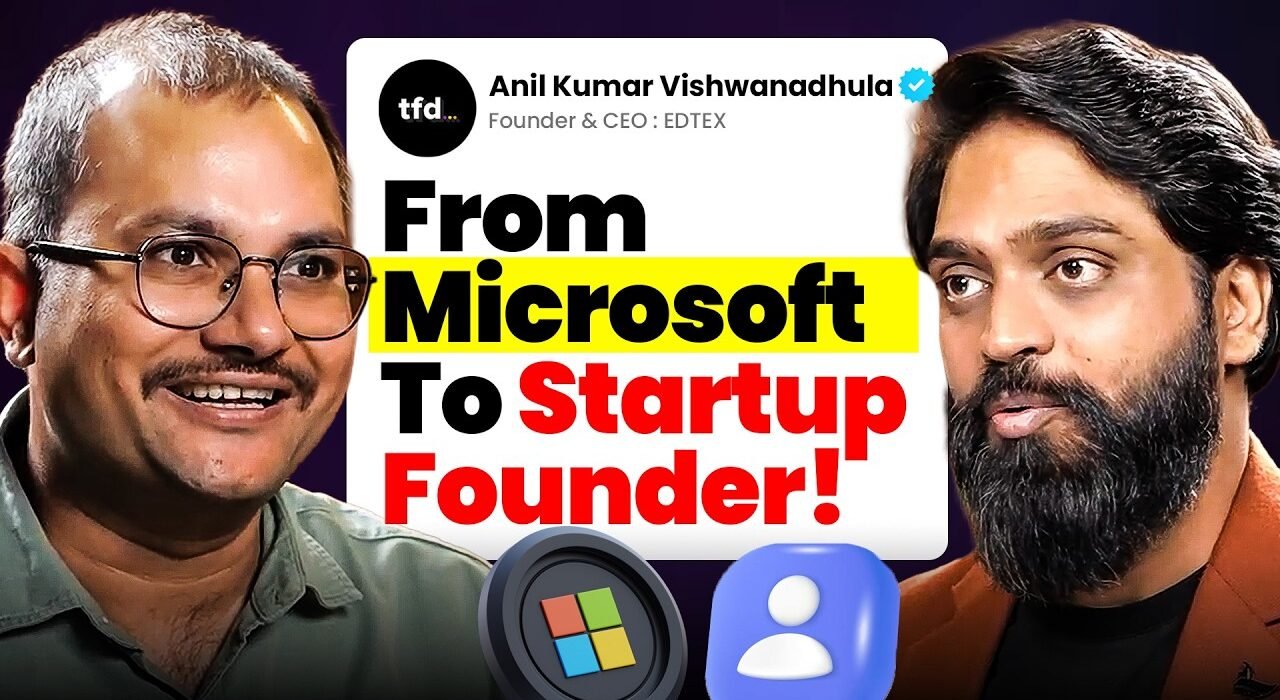
Leaving a steady paycheck at Yahoo or Microsoft to bet on an idea nobody has validated yet is the kind of decision most people talk themselves out of. Anil Kumar Vishwanadhula did it twice, failed at two ventures in between, and still built EdTechs into a company that now runs placement operations for 40 premier Indian B-schools. On a recent episode of The Founder’s Dream podcast, host Abhishek Vyas sat down with him for an Anil Kumar Vishwanadhula interview to unpack exactly what that road looked like — and the result is as much an entrepreneur success story India can relate to as it is a cautionary tale about timing, money, and patience. This EdTechs founder story is worth hearing in full, because the company almost didn’t happen the way it eventually did.
An Entrepreneur Success Story India Can Actually Learn From
Anil’s path was not linear. He joined Yahoo as a software engineer in 2009 after campus placement from IIT Guwahati, spent three years there, and then quit in 2012 to pursue an MBA at IIM Ahmedabad. In between, in 2011, while still at Yahoo, he started eBata — an online Telugu music platform built on a custom search engine that let users find combinations like a specific music director paired with a specific film director.
The idea was sound, but music licensing proved too complicated and expensive for a solo founder to navigate. He kept pursuing it even during his MBA years, but eventually had to let it go. His own read on why it did not work is blunt:
“To be honest, maybe I think for the first time entrepreneurs they need some backing… I think that was what was missing I felt. So if somebody would have backed, right, I mean maybe I’m like single founder and all of that, right, I think maybe some backing was missing for me to really kind of pursue that further.”
After IIM Ahmedabad, he joined Microsoft — a decision he now describes as a way to buy time and reassure his family rather than a real change of heart. Six months in, he knew it was not for him, but it took him longer to actually quit.
Why He Left Yahoo in the First Place
Two things pushed him out of a comfortable corporate job. First, boredom — the challenges at a company as large as Yahoo stopped feeling big enough. Second, watching Yahoo’s own young CEO, who had an MBA, made him wonder if business school was the shortcut to bigger responsibility. Both reasons sound ordinary, but they explain why he chose IIM Ahmedabad over staying in a safe seat.
Winspire Magazine and the Lesson in Founder-Market Fit
Between Microsoft and EdTechs, Anil ran two ventures in parallel, unsure which would work: EdTechs and something called Winspire Magazine, a print publication for high school students meant to widen their career imagination beyond becoming a doctor or an engineer. He personally traveled to nearly 300 schools and spoke to more than 50,000 students.
The response was genuinely good — students came back to him after talks, inspired. But the business itself was wrong for him, partly because of timing (readers were shifting to digital just as he launched a physical magazine) and partly because he lacked real expertise in publishing. After his marriage, he took a deliberate break to introspect and made a call: this was not the venture to bet his future on.
How Anil Kumar Vishwanadhula Built EdTechs: From a Favor to IIM Indore to 40 Clients
EdTechs did not start as a grand plan. While still deciding whether to leave Microsoft, Anil got a call from his alma mater, IIM Indore, which was struggling with its course bidding system. He had been a student IT secretary there years earlier, building systems for the student council, and someone remembered that. He built the system, and IIM Indore became EdTechs’ first customer.
He gave himself a hard deadline — three months to make it work, or go back to a job. It worked: by the second quarter, the business was profitable. From there it expanded to IIM Calcutta, IIM Bangalore, IIM Lucknow, IIM Kozhikode, ISB, and XLRI. Today EdTechs builds placement automation, course bidding, timetabling, and admission automation systems, and Anil says the company serves nine of India’s top 10 business schools and 80% of the top 20.
What makes the EdTechs business model hard to replace, in his view, is not the code but the accumulated domain knowledge — the ability to tell an institution what to build, not just how to build it. He mentioned that EdTechs now also works with SDA Bocconi in Milan on designing their bidding process from scratch, and that EdTechs has grown without raising any outside funding.
Education Loans and the Real Cost of the Entrepreneurial Leap
A theme Abhishek Vyas pushed on directly was money — specifically, how someone carrying an education loan from an MBA justifies the risk of entrepreneurship. Anil’s answer was not a clever financial hack; it was about sequencing life decisions.
“I think you should take up entrepreneurship when your cost of survival is as low as possible. When your cost of survival is low, you can take risk. And when you are young, it is better because the kind of energy required to be successful as an entrepreneur is very high.”
He pointed out that a loan looks manageable compared to what comes later — marriage, children, bigger fixed costs. Mentors like Sunil Handa from the IIM ecosystem encouraged him to take the leap anyway, and public sector bank moratoriums gave him some breathing room. The underlying message: delay entrepreneurship and the obligations only compound.
How COVID-19 Turned Years of Groundwork Into Growth
For years before the pandemic, onboarding a new client took EdTechs nearly two years of manual relationship-building and trust. COVID changed that overnight, because institutions suddenly had no way to run placements without an automation system.
“In our case, we have not lost a single deal during the COVID. In fact, our revenue grew by 120% during the COVID time.”
Onboarding that used to take two years happened in two weeks because institutions had no alternative. EdTechs ran some of the first virtual placement drives in the country — starting at IIT Bombay, then IIM Kozhikode, IIM Lucknow, XLRI, IIM Bangalore, and ISB — coordinating situations where up to 2,000 recruiter panelists, 900 students, and 600 student volunteers needed to be scheduled and tracked in real time through a single system.
AI, SaaS, and Advice for Aspiring Founders
Asked directly about AI undercutting SaaS pricing — the host gave the example of custom CRMs now being built for a fraction of what tools like Salesforce charge — Anil did not dismiss the threat. He agreed disruption is coming for standard, replicable software. His bet is that EdTechs survives by staying in the complex, domain-heavy end of the market rather than competing on commodity features.
His reading list for anyone weighing a similar jump is specific: Think and Grow Rich for building what he calls the entrepreneurial mindset, Zero to One by Peter Thiel for picking a problem few others can solve, and The Lean Startup for not wasting months building what the market never asked for. On mindset specifically, he was direct:
“Entrepreneurial mindset is very different from a job mindset. Entrepreneur mindset is like taking ownership, you know, facing the challenges, not quitting too early and all of that.”
He also pushed back on the idea that failure is fatal to a career in India today, which is part of why this counts as an entrepreneur success story India’s younger founders should sit with rather than skim past.
“Today it’s a very different game. Even if you fail as an entrepreneur, you are most welcome for any job, etc. So people should start early… try to start early. Don’t delay it.”
Key Takeaways for Anyone Considering the Jump
- Lower your fixed costs before you leap — survival cost, not savings, decides how much risk you can absorb.
- A failed first venture (or second, in Anil’s case) is not disqualifying — eBata and Winspire Magazine both shaped what eventually became EdTechs.
- Founder-market fit matters as much as market size — Winspire had real demand but was not where Anil’s expertise lived.
- Give an idea a genuine window (Anil used three months, then stretched to years) before judging it, but set that window in advance.
- Build for problems that require deep domain knowledge, not just code — that is what protects a business as AI compresses software costs.
For more conversations like this one, the entrepreneurial journey stories on The Founder’s Dream cover founders across very different industries making the same kinds of hard calls Anil did. Watch the full conversation with host Abhishek Vyas on The Founder’s Dream YouTube channel and subscribe for new founder interviews every week.
Frequently asked questions
Who is Anil Kumar Vishwanadhula?
He is an IIT Guwahati and IIM Ahmedabad alumnus who worked at Yahoo and Microsoft before founding EdTechs, a SaaS company that builds academic and placement automation systems for premier Indian B-schools.
What is EdTechs known for?
EdTechs builds complex automation systems such as course bidding, timetabling, admission automation, and placement operations software used by institutions including IIM Ahmedabad, IIM Bangalore, IIM Calcutta, IIT Bombay, ISB, and XLRI.
Did Anil Kumar Vishwanadhula raise funding for EdTechs?
No, he confirmed on the podcast that EdTechs has not raised any outside funding and has grown as a bootstrapped company.
How did COVID-19 affect EdTechs?
Anil said the company did not lose a single deal during COVID and its revenue grew by 120% as institutions urgently needed automation systems to run virtual placements.
What books does Anil Kumar Vishwanadhula recommend to new entrepreneurs?
He credits Think and Grow Rich for building an entrepreneurial mindset, Zero to One by Peter Thiel for picking the right problem, and The Lean Startup for execution.
1 Comment