
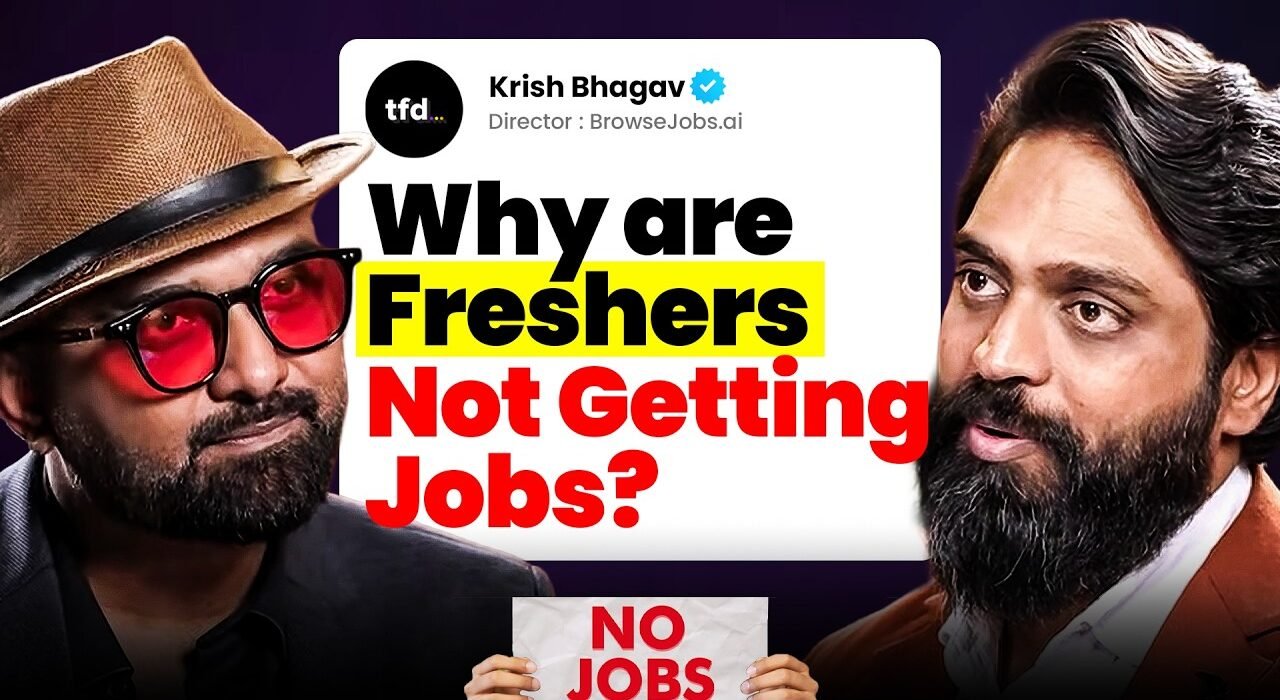
An HR recruiter earning a monthly salary of 18,000 rupees takes a payment of around 1 lakh rupees to push one resume forward. The candidate never gets a callback and spends months blaming their own resume, their own interview skills, their own luck. This is the opening claim in the Dr. Krish Bhagav interview with host Abhishek Vyas — the episode, Dr. Krish Bhagav on The Founder’s Dream, sets up everything else in the Dr. Krish Bhagav success story, from a 24-year corporate career in London to building an AI system that runs job interviews with zero human interference.
Dr. Krish Bhagav is a data science expert and the founder of BrowseJob AI, a platform built to challenge how hiring actually works in India. Before this, he spent over two decades in London’s corporate and banking world, building analytics systems for major banks and tech companies. What pulled him back into recruitment wasn’t a business plan — it was a personal loss that exposed just how broken India’s hiring system had become.
Dr. Krish Bhagav Success Story: From Banking in London to Building BrowseJob AI
Dr. Krish Bhagav lived in London for 24 years, working across banking analytics for clients that, by his account, included nearly every major global bank and tech company. He describes the decision to leave as driven less by opportunity and more by a slow realisation that the life didn’t fit him.
If you stay there more than a year, you get bored. The conveniences you get here — Swiggy, Zomato, ordering a blanket — none of that exists there. Snow is coming, rain is coming, you still have to go out and shop at Tesco yourself.
He eventually moved back to India to be near his mother. Six months later, she passed away during the second wave of COVID-19, after the Remdesivir dose he had arranged for her was reportedly diverted and sold to someone else. That loss, and the anger that followed, redirected his entire career.
While trying to process what happened, he met a mechanical engineer working as a ward boy on a salary of 8,000 rupees because he couldn’t find engineering work. Dr. Krish Bhagav helped him retrain and land a 16 lakh package as an engineer. He later onboarded members of the transgender community at a facility in Whitefield, Bengaluru, training and placing them as engineers too.
I only have one kind of knowledge, and I can share it with people. That became the only thing I wanted to do.
That single realisation — that skill gaps are often opportunity gaps, not talent gaps — is the real root of the BrowseJob AI founder story and the reason the company exists today.
The Resume Selling Racket Nobody Talks About
Dr. Krish Bhagav says the hiring websites India uses today are barely different from the ones that existed 24 years ago when he first left the country. The process looks the same, but underneath it, he claims, a quiet market in resumes and interview slots runs almost unchecked.
So many thousands and lakhs of children are going through this, and they think it’s their own mistake. It is not their mistake — their resume is being sold.
He describes this as a top-down arrangement where directors, hiring managers, HR staff, and sometimes even candidates are all aware of what’s happening. In one example he lays out, an HR person takes 1 lakh rupees to pass a resume along, an HR manager takes another 1 lakh to allocate an interviewer, and the interviewer themselves takes 1.5 lakh — with some interviews reduced to a candidate simply sitting in front of a camera for thirty minutes without being asked a single real question.
According to him, IT draws the most of this activity because of the money circulating in the sector — real estate purchases, disposable income, and high salaries all trace back to IT hiring, making it the most lucrative place for this kind of arrangement to exist. He says he tried to flag this within India without success, but after connecting with editors at the Wall Street Journal and getting the issue published, one company reportedly removed around a thousand employees within a week after internal checks.
How AI Interviews Catch Cheating Without Human Bias
This is where BrowseJob AI’s actual product comes in. The BrowseJob AI business model centers on removing humans entirely from early-stage screening: the platform’s AI, which Dr. Krish Bhagav named Torus, runs L1 and L2 interview rounds over a normal video call link — no recruiter, no interviewer, no human decision-maker in the loop at that stage.
You’ll be surprised how fine-tuned it already is. We’ve built in so much customization that you can design it however you need — tell it the candidate’s English should be strong, reduce the weight on technical skill, and it will focus mainly on communication.
He walks through the kind of cheating the system is built to catch: lip-sync mismatches where a candidate’s mouth movements don’t match the words being spoken because someone else is answering off-camera, and candidates secretly running software or scripts on a shared screen. The AI reportedly flags both, gives the candidate two warnings, and terminates the interview on a third attempt. It also tracks eye movement and camera focus to pick up on genuine nervousness versus scripted answers.
His reasoning for why cheating rarely pays off anyway is simple:
Even if someone cheats their way through the interview, how will they survive three months later on the job?
He estimates that out of ten people who get in through manipulated interviews, only about one in ten actually survives long-term, since real project work eventually exposes the gap in skill.
Why Engineers Still Can’t Find Jobs Despite Having a Degree
Dr. Krish Bhagav is direct about where he thinks the deeper problem sits — and it isn’t only corruption. Students from Tier 2, Tier 3, and Tier 4 cities, some of whom mortgage land or jewellery to pay for engineering degrees, come out with real skill but still can’t break through because of how few genuine openings exist relative to demand.
He points to a telling detail: engineers with five years of experience are sometimes offered salaries as low as 30,000–40,000 rupees, while data on IIT Bombay placements showed close to 40-50 percent of students not getting hired this year. Even a top-tier degree, he argues, is no longer a guarantee.
- Thousands of students assume non-response means their own resume or interview is weak
- Resumes are often never shortlisted because the slot is already informally filled
- Candidates rarely receive honest feedback from HR after interviews
- Even IIT and IIM graduates are seeing placement rates drop sharply
He also recounts a case of a school teacher from a village in Andhra Pradesh who paid a manager 4 lakh rupees to get placed in a software company, doing repetitive, low-skill monitoring work for three years at a 19 lakh package — until a client interview exposed that he had no real technical ability. That story, Dr. Krish Bhagav says, repeats itself constantly across the industry, not just at one company.
Will AI Replace Jobs? Recession, Automation, and What’s Safe
Asked directly whether a recession is coming, his answer was unambiguous.
Recession will come, one hundred percent. If you think jobs are going away, it’s the jobs of people who spend money that are at risk.
His logic: work that follows a fixed, repeatable process — accounting, finance analysis, CFA or ACCA-style roles, and coding to a given specification — is the most exposed to automation. Roles tied to physical trades like plumbing and carpentry are comparatively safer, he argues, simply because they depend on people with disposable income continuing to spend, and that spending itself is under pressure as mid-income earners struggle with EMIs on new flats.
On the flip side, he sees growth concentrated around data. With companies building data centers and recent budget announcements offering a 25-year tax exemption for data centers set up in India, he expects strong demand for big data engineers and AI engineers over the next three to five years — a shift already pushing up pay for roles that were previously underpaid, like civil engineers working on data center construction.
Lessons for Job Seekers and Founders
Dr. Krish Bhagav is blunt about guarantees in the placement industry: BrowseJob AI does not offer a 100 percent placement guarantee, and he’s had to correct his own sales team for promising one.
If anyone tells you they guarantee a job, run 100 kilometers away from them — because they’re lying.
His closing advice, after 24 years in this space, was less about tactics and more about mindset: focus on solving real problems around you rather than chasing money directly, because the chasing itself never ends in satisfaction. If founders and job seekers want to understand how guests like him end up on shows like this one, The Founder’s Dream covers more stories like this across its entrepreneurial journeys section, which is worth reading alongside this episode. It’s also a useful reference if you’re building your own founder story the way the BrowseJob AI founder story got built — through a willingness to publicly name a broken system, offer a working alternative, and the kind of self-growth that drives that decision.
Watch the full conversation with host Abhishek Vyas on The Founder’s Dream and subscribe for new founder interviews every week.
Frequently asked questions
What is BrowseJob AI?
BrowseJob AI is a recruitment platform founded by Dr. Krish Bhagav that uses an AI system called Torus to conduct L1 and L2 job interviews without any human recruiter involved, aiming to remove bias and corruption from hiring.
What did Dr. Krish Bhagav say about resume selling in India?
He said HR recruiters earning salaries as low as 18,000 rupees take payments of around 1 lakh rupees to push a candidate’s resume forward, while genuine applicants never get a response and wrongly assume it is their own fault.
Can AI interviews catch cheating like lip-syncing?
Yes, Dr. Krish Bhagav explained that the AI system detects lip-sync mismatches, unauthorized screen-sharing software, and even genuine nervousness by tracking eye movement and camera focus during online interviews.
Will AI replace jobs for software engineers and HR professionals?
Dr. Krish Bhagav said work that follows a fixed process, like coding to spec, accounting, or finance analysis, will get automated, while roles solving real, pinpointed problems and physical trades like plumbing remain safer.
Why do IIT and IIM graduates also struggle to get hired?
He cited that IIT Bombay reported close to 40-50 percent of its students did not get placed, showing that even top degrees no longer guarantee hiring without demonstrable practical skills.

1 Comment