
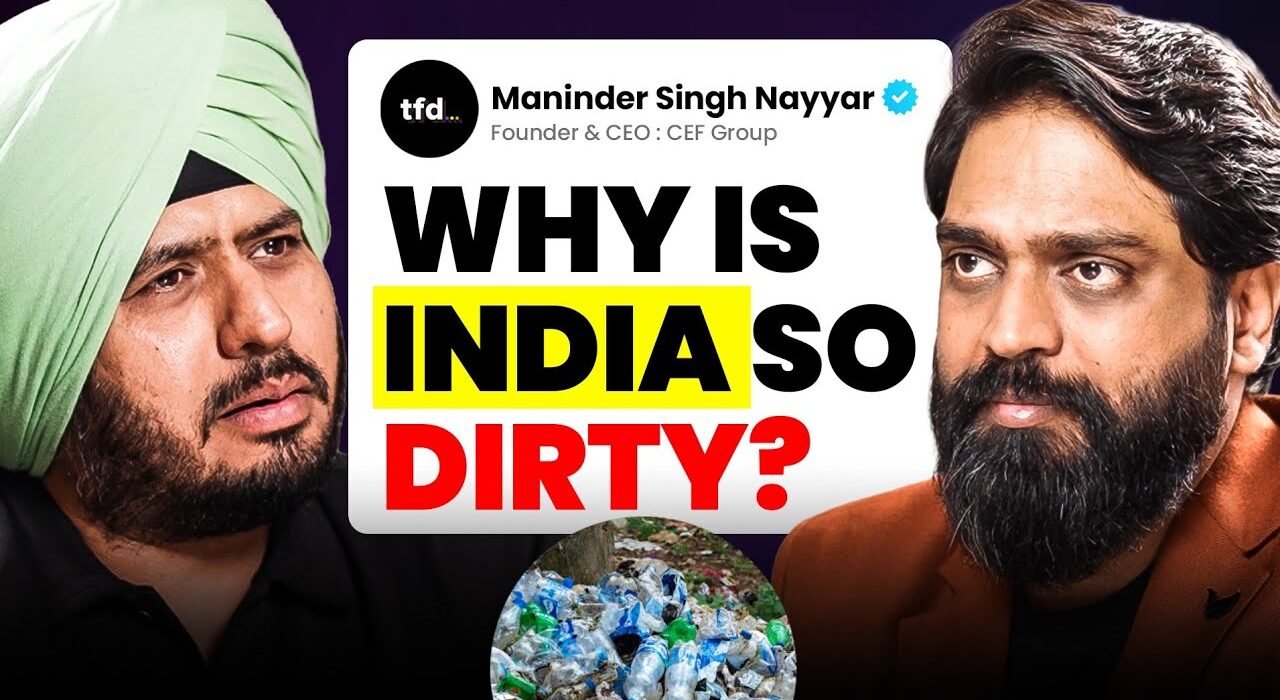
India loses close to $45 billion every year to poor waste management, according to Maninder Singh Nayyar of CEF Group, who joined host Abhishek Vyas on this Indian business podcast to unpack the real state of waste management in India and explain exactly where that money disappears. The conversation moves from overflowing landfills in Gurgaon and Delhi to why cancer cases have spiked near Okhla, and from failed incineration plants to a genuine business opportunity hiding inside India’s agricultural and organic waste.
The Real Cost of Poor Waste Management
Nayyar’s starting number is blunt: India loses almost $45 billion a year due to poor waste management. Part of that loss is simple bad budgeting — money allocated decades ago keeps getting spent on the same line items whether or not they’re still needed.
We are very good at making policies on paper, but we are equally bad when it comes to implementation. Fifty percent of the budgets spent on waste management infrastructure is essentially wasted spend today.
That gap between good intentions on paper and poor policy implementation on the ground is, in Nayyar’s telling, the single biggest reason India’s waste problem hasn’t been solved despite decades of rules and rulebooks.
The bigger cost, he argues, is behavioural. When an ecosystem stays dirty, people stop wanting to sit in it, invest in it, or spend time in it — and that quietly drags down how much money circulates through a city’s economy.
When we don’t want to experience the waste, the traffic, and the air pollution in our daily urban life, we stop stepping out. When that happens, the circulation of money stalls and the country ends up in a bigger fiscal deficit.
He extends the same logic to tourism. Recalling a trip to Paris years ago, he says foreigners were curious and warm about Indian culture until conversations turned to visiting — at which point cleanliness became the deal-breaker.
Someone told me Paris alone gets more tourists in a year than the entire country of India put together. We assume we’re getting huge tourist numbers and huge foreign currency inflow — that isn’t correct. We may be getting the bare minimum a country our size can get.
Why Indian Metros Keep Ranking Among the World’s Dirtiest Cities
Delhi alone generates around 11,000 tonnes of municipal solid waste every day; Gurgaon generates roughly 1,200 tonnes daily. Nayyar points out that seven of the ten worst-ranked cities globally for waste management systems are Indian cities — and metros like Delhi, Mumbai and Bengaluru are consistently the worst performers within the country itself.
He traces the failure to a rulebook written in 2000 that outlined two technologies: incineration and RDF composting. Incineration burns mixed waste at 1100°C to generate steam-powered electricity, but without expensive pollutant-control systems it releases sulphur and nitrogen oxides. As cities expanded, old dumpyards that used to sit outside town limits ended up surrounded by residential areas.
We are seeing this in Delhi. In Okhla, there are numerous cases of children nearby developing cancer rapidly, but nobody has actually done anything about it.
Public protests against low-quality incineration plants effectively killed that route after around 2011, leaving RDF composting as the only system cities kept using — with results Nayyar describes as a slow-motion failure.
The Segregation Problem Nobody Talks About
Waste segregation at source barely exists in Indian cities. Waste is collected mixed, run through mechanical drums called trommels at dumpyards, and technically labelled “wet” and “dry” — except neither label is accurate.
The wet waste that’s separated actually has 30-35% dry content in it, and the dry waste has 20-25% wet content mixed in. So the RDF that comes out is such poor quality that no cement factory or paper mill wants to buy it, and the compost has enough toxins in it that no farmer’s soil should touch it.
Because tenders are awarded on lowest-bid (L1) terms without specifying required technology, contractors have no incentive to process waste scientifically — they simply move it. Gurgaon has gone seven years without a single working waste-processing plant; Delhi’s municipal corporation, Nayyar says, still hasn’t found the 25 acres a proper plant needs and instead offers contractors 8-10 acre plots that can’t support viable operations.
There’s also a weighing scam built into the system: trucks are paid per tonne delivered to landfill, so a load weighed at 1,000 tonnes may only actually contain 500 tonnes of real waste — a number that would be exposed the moment a genuine processing plant with accurate scales came online, which Nayyar suggests is precisely why such plants keep getting stalled.
Turning Organic Waste Into CNG
Nayyar’s alternative path treats organic waste as a fuel resource rather than an electricity source, turning a linear dump-and-forget system into a working circular economy. Organic waste, when it decomposes, releases biogas — roughly 30-35% CO2 and 60-65% methane. Purify that biogas by removing the CO2 and what’s left is biomethane, chemically identical to the CNG used in vehicles.
As a country we import roughly ₹2 lakh crore worth of CNG. Our own capacity, through population and agriculture, is enough to produce ₹3 to 3.5 lakh crore worth of CNG right here in India — enough for our own use and enough to export the rest.
He began advocating this model to the government in 2014. A turning point came in 2017, when the Sri Lankan cricket team played a match at Ferozeshah Kotla wearing masks due to pollution, drawing coverage from outlets including the New York Times and Washington Post. NAFED subsequently floated a tender for technical waste solutions, which is when Nayyar’s team proposed the CNG-from-organic-waste route to then oil minister Dharmendra Pradhan.
The minister visited a running biogas plant in Germany along with then-IndianOil chairman Sanjiv Singh, and returned to launch what became the SATAT policy, later folded into the CGD (City Gas Distribution) policy — under which government oil companies purchase compressed biogas at a rate now linked to international gas prices, up from ₹46/kg at launch to around ₹80-85/kg today. The byproduct is organic fertiliser that can reduce reliance on chemical inputs, a small but real piece of the circular economy Nayyar is trying to build around India’s organic waste.
Ethanol vs CNG: A Warning About Rushed Policy
Host Abhishek Vyas pushed Nayyar on whether biogas could turn out like ethanol blending — a policy that looked good on paper but revealed problems later. Nayyar agrees the ethanol story is a cautionary tale, though for a different reason: India moved too fast without matching infrastructure.
Australia caps ethanol blending at E10. Japan is only at 2% blending and plans to reach E10 over the next fifteen years. We rushed in, and everyone jumped on ethanol because there was money to be made, grabbing limited raw material like molasses and broken rice until production ran into surplus.
With more ethanol produced than the market could absorb, it got blended into petrol faster than vehicle engines were adapted for it, denting engine efficiency. Natural gas, by contrast, is tested for purity with an analyser and can’t legally leave a plant below 96% methane — a built-in quality check ethanol blending never had. Nayyar believes that with the same subsidy push and pipeline investment given to ethanol, India’s roughly 200 CNG plants today could have been 1,000, generating rural jobs and cutting gas imports.
What This Indian Business Podcast Conversation Means for India’s Future
Nayyar’s clearest example of what works is Indore. An official who joined the city’s urban development team in 2016 mapped every collection point, built a control room tracking garbage trucks by route in real time, and created a complete blueprint before execution began.
They built a proper war room in Indore. If a truck deviated even slightly from its route, a red flag would show up. This isn’t rocket science — we’re living in the IT age.
The same official was later moved out of the department after political friction — a pattern Nayyar links to a deeper accountability gap across Indian civic administration.
There is no accountability in our system. If you’re a municipal commissioner, there’s no mapping of what good or bad work you did in your three-year or five-year term. Why would someone do good work unless they’re deeply patriotic?
He also points out that a city actually generates 16 distinct waste streams — plastics, textiles, horticulture waste, cow dung, cooking oil, construction debris, road-sweeping waste, abattoir waste, market waste, e-waste and more — while most municipalities still manage only three categories with roughly 97% inefficiency. His own company, CEF Group, still relies on government grants because segregation machinery has to be imported and wouldn’t pay back its cost otherwise; he notes India already gives among the lowest waste-management grants globally, compared with countries that offer $2 to $150 per ton in support.
For readers who want the fuller picture of how founders build commercially sustainable models around policy gaps like this, it’s worth browsing more entrepreneurial journey stories on The Founder’s Dream. Nayyar’s closing point is that citizens aren’t blameless either — carrying a reusable steel or copper bottle instead of buying plastic water, and pushing for plastic bans on hill stations, are small habits that matter, even as he admits city cleanup ultimately depends on top-down planning that mostly hasn’t arrived yet.
Watch the full conversation with host Abhishek Vyas and explore more episodes on The Founder’s Dream, and subscribe for new founder interviews every week.
Frequently asked questions
How much does poor waste management cost India every year?
According to Maninder Singh Nayyar, India loses close to $45 billion every year due to poor waste management, largely from wasted infrastructure budgets, lost tourism revenue, and slower economic circulation in dirty urban ecosystems.
Why is waste segregation at source such a big problem in India?
Most Indian cities never actually separate wet and dry waste; mechanical trommels used at dumpyards fail to properly separate the two, leaving so-called wet waste with 30-35% dry content, which makes the resulting compost and refuse-derived fuel too poor in quality to sell.
What is the SATAT or CGD policy discussed in the episode?
It is a government policy, first pushed after 2017, under which oil marketing companies buy compressed biogas made from organic waste as compressed natural gas for vehicles, turning agricultural and municipal organic waste into a fuel resource.
Why did Indore succeed in waste management when other cities didn't?
An official who joined Indore in 2016 mapped every collection point in the city, built a real-time control room to track garbage trucks by route, and created a full blueprint for the city’s waste system, which most Indian cities have never attempted.
Does India give subsidies for waste management like other countries?
Guest Maninder Singh Nayyar says developed nations give grants of roughly $2 to $150 per ton for waste management because it’s treated as a core city requirement, while India offers among the lowest such grants globally, making commercially viable models harder to build.

1 Comment