
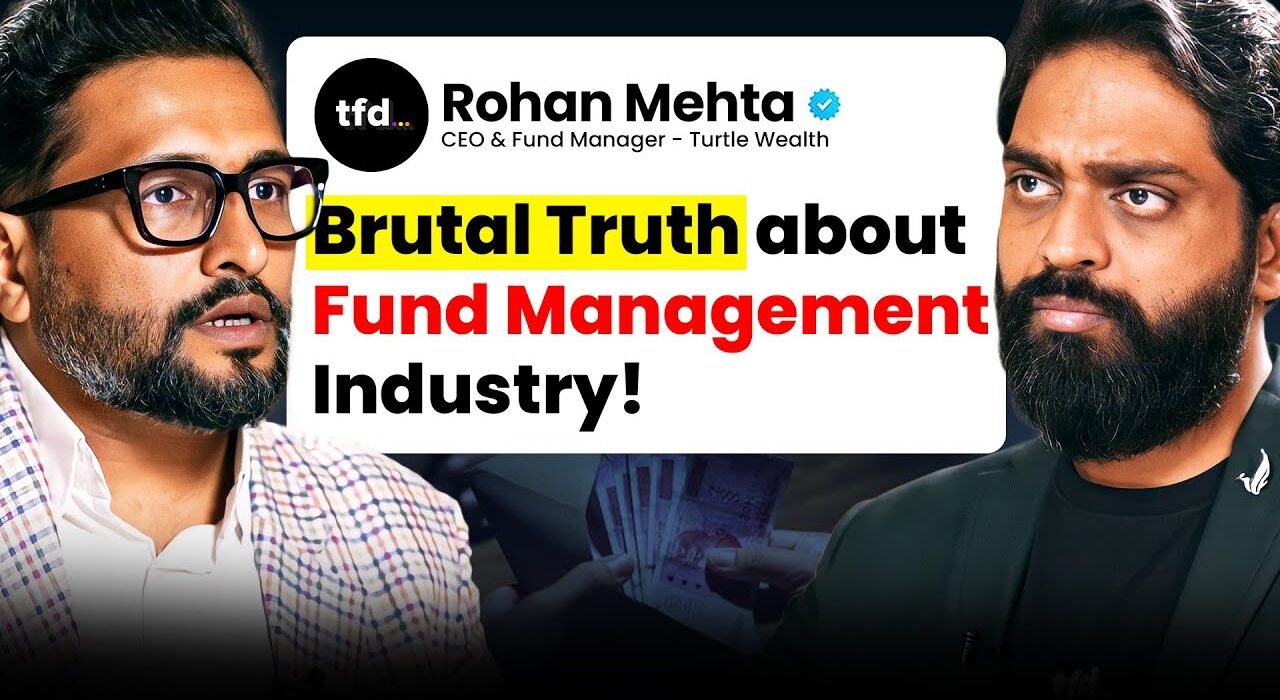
Most investing conversations rush to tips and stock names. This one, from a recent episode of The Founder’s Dream hosted by Abhishek Vyas, slows down instead — which is fitting, since the guest runs a firm named after one of the few animals that actually lives a long time. On this Indian business podcast, Rohan Mehta, founder of Turtle Wealth, talks through what a fund manager’s job really is, why India’s regulatory system changed everything, and why the people who make the most money are often the ones who simply forgot they had invested.
Why Turtle, Not Tortoise: The Thinking Behind Turtle Wealth
Rohan opens by correcting a common mix-up. People assume turtle and tortoise mean the same thing, but he says they don’t:
Tortoise is slow and steady. Turtle is fast and reliable. A turtle can live in water, land and snow, while a tortoise mostly stays on land — so we are not slow and steady, we are fast and reliable.
There’s more to the name than biology. In Feng Shui, the turtle is treated as a symbol of wealth and luck. Rohan also points to the animal’s shell as a metaphor for the firm: strong and protective on the outside, representing firm principles, but soft underneath — meaning the organisation stays open to change. It’s a small detail, but it sets up the rest of the conversation well: this is a firm built on structure, not impulse.
What Does a Fund Manager Actually Do? Insights from an Indian Business Podcast
Abhishek asks the obvious question early: if someone is already earning crores from their own business, why do they need a fund manager at all? Rohan’s answer is simple — at some point, a successful business owner wants to diversify wealth beyond the business itself, and that requires someone whose full-time job is finding new opportunities and investing according to the client’s risk appetite and goals, whether that means equities, FDs, bonds, or gold.
He uses Covid as an example: plenty of business owners realised too late that pulling some money out earlier would have protected them. That’s the gap a fund manager is meant to fill — matching the right asset to the right risk level, continuously, not just once.
From Harshad Mehta’s Era to SEBI-Regulated Fund Management Today
When Abhishek brings up Harshad Mehta as, in a loose sense, a fund manager of his time, Rohan agrees — but draws a sharp line between then and now. Becoming a fund manager today means clearing serious regulatory hurdles under SEBI regulation: a SEBI license, a clean legal record, adequate capital, and a qualified team. SEBI decides whether a PMS or fund management license is granted at all, and even after approval, a fund manager only controls buy/sell decisions — not the client’s money or assets directly, since those sit in separate, regulated structures.
I can tell you that if a firm is SEBI-registered in India, it cannot run away with your money even if it wanted to — the market can go up or down, but fraud from a SEBI-regulated entity is close to impossible.
This regulatory framework is a recurring theme through the episode, and it’s part of why this particular Indian business podcast conversation is useful for anyone evaluating where to park serious money — not just in equities, but across any regulated investment vehicle.
The Vijay Mallya Lesson: Greed Doesn’t Stop at a Number
Asked directly about Vijay Mallya’s bankruptcy despite having access to fund managers and resources, Rohan is careful to say he isn’t speaking as an expert on the specifics, but he offers a broader pattern he’s observed repeatedly:
Greed is something that has no end. As people get closer to a goal, the goalpost itself keeps shifting — someone says they want 100 crore at 50, then as they get close, it becomes 1000 crore, and once that’s not practically possible anymore, they start looking for shortcuts.
He brings in Charlie Munger’s line about leverage, ladies, and liquor being the three killers of a man, arguing that leverage is usually where the damage starts — people try to compress a ten-year goal into two years because they want to prove something. In his reading of the Mallya case, ambitions were overly aggressive, debt management went wrong, and the timing — India’s financial environment at the time — didn’t help either.
Why Patience Beats Speed in Long-Term Investing
This is where the episode gets most practical. Rohan’s core argument: the real question isn’t where you can earn the most, it’s where you can stay invested the longest.
The point is that the longer you stay invested, the higher your probability of earning more. There’s no guarantee you will earn — but the probability is there.
He backs this with a compounding example: at 25% CAGR, money triples in five years but multiplies ten times over ten years — the gains aren’t linear, they compound. The catch, he says, is that people expect a doubling every single year, which isn’t realistic; some years go down, some go up, and the discipline is in staying through both.
To illustrate, he shares two family examples. His father bought shares of Aarti Organics in 1992 for roughly ₹1,000, and by 2018-19 the family discovered that investment had grown roughly 200 times over — not because of a brilliant strategy, but because they forgot about it. Separately, his mother invested in gold years ago and never sold through any rally or crash, and that holding ended up outperforming Nifty returns. Rohan’s conclusion is blunt:
There are only two ways to make large money in life — either be forgetful and lose track of it, or be disciplined and follow a process.
This theme of discipline over cleverness connects well with the ideas explored in The Founder’s Dream’s business mindset podcast episodes, where founders repeatedly circle back to consistency as the real differentiator, not raw talent.
How Market Frauds Actually Happen
Rohan walks through two fraud patterns he’s seen up close. The first is retail-facing: a client got a call claiming to offer discounted trades on Bajaj Finance shares through a WhatsApp group, backed by a fake API app showing “trades” that weren’t real, and a forged SEBI license borrowed from Bajaj Finance’s own credibility. The investor’s ₹1 lakh apparently grew to ₹50 lakh in two months — and when he tried to withdraw, he was told to first pay 30% as tax. He paid ₹15 lakh, expecting ₹35 lakh in return, and the line went dead.
Wherever there is greed, there will be a fraudster who comes to take your money. This isn’t about India, Delhi, or Gujarat — this is about the world, wherever humans are.
He references tulip mania in the Netherlands as history’s clearest example of the same pattern repeating across centuries. The second fraud he describes is more structural: company promoters sometimes arrange for a fund manager to place stock in a portfolio in exchange for a direct cash kickback — a practice he calls one of the “grey areas” regulators are still working on, especially in smaller companies with lower market caps. It’s part of why Turtle Wealth restricts itself to India’s top 750 companies by market capitalisation, and why Rohan points out that the small-cap index fell 78% at one point and took ten years to recover to that level.
Picking the Right Fund Manager — and Where to Invest
Toward the end, Rohan lays out how he thinks about asset allocation in stages: insurance first for security, then FDs and SIPs for day-to-day needs, then equity and PMS for wants, unlisted AIFs for bigger desires, and luxury assets like crypto or art only after the earlier layers are covered. He’s candid that this isn’t about right or wrong — it’s about matching the stage of life to the asset.
On choosing a fund manager, his advice cuts against the instinct to chase the highest recent returns:
Returns are an illusion — someone’s returns look good earlier, someone else’s later. Look instead at the process, how long the fund manager has actually survived in the business, and whether their core focus, every single day, is building your wealth.
He adds a striking data point: the average mutual fund investor stays in a single scheme for only about two years — not because the scheme failed, but because nobody studied the fund manager or the process behind the numbers. Readers who want more founder conversations built around this kind of discipline and long-term thinking can explore more Hindi business podcast episodes on The Founder’s Dream, where similar themes come up across different industries.
Turtle Wealth also runs an ethics filter — the firm avoids six sectors entirely: animal-killing businesses, liquor, tobacco, leather, casinos, and hotels — a stance Rohan says is more commonly expected by global investors than Indian ones, but one he’s held onto regardless.
Watch the full conversation with host Abhishek Vyas on The Founder’s Dream YouTube channel and subscribe for new founder interviews every week.
Frequently asked questions
Who is Rohan Mehta of Turtle Wealth?
Rohan Mehta is the founder of Turtle Wealth Management, a SEBI-registered portfolio management service, and he also runs ExitMantra, a free research platform for retail investors.
Why is the company called Turtle Wealth and not Tortoise Wealth?
Rohan Mehta explains that a turtle is different from a tortoise because it is fast and reliable and can live in water, land and snow, while a tortoise only lives on land, and he felt this matched his firm’s investing philosophy better than the usual slow-and-steady tortoise idea.
What did Rohan Mehta say about the Vijay Mallya case?
Rohan Mehta said he has studied the Vijay Mallya case over a long period and believes unchecked ambition combined with poor debt management and shifting goals, driven by greed, were central reasons things went wrong.
How does Turtle Wealth avoid investing in risky or unethical companies?
Turtle Wealth only invests in India’s top 750 companies by market capitalisation to reduce fraud risk, and it avoids six sectors entirely: animal-killing businesses, liquor, tobacco, leather, casinos, and hotels.
What is ExitMantra?
ExitMantra is a free do-it-yourself platform built by Rohan Mehta where any investor can enter a stock and get a simple read on whether to add, hold, replace, or exit it, since Turtle Wealth’s PMS has a higher ticket size that retail investors cannot access.

1 Comment