
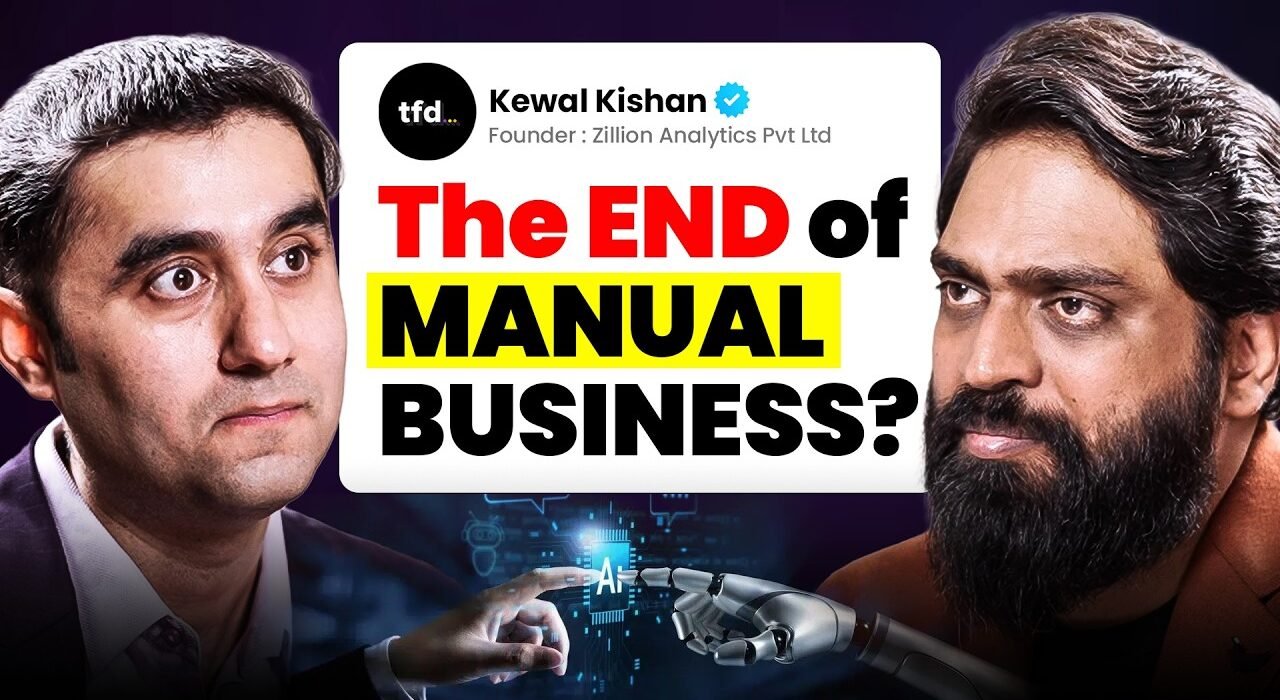
Most small business owners in India are still running on what Keval Kishan calls the “₹2 in, ₹3 out by evening” mindset — put in some money, hope more comes back before the shop shuts. On this episode of The Founder’s Dream, host Abhishek Vyas sits down with Kishan, a Business Automation Coach and MSME Growth Strategist who runs Zillionn Analytics, to talk about how to grow your business once Excel sheets and memory-driven follow-ups stop being enough.
Kishan isn’t speaking in theory. His company, Automate Business, already serves 12,000 MSMEs across India, and during the conversation he triggers a live AI agent call to prove the systems he describes actually work in real time.
How to Grow Your Business With Systems, Not Just Hustle
Asked directly whether automation alone can grow a business, Kishan was clear that it’s one leg of a three-legged stool.
To grow any business you need three things: the right systems, which is what we call automation; a clear strategy for how you’re going to grow; and a solid team of leaders who can run each department and deliver the product or service to customers, so you as the founder can focus on strategy and growth.
Without systems, he warns, even a business with strategy and a good team gets pulled back into daily operations. This is the same leadership gap explored in Biggest Business Challenges in India, and Kishan’s take adds a sharper edge: most MSME owners aren’t short on ambition, they’re short on the systems that let ambition survive scale.
Why MSMEs Are Stuck With Excel Sheets and Slow Follow-Ups
Kishan’s clearest example of what automation actually fixes came from a manufacturing scenario. Inquiries from platforms like IndiaMART or Trade India get downloaded manually, handed to a sales team, and called back three or four days later — by which point, he says, four competitors have already reached the same buyer.
He makes a strong case for WhatsApp over cold calling and email, citing open rates: SMS around 2%, email around 10%, and WhatsApp around 98%. Real estate buyers, he says, have simply stopped answering cold calls because they know exactly what’s coming.
The proof point is an RDB Hyundai dealership in Kolkata. The dealer had roughly 2,000 contacts of people who had visited the showroom but never bought a car. Kishan’s team triggered an AI-driven WhatsApp campaign with two buttons — request a callback, or start a chat.
We sent it to 2,000 people, and the next week 200 of them booked an appointment to visit the showroom for a test drive. Within that one week, 60 people walked in and 15 cars were sold — that’s ₹1.5 crore in sales, and the cost of sending each WhatsApp message was about 90 paisa.
The dealership repeated the campaign during Diwali and again in December, each time converting fresh batches of the same 2,000 contacts — proof, Kishan says, that the win wasn’t luck but a repeatable system, including what he calls WhatsApp drip marketing: automatic, scheduled follow-up messages that continue for months without any human sending them manually.
The AI Agents Running Pre-Sales, Support and Hiring
Inside his own company, Kishan says AI automation has already reshaped headcount. Marketing used to need two content writers and four video editors; AI tools now handle content creation directly. Pre-sales, which needed three people calling trial users, is now run by an AI agent named Raj who calls clients instantly after a trial signup, books demos with the human sales team, sends reminders, and later supports the client post-payment.
He counts three AI agents currently running inside his company: a pre-sales agent, a customer support agent, and a hiring agent — though he’s quick to note humans still manage the agents themselves.
The live demonstration on the episode makes this concrete. Kishan fills out a “request a callback” form for the RDB Hyundai dealership, and within moments an AI voice agent named Avira calls back, asks which model the caller is interested in, quotes on-road variant pricing, offers to send a brochure over WhatsApp, discusses loan options, and books a test drive slot — all in natural conversational English. Customers who later visited the showroom, Kishan says, specifically asked for Avira by name, not realizing she was an AI agent.
What Happens to Jobs When AI Takes Over Routine Work
The conversation doesn’t dodge the uncomfortable side of this shift. Kishan draws a line between “routine workers” doing repetitive, non-creative tasks and “knowledge workers” who manage and direct AI systems.
Any work that is repetitive and has no creativity in it — that work will be completely taken over by AI within the next five to ten years. The next level of unemployment is coming, in India and in other countries, and governments should be taking steps to tell people to either start their own business or upgrade themselves into AI.
He references entrepreneur Mark Cuban’s line that the next trillionaire will be someone sitting in a basement working with AI — not to glamorize solo founders, but to argue that founders who adopt AI early will out-earn and outpace competitors who don’t. His warning is blunt: businesses that skip automation risk becoming, in his words, the “dinosaur of their industry,” the same way Nokia and BlackBerry assumed customer loyalty would protect them.
Leadership Gaps Keep Indian MSMEs Below ₹100 Crore
One of the sharpest data points in the episode: Kishan cites a figure of roughly 15,000 companies in India crossing ₹100 crore in revenue — a tiny fraction against the country’s roughly 63 million MSMEs. His diagnosis isn’t lack of ambition; it’s a missing leadership layer.
He describes founders who can push a business to ₹10–30 crore alone, but then get trapped in a cycle: focus on sales and operations suffer, fix operations and new customer acquisition stalls, fix acquisition and operations slip again. Building a leadership team — people who run marketing, sales, operations and HR as capably as the founder would — is, in his view, the actual bottleneck, not funding or market size. Founders weighing this exact tension between chasing revenue and building a durable company will find useful context in Start a Business in 2026? Learn From Top Indian Founders.
The Keval Kishan Success Story: From Chief Follow-Up Officer to Zillionn Analytics
Kishan’s own backstory explains why he’s obsessive about systems. After a computer science engineering degree and a corporate job, he started a training and Excel/SQL consulting business, hired five or six people, and quickly discovered people management was harder than expected. He jokes that his real title back then wasn’t CFO — it was “Chief Follow-Up Officer,” spending entire days chasing his own team for updates instead of focusing on strategy or new clients.
That entrepreneur mindset of personally chasing every task changed after he noticed how a Japanese CEO of a multinational auto company could run operations from a beach while Indian teams built the cars — because the company ran on documented SOPs, not on memory. MSMEs, by contrast, he says, hand out raises based on who brought lunch or who didn’t argue last month rather than on measurable performance.
He first built these systems for his own company, then moved into coaching thousands of entrepreneurs using Google Forms and Sheets — until, in his account, Google raised per-user pricing sharply without upgrading the underlying tool. That gap pushed him to build an in-house, AI-powered platform instead. The Zillionn Analytics business model now prices its tools at roughly ₹10,000 to ₹20,000 a month covering CRM automation, WhatsApp marketing, HRMS and AI agents together, aimed squarely at businesses with revenue between 50 lakh and 50 crore rather than large enterprise clients.
My purpose as a founder is to automate one million MSMEs in India. If I keep the cost high, I know that dream can’t be achieved — but if I help MSMEs grow their revenue and profit, that becomes one of the biggest contributions my company can make to India’s economy.
In this Keval Kishan interview, that mission comes through clearly in the numbers he shares: from one crore in revenue taking five years to reach, to ten crore in two years once automation was in place — a claim he says he uses to convince skeptical business owners who still insist human-only sales processes can’t be replaced.
For founders still weighing which tools are worth learning before scaling a team, the broader skills conversation in Top Skills in 2026: What Successful Business Leaders Are Learning pairs well with what Kishan describes here — AI as a coach and strategist, but execution still resting on human leadership.
Watch the full conversation with host Abhishek Vyas on The Founder’s Dream YouTube channel and subscribe for new founder interviews every week.
Frequently asked questions
Who is Keval Kishan?
Keval Kishan is a Business Automation Coach, entrepreneur and MSME Growth Strategist who runs Zillionn Analytics, a company that builds AI-powered CRM, WhatsApp automation and AI agent systems for small and mid-sized Indian businesses.
What is Automate Business?
Automate Business is the product built by Zillionn Analytics that combines CRM, WhatsApp marketing, HRMS and AI agents in one dashboard, priced for MSMEs with revenue between roughly 50 lakh and 50 crore.
How can AI automation help a small business generate more leads?
By connecting ad platforms like Meta and IndiaMART directly to a CRM, using WhatsApp chatbots to qualify leads instantly, and letting AI voice agents call leads within a minute instead of days, which Keval Kishan says sharply raises conversion rates.
Will AI take away jobs in India?
Keval Kishan says repetitive, non-creative ‘routine worker’ roles will shrink over the next 5 to 10 years, while ‘knowledge workers’ who can manage and train AI agents will remain in demand.
What three things does a business need to grow, according to Keval Kishan?
He names right systems (automation), a clear growth strategy, and a strong leadership team that can run each department without the founder’s constant involvement.
1 Comment