
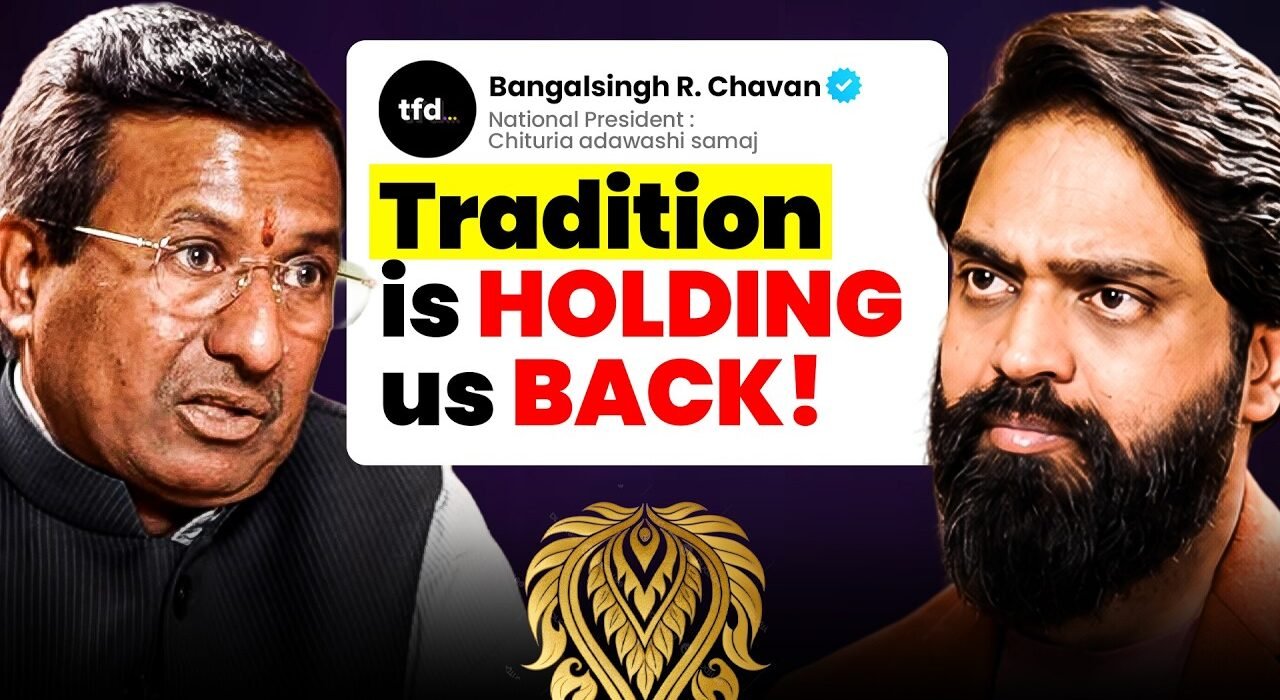
What does it take to prove you belong to your own country? In this Mangal Singh Chavan interview on The Founder’s Dream, host Abhishek Vyas sits down with a social leader who has spent years travelling through tribal settlements, doing caste documentation nobody in government offices has attempted, and trying to change customs that are older than most state governments. Chavan comes from the Barwa Chittoria tribal community, and his fight is not about funding or growth — it is about getting his people officially recognised to exist on paper.
Inside the Mangal Singh Chavan Interview: Who Speaks for Tribal Identity?
Chavan opens with a line that frames the entire conversation: identity is not something a community can give itself. As he puts it in the episode,
Giving people their identity is the government’s job — we don’t even have land, and even today our community has no house to live in. So who else will get us that recognition?
He says 730 tribal castes in India have never been registered in the central government’s gazette, and his own community is far from alone in this. A large share of these nomadic communities have lived a forest-linked, semi-nomadic life for generations, moving from village to village, which he believes is the core reason their documentation never caught up with them.
The Paperwork Problem: Why Tribal Communities Can’t Prove Who They Are
Caste documentation in India typically requires pre-1947 land records, birth certificates, or a living lineage certificate from families seeking an official caste certificate — documents that assume a settled, literate, land-owning household. Chavan points out the obvious problem: his community never owned land, and most births for generations happened at home, not in a hospital, so there was never a government record to begin with.
He also raises a detail that rarely gets attention: the same community is recorded under different names in different states. In Maharashtra, his people are known as Chittoria, Chauhan Rajput or Thakur, even though their customs, their marriage practices and their shared history are identical across 28 states. He calls this the first and most basic obstacle his people face — simply explaining who they are.
There has been some progress. Chavan mentions that in 2018, under the National Commission, 1,235 castes were newly added to the gazette. But he says many smaller tribal groups still need a fresh survey and formal registration before they can access the same rights as other citizens.
Nomadic Life, No Home, No Steady Work
Housing and employment come up as daily, unresolved struggles. Chavan says a large part of his community still doesn’t have a fixed home — not even a small one — and survives on daily wage labour: carrying bricks, hauling iron rods up buildings, collecting forest produce to sell by the roadside. The uncertainty, he says, is constant — earning enough for dinner tonight does not guarantee there will be food tomorrow.
This instability directly affects children’s schooling. Families that move every few months between villages in search of work cannot enrol children in a private school, and even government schools ask for documents — a permanent address, a voter ID, an Aadhaar card — that many families simply don’t have.
Why Educating Daughters Is the First Step to Change
When Abhishek Vyas asks directly whether girls in these communities are still kept out of school, Chavan doesn’t soften the answer. He says sending daughters to school is still seen as a serious violation of custom in parts of his community — families who do it risk being told they’ll be excommunicated.
If we don’t educate our daughters, how will the home ever develop, sir? Earning a living is seen as a man’s job, but fifty percent of that effort should come from women too.
He connects this directly to his broader mission: changing mindsets about girls’ education, he argues, is not a side issue — it’s the starting point for every other kind of community development he’s trying to drive.
The Mindset Problem: Traditions That Hold Communities Back
When asked about the single biggest challenge he faces today, Chavan doesn’t point to government apathy first — he points inward.
Our biggest challenge is the centuries-old orthodox traditions of our own society. Until we change our community’s thinking and let go of these rigid customs, our society will not move forward.
He walks through several of these traditions in detail. One is “Olakh” — a custom where if a woman’s clothing, bathing soap, or certain household items are accidentally touched by someone considered impure during a dispute, the entire household is declared untouchable. Everything inside — clothes, utensils, cooking vessels — has to be thrown away and replaced, an expense his community, living on daily wages, can barely afford.
Another tradition involves accidental deaths. If a family member dies in an accident and the family accepts government insurance compensation, Chavan says the community can label them “murderers” for profiting from a death, forcing them through a long and expensive purification ritual before they are allowed back into the fold. He shares the story of a relative’s two sons who died after their motorbike collided with a truck; even though the police and insurance company were ready to process the claim, community elders refused to let the family accept the money, fearing their daughters would never find marriage matches if they did.
He is equally blunt about love marriages, which can result in five years of social exclusion for the entire family, and about a double standard he’s experienced personally — a daughter’s cooking is acceptable, but a daughter-in-law’s cooking is often not, even in his own extended family circle.
Government Recognition and Collective Responsibility
Chavan is careful not to pin all the blame on the state. He says no social worker from his community had seriously pushed this issue before, so he doesn’t hold the central government solely responsible. What he wants now is straightforward: proper registration of his community’s 12 sub-castes under one recognised umbrella name, without demanding impossible-to-produce pre-1947 documents, along with basic housing support and access to government jobs once caste certificates are valid.
He’s also direct about a danger closer to home — community members undermining the few people trying to drive change. As he tells Abhishek Vyas,
A society exists to help its own people. If the people within a society keep pulling down anyone trying to do good work, how will that society ever rise? If we keep doing this to each other, our community won’t just stay behind — it will fall two hundred years further back.
This is the thread running through the whole conversation — that government paperwork matters, but so does the community choosing, internally, to drive social reform by ending the customs that keep it poor and unseen.
What This Interview Asks of Listeners
This episode doesn’t fit the usual startup-growth format you’ll find elsewhere on The Founder’s Dream podcast, but it belongs in the same tradition of listening closely to people solving hard, unglamorous problems. If you’re drawn to stories about people rebuilding systems from the ground up, the site’s entrepreneurial journey stories and self growth lessons sections carry similar threads of persistence against long odds.
- 730 tribal castes remain unregistered in India’s central gazette, according to Chavan.
- Pre-1947 land and birth documents are routinely demanded, despite being impossible for most tribal families to produce.
- Girls’ education is treated by Chavan as the single most important lever for community development.
- Customs like Olakh and insurance refusal keep families poor by design, not accident.
- Chavan is asking for a single consolidated registration covering his community’s 12 sub-castes.
Watch the full conversation with host Abhishek Vyas on The Founder’s Dream YouTube channel and subscribe for new founder interviews every week.
Frequently asked questions
Who is Mangal Singh Chavan?
Mangal Singh Chavan is a social leader, national president and social reformer who works on tribal identity, caste registration and education issues for nomadic and tribal communities across India.
What is the main problem discussed in the Mangal Singh Chavan interview?
The episode centers on how many tribal and nomadic castes still have no official government registration or gazette recognition, which blocks them from school admissions, housing and jobs.
Why do tribal communities struggle to prove their caste or identity?
Mangal Singh Chavan explains that most births happened at home without hospital records, families have no land documents from before 1947, and many communities are known by different names in different states.
Why does Mangal Singh Chavan say girls' education matters so much?
He says that unless daughters are educated, families and homes cannot develop, since traditionally only men are expected to earn while women are kept out of decision-making.
What traditions does Mangal Singh Chavan want to change?
He talks about practices like Olakh (treating a household as untouchable after certain incidents), refusing accident insurance money, and long social boycotts for love marriages, all of which he says need reform without erasing cultural identity.
1 Comment