
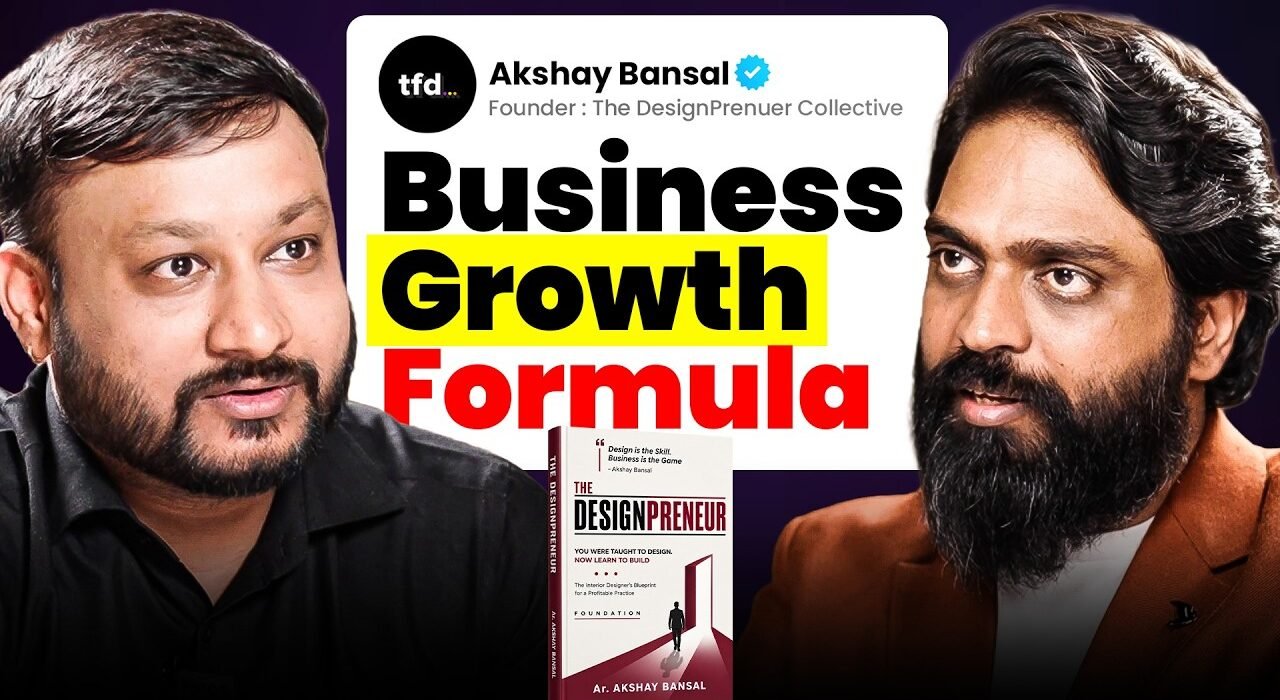
Akshay Bansal spent seven years studying architecture and almost none of it, by his own admission, taught him how to run a business. On this episode of The Founder’s Dream — an indian business podcast — host Abhishek Vyas asks him a question that frames the whole conversation: is being a good architect the same as being successful? Akshay’s answer is blunt — it isn’t — and what follows is a practical breakdown of why an entrepreneur mindset matters more than technical skill once you step out of college.
Akshay is an architect and entrepreneur behind The Designpreneur Collective, a firm that has executed projects “from Kashmir to Kochi,” including a store in Srinagar’s Lal Chowk. His path to business mindset wasn’t inherited easily — it was built through financial crunch, a startup job, and a decision to treat design as a controlled passion rather than the whole business, making his rise an entrepreneur success story india’s design industry doesn’t often tell in full.
Why an Entrepreneur Mindset Matters More Than Design Talent
Akshay is direct about the gap between his architecture degree and what the market actually demanded of him. He puts it plainly:
What I studied made me a good designer, but it didn’t make me a good businessman. I only learned what being a good businessman really means once I got into the market.
He credits a year and a half working at a startup for teaching him what his five years of architecture school and two years of a master’s degree never touched — sales, marketing, finance, contracts, legal, and taxation. That stretch, right before COVID hit, became the foundation for building his own company instead of staying a freelancer or a studio owner stuck doing everything himself.
This is the core argument running through the episode: an entrepreneur mindset isn’t a personality trait you’re born with — it’s a set of operational skills that most creative professionals, architects included, never get taught and have to pick up the hard way.
The Financial Struggle Behind the Story
Akshay’s family has run businesses for three generations — nobody in his family has held a job. But that didn’t mean money was easy. The 2016 demonetization hit the family business hard right around the time he moved from his hometown Agra to Gurgaon to start fresh, with no name and little money.
He funded his own master’s degree and worked three or four jobs simultaneously — freelancing, teaching as a guest assistant professor once a week, and hunting for stability. His first job offer after seven years of education was ₹35,000 a month, which barely covered his expenses in Gurgaon at the time; freelancing actually paid him more. That mismatch between years invested and income earned is something he returns to repeatedly when explaining why architecture graduates scatter into other fields.
The Industry’s Unpaid Intern Problem
One of the sharper moments in the conversation is Akshay naming an uncomfortable reality in his own industry. According to him, many cities still run on free intern labor, with small studios surviving entirely on unpaid interns under the excuse of “learning.”
If you don’t have the skill, nobody will pay you even ₹5,000 in this industry. Interns are kept for free. Even today, in many cities, interns work for free purely for the learning — and I won’t name names, but there are architects who exploit that.
He connects this directly to career choices after graduation: with no campus placements and poor starting salaries, young architects are left with three options — go into academics, join a studio to build expertise, or start their own practice. The third option, he says, rarely works because studio owners don’t hand over the fundamentals of running a business — leaving many stuck without capital or risk appetite.
Studio Mindset vs Designpreneur: Building Something That Outlasts You
Akshay draws a clear line between a traditional architect and what he calls a “designpreneur.” A traditional architect or studio builds spaces. A designpreneur builds a system that keeps running without them.
You have to get out of the studio mindset. Out of the solopreneur mindset. Out of the self-employed mindset. You have to move into a business mindset — and into a mindset of giving back to society.
He points to global firms like Norman Foster’s practice and Zaha Hadid’s studio as examples of companies that built a repeatable design language, not just a famous individual name. This is where hiring the right people matters — Akshay says his leadership team includes a dedicated designer, project manager, and business development lead, while he focuses only on sharing vision and formulas rather than doing the hands-on work himself. If you’re weighing whether to build that kind of team solo or bring in a partner, it’s worth reading Do You Need a Business Co-Founder? Pros, Cons, and Lessons for a broader look at that decision.
His sharpest line on why passion alone doesn’t scale a business:
Passion-driven businesses are not profitable businesses.
He says he’s always kept his own design passion “in control” and deliberately involved himself in the business side instead of just the creative side — a distinction he thinks more architects need to make.
India’s Infrastructure Opportunity — and Why Mumbai 3.0 Shouldn’t Only Go to Singapore
Akshay raises a pointed example: when a city like “Mumbai 3.0” gets built, mega-projects often go to foreign firms — a Singapore company, for instance — rather than Indian architects. His explanation isn’t that India lacks talent.
India has talent, boss. But that talent is concentrated among a handful of people. We bring in talent from outside for mega projects because their expertise is already tested and tried.
He uses Chandigarh as the historical example — built through a French architect because that expertise was considered proven at the scale India needed. His argument is that India produces enough skilled individuals, but not enough scaled companies that can be trusted with mega infrastructure the way Norman Foster’s or Zaha Hadid’s firms are trusted internationally.
He ties this to bigger numbers: India wants to become a $5 trillion economy, spends roughly 4-5% of GDP on infrastructure, and the architecture-engineering-construction sector is already a ₹17.5 lakh crore industry, with services alone projected around $7.5 billion by 2030. Every retail brand expanding physically — D2C, FMCG, eyewear, fashion — needs a designer who understands execution speed, not just aesthetics. That demand, he argues, points to some of the biggest business ideas india has right now for designpreneurs with an entrepreneur mindset, instead of ceding every large project abroad.
Retail Expansion, Speed, and Why AI Is a Co-Founder, Not a Threat
Akshay built his own practice starting in retail and B2B right after COVID — a market that was, in his words, the most “panicked” at the time because shops weren’t even opening. His bet that retail would boom paid off; he points to brands like Sugar Cosmetics, Lenskart, and others that moved from online-only to offline expansion.
His edge in that space is speed through standardization — delivering a 30-day project instead of 60 days, which saves a retail client a month’s rent and often covers his fee outright. He explains the math simply: a 10% margin compounded across two 30-day projects beats a single 20% margin on one 60-day project, because of how quickly trust and word-of-mouth compound once clients see fast, reliable handovers.
On AI, his framing is practical rather than fearful:
Treat AI as your co-founder. AI can never eat up the job of a professional — be it an architect, a lawyer, a doctor, or a chartered accountant.
He notes AI is useful for 3D visualization and closing sales conversations faster, but it doesn’t know which room gets sunlight, how spaces connect, or what a client actually needs emotionally from a design — judgment calls that remain human.
Giving Back to the Fraternity
Akshay wrote a book distilling fifteen chapters of lessons — niche, self-evaluation, sales, marketing, finance, legal, taxation, HR — things he says he never learned in college. His stated reason for starting this public conversation now, rather than waiting for a milestone anniversary, is simple: he feels capable of giving back today, and sees no reason to wait. He mentions the Council of Architecture shutting 75 colleges in recent years, including the one he graduated from, as part of what pushes him to speak now rather than later. For founders thinking about when and how to build community around their work, the ideas in Networking for Founders | TFD Business Podcast cover similar ground.
His closing argument is about professional respect — he wants architects treated with the same regard as doctors or lawyers, paid for advice and expertise rather than seen as an “additional cost.” He references a building collapse in Delhi’s Shanti Niketan area as a reminder of what happens when that expertise is ignored, contrasting it with buildings that survive disasters because of sound design and engineering.
- Design skill alone doesn’t build a business — sales, finance, and legal knowledge do.
- Unpaid internships are a real, acknowledged problem in parts of the architecture industry.
- Scaling requires building a company and team, not staying a solopreneur or studio-dependent practice.
- India’s infrastructure spend is large enough to support many more scaled, India-built design companies.
- AI supports execution speed but doesn’t replace professional judgment.
Watch the full conversation with host Abhishek Vyas on The Founder’s Dream YouTube channel and subscribe to this founder podcast for new founder interviews every week.
Frequently asked questions
Who is Akshay Bansal?
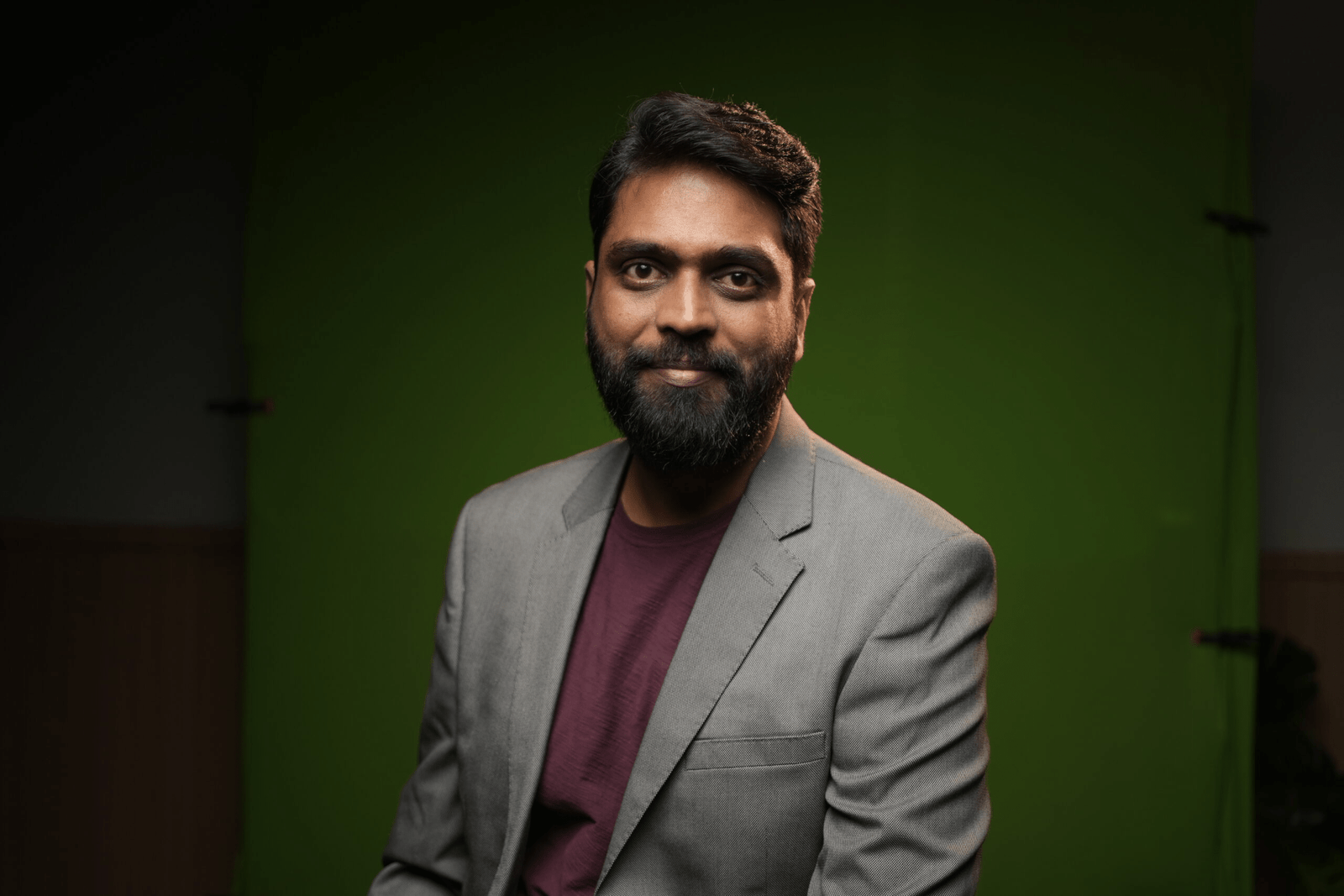
Akshay Bansal is an architect and entrepreneur who runs The Designpreneur Collective, a company that works on retail, interior, and infrastructure projects across India from Kashmir to Kochi.
What does Akshay Bansal say about architecture education in India?
He says architecture education made him a good designer but not a good businessman, and that skills like sales, marketing, finance, and legal work are learned on the job, not in college.
Why does Akshay Bansal say good architecture is not the same as success?
He argues that technical design skill alone does not guarantee a sustainable career, and many architecture graduates end up in unrelated fields because the industry’s return on investment is slow and often unpaid at the intern stage.
What is Akshay Bansal's advice for young architects and designers?
He recommends spending at least three to four years in a job, working at both a small studio and a large company to learn the business side, before starting an independent practice.
What is The Designpreneur Collective known for?
The Designpreneur Collective has completed retail, residential, and interior projects across India, including in Srinagar’s Lal Chowk, and focuses on fast, standardized execution for retail expansion.
1 Comment