
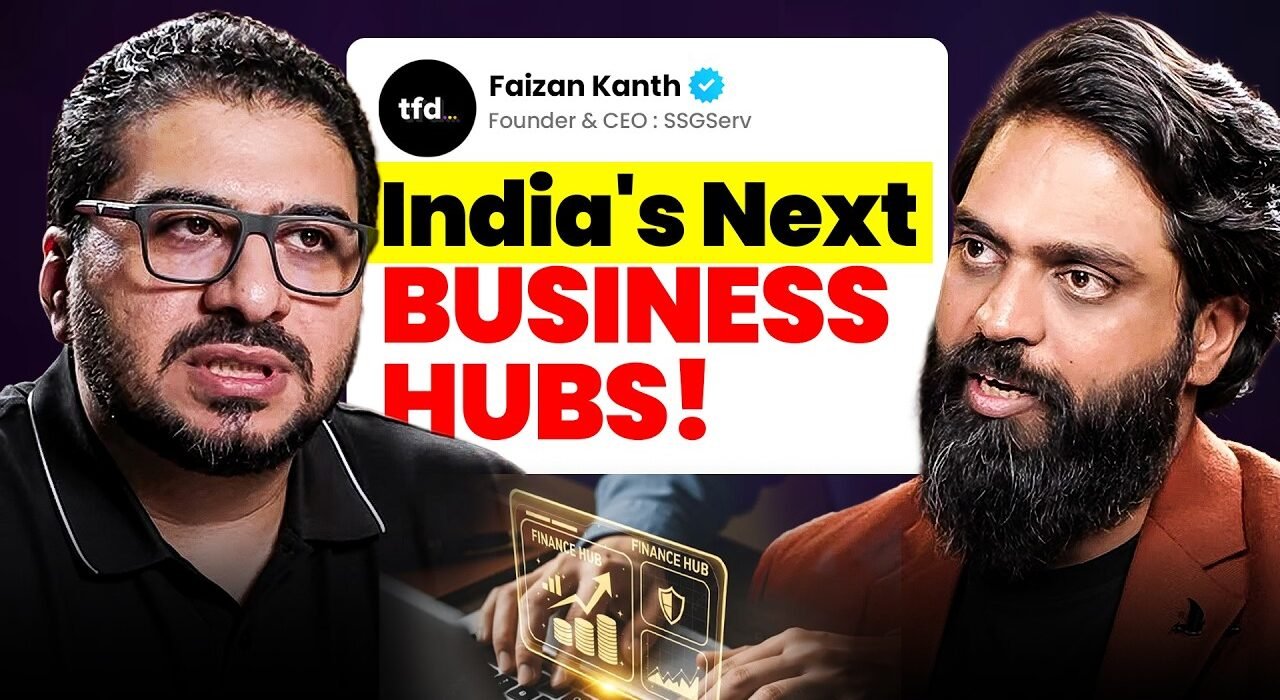
Most conversations about India’s IT and outsourcing growth start and end in Bengaluru. Faizan Kanth, Founder and CEO of SSGServ, spent 11 years building a business on a different bet — that the real opportunity for global companies lies in India’s Tier 2 and Tier 3 cities. On this episode of The Founder’s Dream, a founder podcast built around in-depth conversations with Indian entrepreneurs, host Abhishek Vyas sits down with him to unpack the Faizan Kanth success story, from a too-early startup attempt in 2015 to running a Micro GCC model that now works with over 50 brands.
Kanth’s journey runs from Srinagar to Bengaluru, and his business — SSGServ — sits at the intersection of two trends reshaping Indian business services: the rise of Global Capability Centres (GCCs), and the slow but real shift of opportunity away from India’s biggest metros.
The Faizan Kanth Success Story: From Srinagar to Bengaluru
Kanth is originally from Srinagar and has lived in Bengaluru for 26 years. He describes the city plainly as the place that gave him everything, even though he had multiple chances to move elsewhere over the years.
That dual identity — a Srinagar native who built his career and company in Bengaluru — shapes nearly everything about how he thinks of talent. He doesn’t see Srinagar, Mysuru or Bengaluru as fundamentally different talent pools. He sees them as different levels of opportunity and training.
Why Starting in 2015 Was “Too Early”
Kanth started his business in 2015, well before most Indian companies or clients understood what a GCC even was. He had already left a stable, well-paying job to make the move, and the early conversations with potential customers followed a familiar pattern.
We had already left our well-paying job to start a business. We had our share of difficulties talking to our first customers, and the difficulty was always the same — you are too early, you don’t have any proof of concept.
Clients kept asking why they shouldn’t simply outsource the work instead of going the GCC route with an unproven company. Kanth’s first real break came within six months, with a 20-member team under a BOT (Build-Operate-Transfer) arrangement, generating around Rs 8-9 lakhs a month — a client relationship that, he says, continues to this day.
What a BOT Model Actually Protects
The Build-Operate-Transfer model, Kanth explains, exists specifically to de-risk GCC adoption for companies that aren’t ready to commit fully. A provider builds the capability centre, hires the team, sets up infrastructure and HR processes, and operates it for an agreed period — often around five years — before transferring full ownership to the parent company.
- The client tests the India market without heavy upfront investment
- They avoid setting up a legal entity before they’re sure of the model
- Risk is mitigated because the provider absorbs early operational uncertainty
- At transfer, the entire built capability — people, process, infrastructure — moves to them
Traditional BPO vs GCC vs Micro GCC
Kanth draws a sharp line between the three models that often get lumped together. A traditional BPO, in his telling, is purely about cost arbitrage and headcount — how many people are needed to handle a given volume of calls or tickets.
In a BPO you might get 10,000 calls and they’ll keep coming. In a GCC, we can tell you how many of those calls are repeat issues and how we can reduce that repeatability. We work directly toward the company’s actual end goal, not just the volume.
The difference, he says, is ownership. Under a GCC, the client owns the capability and the workforce — the India team functions as a genuine extension of their own organisation, not a vendor relationship. That distinction is also what historically locked out small and mid-sized companies: traditional GCCs were built for businesses doing $500 million to $1 billion in revenue, with a baseline expectation of needing at least 500 people to make outsourcing worthwhile.
SSGServ’s Micro GCC model is built for the gap underneath that — companies between $5 million and $500 million who were told, in effect, that this kind of capability-driven structure wasn’t for them. Kanth’s pitch to that segment is straightforward: a 20, 30 or 40-member team delivered under the same GCC principles, without needing to look like an enterprise first.
Why Companies Choose India: It’s Talent, Not Just Cost
Asked why global companies set up operations in India rather than building locally, Kanth is direct that the answer has changed over the past decade.
Ten years ago it was mostly about cost. I don’t think cost is the point right now — currently it is mainly the talent, the untapped talent which India has, whether in engineering or back office.
He points to a recent example: a large construction and infrastructure firm based in Saudi Arabia, building hospitals and malls, which needed a continuous supply of AutoCAD and BIM engineers. SSGServ built a competency benchmarking exercise comparing engineers across markets, and found Indian engineers delivering at a level the client’s own CEO hadn’t expected.
When I spoke to the CEO there, he said he didn’t know India was aware — quote unquote — that it had such brilliant engineering teams who could build such designs. That was an eye-opener for us, and that’s where I felt we need to put India on the map.
Tier 2 and Tier 3 Cities: The Untapped Talent Argument
This is the core argument Kanth returns to throughout the conversation: the talent gap between Bengaluru and smaller cities isn’t about raw ability, it’s about access to opportunity and training.
The question is whether the talent in Srinagar, Mysuru or any other Tier 1 or Tier 2 city is trainable — can they grow to the same level as Bengaluru? Yes, it will take time, but giving them that opportunity is important.
He makes the comparison concrete: walk into any large firm in Bengaluru or Mumbai and segment the employees by where they’re from, and it’s the same pool of young men and women from across the country. The difference, in his view, is simply that metro companies train people and build systems around them, while smaller cities expect fresh graduates to arrive already knowing how to build or deliver at a senior level.
Kanth also brings up a pattern he’s observed about local versus outside talent — that people who move cities purely to work and earn tend to outperform local talent who may take opportunity for granted, since mobility itself forces a kind of hunger that local comfort doesn’t. He ties this directly to his own story: growing up in Srinagar with a solid education, but still needing to prove himself, whether through BPO work or food delivery, before anything clicked.
On government support, Kanth is measured but positive. He cites Karnataka’s GCC panel projecting roughly 50 additional GCCs by 2029, expected to generate around 3.5 lakh jobs and more than $20 billion in value — numbers he reads as proof that state-level policy is genuinely pushing growth beyond Bengaluru into cities like Mysuru.
Personal Branding and Lessons on How to Grow Business
For a B2B founder, Kanth’s approach to visibility was almost the opposite of conventional startup advice. SSGServ didn’t do any branding for most of its existence.
Honestly, we were not doing any branding until about eight months back. For the last 11 years we wanted to prove the concept, and now we wanted to showcase our brand more openly.
His advice to founders starting out today is different from what worked for him: if you’re building a business between 2026 and 2036, personal branding needs to come first, not as an afterthought nine years in. That shift — from hiding behind client brands to stepping into the spotlight — is exactly the territory covered in Building Founder Authority with Podcasts, and it connects to a broader point about how B2B companies are rethinking visibility, a theme also explored in Generate B2B Leads in 2026.
On sales specifically, Kanth holds a firm, slightly contrarian view for a founder of 11 years: a founder can learn operations, finance, even the CEO role, but sales has to come from within. He says he’s never found a book that actually teaches someone to sell, and doesn’t believe there’s ever a “right moment” for a founder to stop selling — he expects to keep doing it himself indefinitely.
The Entrepreneur Mindset Behind 11 Years of Operations
Asked about the biggest lesson from over a decade of entrepreneurship, Kanth’s answer reflects a particular kind of entrepreneur mindset built on constant recalibration rather than big wins.
There are surprises in every corner. We should be ready to handle every curveball coming toward you. You can’t really relax — you can’t say today went well, because there might be a new curveball the very next morning.
That same mindset shapes how he talks about reliability with high-stakes clients, including Bengaluru airport. Rather than promising zero failures, he commits to a standard of response.
There is nothing called zero failure operations. It’s the mindset, it’s your team, it’s the processes. What we can commit is that if there is a failure at all, we will give 100% to ensure nothing goes wrong.
Scaling across more than 300 countries taught SSGServ a harder lesson: a process that works for one client or region doesn’t automatically transfer. Kanth says the team failed multiple times assuming a UK process would work in Dubai or an India process would translate elsewhere, before learning to treat every region as genuinely different.
On AI, he’s not dismissive but has a specific plan. Rather than framing GCCs as protected from disruption, he says every employee needs to keep moving up the value chain — if someone’s job today is writing emails, the next skill is deciding how to design and compose emails using available tools, because AI will eventually handle the writing itself. He’s also clear that he doesn’t see Indian IT firms shrinking because of GCCs; he sees it as a parallel track companies are now testing alongside their existing models.
Looking ahead, Kanth wants SSGServ to become the default name any company between $5 million and $500 million thinks of when considering GCC operations in Bengaluru, and ultimately wants more GCC enablers to set up in Jammu & Kashmir as well — closing the loop between the two cities, Bengaluru and Srinagar, he calls his favourites.
Watch the full conversation with host Abhishek Vyas on The Founder’s Dream YouTube channel, the Indian business podcast bringing you founder stories like this one, and subscribe for new founder interviews every week.
Frequently asked questions
What is a Micro GCC model?
A Micro GCC is a scaled-down Global Capability Centre built for businesses between 5 million and 500 million dollars in revenue, offering teams of 20 to 40 members instead of the 500-plus headcount traditional GCCs required.
How is a GCC different from a traditional BPO?
Faizan Kanth explains that a traditional BPO sells cost arbitrage based purely on headcount and call volumes, while a GCC gives the client ownership of the capability, reduces repeat issues, and works directly toward the parent company’s end goals.
Why are global companies setting up GCCs in India?
According to Faizan Kanth, ten years ago it was mainly about cost, but today companies come to India mainly for its untapped talent across engineering and back-office functions.
Is talent in Tier 2 and Tier 3 cities like Srinagar or Mysuru as good as Bengaluru?
Faizan Kanth argues the same young talent pool exists everywhere in India; the difference is that Tier 2 and Tier 3 cities don’t get the same training and opportunities that metro cities do.
What is the BOT (Build-Operate-Transfer) model in GCC setups?
Under BOT, a provider like SSGServ builds and operates the capability centre for an agreed period, typically a few years, and then transfers full ownership and rights to the parent company, letting them test the market with lower risk.
1 Comment