
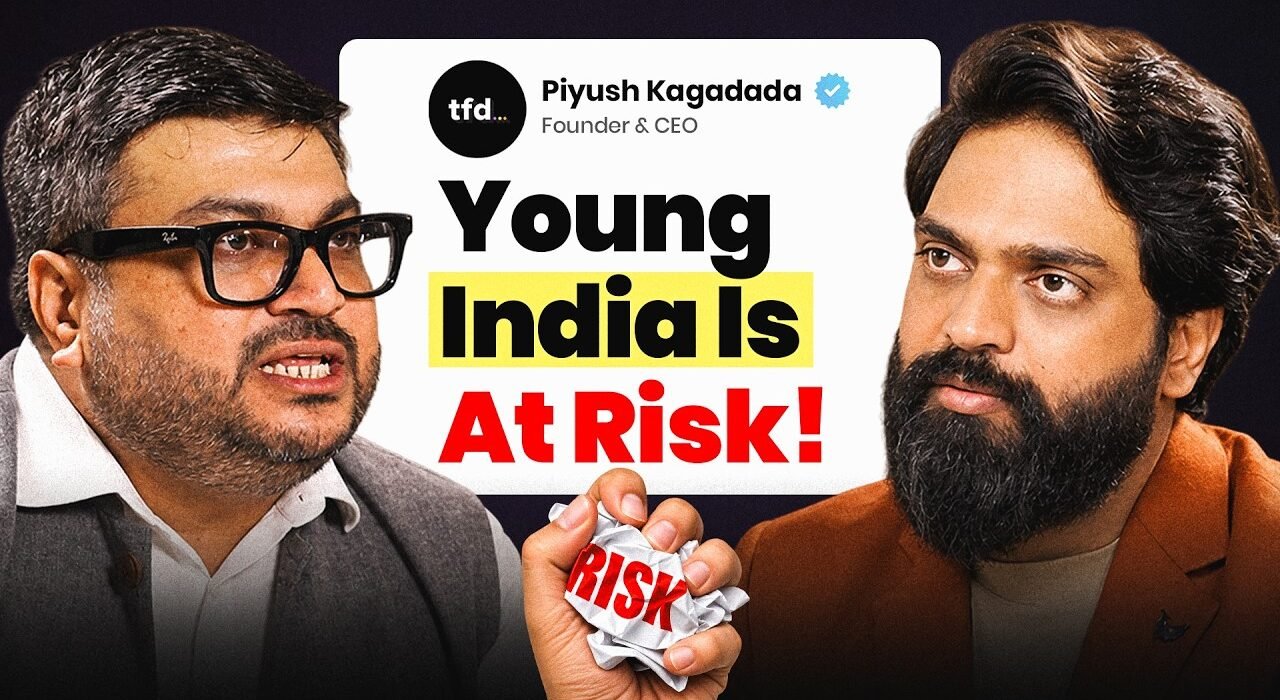
Nearly one in three stroke patients in India today is under 50. That single data point from a recent ICMR publication anchors this episode of The Founder’s Dream (TFD podcast), where host Abhishek Vyas sits down with Piyush Kagadada — an entrepreneur and neurovascular technology leader building stroke-care devices in India. What unfolds is less a business pitch and more an entrepreneur success story India can genuinely learn from, built around a problem most people don’t think about until it happens to someone they love.
Piyush didn’t set out to work in healthcare. He wanted to be a computer engineer, landed in pharmacy almost by accident, discovered he was allergic to the chemicals he was meant to formulate, and eventually found his way into neurovascular medical devices — a field he now says chose him as much as he chose it. Eighteen years later, he’s working on the exact problem this episode opens with: why strokes are hitting younger Indians, and why so few of them get the treatment that could save them.
30% of Strokes Now Happen Under 50 — Why This Changes Everything
The conversation starts with a number that surprised even Piyush: close to 30% of all reported strokes in India are now occurring in people below the age of 50. He credits the ICMR team and the scientists behind the study for surfacing data that challenges a long-held assumption.
He points to entrepreneur Nithin Kamath, who suffered a stroke a year and a half before this recording, as a visible example that this isn’t a rare occurrence confined to the elderly. Geopolitical stress, environmental pressure, and corporate lifestyle pressures are all flagged as possible trigger factors, though Piyush is careful to frame these as contributing conditions rather than proven causes.
The Golden Hours: Why Every Minute After a Stroke Counts
In stroke care, Piyush says the field has a saying that sums up the entire emergency: “Time is brain.” Unlike most organs, brain tissue damage from a stroke is non-reversible — whatever part of the brain loses blood supply during the delay stays damaged permanently.
“If the right treatment happens within 24 hours, there are very good chances the patient can go back to their normal life and function. But those are the golden hours — the sooner it’s done, the better.”
He breaks down the clinical window further: a clot-busting medicine called a thrombolytic agent works only if administered within four hours. Beyond that, the only option is a thrombectomy procedure to physically remove the clot — and that still needs to happen within 24 hours for the best chance of recovery.
FAST: The Symptoms Nobody Should Ignore
Piyush walks through the acronym doctors use to identify stroke quickly:
- F — Face: drooping or stiffness on one side
- A — Arms: sudden weakness or paralysis on one side
- S — Speech: slurring or impairment
- T — Time: note the exact time symptoms started
- E — Emergency: rush to the nearest stroke-ready hospital immediately
He’s blunt about what gets in the way in real life: urban traffic can eat up the entire four-hour treatment window just getting to a hospital, and in rural India, the nearest stroke-ready facility with round-the-clock neurology, a CT scan, MRI, and a cath lab may simply not exist within reach.
Stroke vs Heart Attack: A Dangerous Misconception
One of the more pointed parts of the conversation is Piyush’s frustration with how casually stroke gets treated compared to heart attack in public perception.
“Stroke is a brain disease. It’s the reason people get paralysed, it’s the reason people die — but those deaths don’t get reported as stroke deaths. In most places, ‘brain attack’ isn’t even a distinguished term, so people assume it was the heart.”
This misclassification, he argues, means the real scale of stroke as a cause of death and disability in India is under-recorded, and public awareness stays low because the condition rarely gets named correctly in the first place.
Minimally Invasive Neurointervention: Treating the Brain Without Opening the Skull
Piyush explains how a blocked blood vessel in the brain can now be cleared without open surgery. Doctors enter through an artery in the thigh or wrist, navigate a specialised device through the vascular system up to the brain, capture the clot, and remove it — all without a craniotomy.
He lays out why this matters in plain numbers. Open brain surgery carries an associated mortality and morbidity rate as high as 35–40%, and recovery can take one to two months even when the surgery itself goes well, partly due to infection risk from the surgical flap. Minimally invasive intervention, done correctly, has an efficacy rate of 90–95%, with associated risk between 5–7%, and patients can often go home within four or five days.
Piyush also explains the two broad types of stroke: ischemic, where blood supply to part of the brain is cut off by a clot or blockage, and hemorrhagic, caused by bleeding. In ischemic stroke, there’s a critical intermediate stage called the penumbra — tissue that’s starved of oxygen but not yet dead, and can still recover if supply is restored in time. Left untreated, it becomes permanent damage, or infarct.
Piyush Kagadada’s Entrepreneur Success Story India Can Learn From
Piyush calls himself an “accidental pharmacist.” He wanted to be a computer engineer, missed admission during the dot-com boom, and was guided into pharmacy by mentors who told him it would expose him to both engineering and medical science. An allergic reaction to lab chemicals during college pushed him further — toward medical devices, where his first job happened to be in intervention therapy.
“We are dealing with somebody’s life and death here. There can be no bigger motivation, no bigger purpose than that.”
What’s striking is how he frames the choice itself. He didn’t grow up wanting to build neurovascular devices — he grew up wanting to be an entrepreneur and to build something with his own identity, distinct from his family’s jewellery business. The specific field found him; the drive to build something meaningful was always his own. It’s a theme familiar to anyone who follows entrepreneurial journey stories — the plan rarely survives contact with reality, but the underlying intent usually does.
Why Building Medical Devices in India Is So Hard
This is where the episode turns from healthcare awareness to a genuine founder problem. Piyush lays out why, unlike cardiology, India’s neurovascular device sector has stayed empty for years.
“India has close to 20 lakh reported stroke cases, but the treatment rate is less than 1%. Only around 300 patients are actually getting the advanced treatment. Companies look at ‘300 surgeries’ and think the market is too small — but they’re not seeing the 19,700 patients who get nothing.”
Beyond market size, he points to three concrete blockers:
- Talent: India has no existing pool of engineers trained specifically in neurovascular device design — unlike software or even cardiology, where benchmarks and talent already exist.
- Raw materials: the specific grades of wires and polymers needed for neuro devices aren’t readily sourced in India, forcing companies to build their own supply relationships from scratch.
- Infrastructure access: government-backed medical device parks, he says, largely reject new entrants without a prior manufacturing history — forcing his team to build their own sterilisation and coating plants in-house instead of plugging into a shared ecosystem.
Even after clearing those hurdles, there’s a perception problem. Doctors and hospitals, Piyush admits, still carry a mental block that foreign devices — German, American, European — are inherently superior to Indian ones. His team ran a blinded study at a conference in London, where physicians rated devices without knowing which was which; the feedback on their product came back comparable to, and in some cases exceeding, established international devices. For a company competing against decades of assumed credibility, that result mattered more internally than externally — proof to their own team that the product holds up.
What This Means for India’s Healthcare Entrepreneurs
This conversation on The Founder’s Dream podcast isn’t a generic founder podcast episode — it’s a reminder that some of the hardest businesses to build in India are also the ones with the most lives riding on them, and one of the entrepreneur stories india needs more of. For listeners of this indian business podcast who assume “medtech” means importing foreign technology and distributing it, Piyush’s account of building the regulatory, manufacturing, and supply chain from zero is a useful corrective.
It’s an entrepreneur success story India’s deep-tech healthcare space needs more of — not because every problem is solved, but because someone is building the groundwork while others wait on the sidelines. If you’re exploring self growth lessons from founders who chose hard, overlooked problems instead of obvious ones, this episode is worth the full watch.
Watch the full conversation with host Abhishek Vyas on The Founder’s Dream YouTube channel and subscribe for new founder interviews every week.
Frequently asked questions
At what age are strokes now occurring in India?
According to a recent ICMR publication cited in the episode, close to 30% of reported stroke cases in India are now happening in people under the age of 50, which breaks the old assumption that stroke is only an old-age disease.
How much time does a stroke patient have for treatment?
Piyush Kagadada explains that stroke treatment within 24 hours gives patients a very good chance of returning to normal life, but brain tissue damage during the delay is non-reversible, so earlier treatment always gives better outcomes.
What is the difference between a stroke and a heart attack?
Stroke is a brain disease caused by disrupted blood supply to the brain, while a heart attack is a heart condition; Piyush points out that many stroke deaths get wrongly recorded as heart attacks because stroke as a cause isn’t always diagnosed or distinguished.
Can a brain blockage be removed without opening the skull?
Yes, through minimally invasive neurointervention, doctors enter through an artery in the thigh or wrist, navigate to the blocked vessel in the brain, and remove the clot using a specialised device, without any open surgery.
Why is India's stroke treatment rate so low?
Piyush says India has close to 20 lakh reported stroke cases annually, but barely 300 patients get access to advanced intervention treatment, largely due to limited stroke-ready hospitals, skilled talent shortages, and gaps in the medical device ecosystem.
1 Comment