
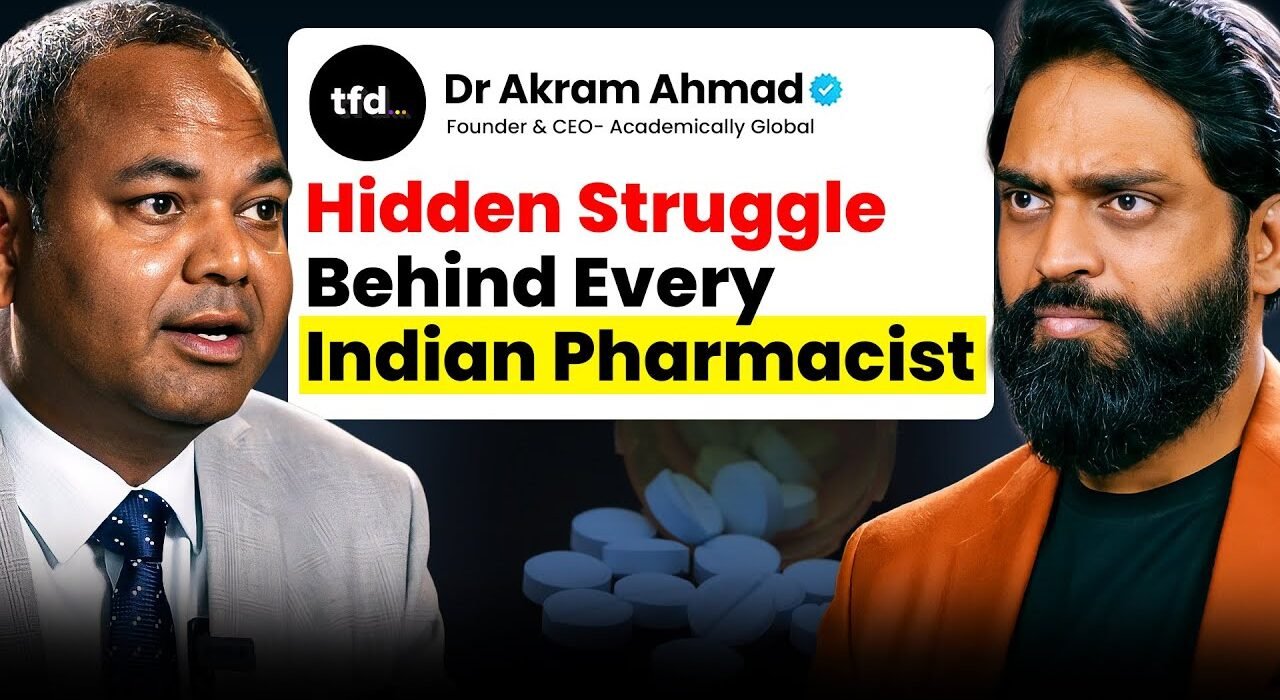
A pharmacist in India with a full degree often starts at ₹10,000 to ₹15,000 a month. The same qualification, once recognised abroad, can fetch 25 to 30 times that salary. That gap sits at the centre of Dr. Akram Ahmad’s conversation with host Abhishek Vyas on The Founder’s Dream, and it also happens to be an entrepreneur success story India rarely gets to hear in this much detail — a boy from an underdeveloped district in UP who built a company now guiding thousands of healthcare professionals into global careers.
Dr. Akram Ahmad is the Founder & CEO of Academically Global. He holds every pharmacy degree India offers — Diploma in Pharmacy, Bachelor of Pharmacy, Doctor of Pharmacy, and a PhD — and his own path from a village with no train station to a research career in Sydney shapes almost everything his company now does.
From a Village in UP: An Entrepreneur Success Story India Should Know
Dr. Akram grew up in Sahaswan, a small town in Budaun, which he describes as one of the most underdeveloped districts in UP. His parents were landless farmers; his father worked on other people’s fields to support the family. He studied up to fifth grade in a government school with no chairs or tables — students sat on the floor.
His decision to study pharmacy came from his older brother, who had done a pharmacy diploma and pushed the family in that direction. Even though his father was not formally educated, the people around him mattered, as Dr. Akram puts it:
If your father isn’t educated but keeps good company, those good people will give him good advice for his children’s lives — our relatives used to mock my father for educating us, but he kept doing it anyway.
His first train journey was for a diploma admission in Karnataka, a 28-hour trip he had never experienced before — he had only seen trains in movies, since his town still has no railway station.
Why Indian Pharmacists Earn So Little
The salary conversation is blunt. Dr. Akram states plainly:
In India, pharmacists still get around ₹10,000 to ₹15,000 a month — and I’m talking about 2025, not some old figure.
The reason, he says, is pure oversupply. India has more than 4,000 pharmacy colleges producing 3 to 4 lakh graduates every single year, while the number of real job vacancies in the market stays tiny by comparison. When a thousand people apply for one opening, pay naturally collapses — a straightforward demand-and-supply problem that he repeats throughout the episode.
He draws the same comparison for doctors: an MBBS graduate from a top institute like AIIMS working 12 to 15 hours a day might still be earning only ₹60,000 a month in India, while the same qualification abroad, after clearing the right licensing exam, can be worth two to three crore rupees a year with a standard 40-hour week.
He’s careful to add a caveat here — not everyone should leave:
Not everyone should go abroad, because then who will work in India? I’m talking about the surplus talent that has no jobs waiting for it here anyway.
Fake Medicines and the Pharmacy-as-a-Shop Problem
Small-town pharmacy, in his telling, had a darker side growing up. He recalls that the fake medicine trade was common where he’s from — medicine that simply didn’t work because it wasn’t real medicine at all. He credits the government with much stronger regulation over the last 15 to 20 years, though the memory shaped his early understanding of what a pharmacist even does.
He also points to a structural issue that keeps standards low in India: anyone with roughly ₹5 to 10 lakh can effectively buy a pharmacy license, rent the shop under a brand, stock medicines, and have someone else run the counter. It’s a license-for-rent arrangement rather than a professional practice, and he calls it “common” rather than exceptional.
The Decision That Changed His Career
A single guest lecture from a US-based speaker, during his Doctor of Pharmacy course in Tamil Nadu, planted the idea that a pharmacy degree could lead to a PhD abroad. He chased that idea relentlessly — writing papers, skipping movies and birthdays, until his classmates called him the odd one out.
That research record got him an academic job offer in Malaysia, interviewing for a lecturer post while he was still a student with no teaching experience. He was honest about it in the interview, asked for a chance to improve, and got hired — eventually becoming, by his account, the first Indian to get a Malaysian academic work visa without prior experience, on the strength of his publication record alone.
The real test came later. After winning a top researcher award and getting a comfortable ₹1.5 lakh salary in Malaysia, he was offered a fully funded PhD scholarship at the University of Sydney — and initially declined it, afraid to give up a stable, well-known position. His professor called him out directly, telling him he was making a mistake by settling for less than he was capable of. Dr. Akram reversed the decision within days, emailed back asking for the scholarship, and was told to wait three months for the next round. He got it.
Building Academically Global
The business began almost by accident, during his PhD in Sydney. He recorded a video explaining the KAPS exam — the licensing test Indian-trained pharmacists need to practise in Australia — and uploaded it to YouTube before going to sleep. By morning it had thousands of views, more than a theatre full of people could ever watch in person.
His scientist friends mocked the idea, telling him video content was for people with nothing better to do. His wife encouraged him to keep going anyway. He kept making videos answering comments from MBBS graduates, nursing graduates, and pharmacists, researching each question for days before responding.
One encounter crystallised why this mattered. He picked up an Uber in Sydney driven by a pharmacy graduate from Andhra Pradesh who had taken a ₹40 lakh loan to study abroad, finished his course, found no job in his field, and was driving a cab to repay the debt — simply because nobody had told him about the licensing exam. Dr. Akram guided him through the process during the ride; that driver is now a registered pharmacist in Australia.
That gap between effort and information is what Academically Global exists to close. The company runs a three-step process: document verification to confirm the degree and registration are genuine, exam preparation for the country-specific licensing test (KAPS for Australia, DHA for Dubai, SPLE for Saudi Arabia, NAPLEX for the US, among others), and finally English-language test coaching plus help building country-specific CVs, cover letters, and interview preparation. By his account, the company has helped around 10,000 students — pharmacists, doctors, nurses and therapists — move toward international registration.
His reasoning for walking away from a stable Sydney government science role, earning roughly ₹80 lakh, to build this company was about reach:
If I stayed a professor, maybe 100 or 200 people in pharmacy would know me. Today, lakhs of people know me — and that’s not about me, it’s about how many more people I can actually help.
What This Means If You’re Weighing the Same Choice
For any pharmacy, nursing or medical graduate in India wondering whether a degree earned at home is enough, the episode lays out a few concrete realities:
- An Indian degree is not automatically valid abroad — it needs an equivalence exam specific to the destination country.
- These exams test the same syllabus already covered in a four-year Indian degree; the barrier is information, not difficulty.
- The full relocation process typically costs 5 to 8 lakh rupees, against salaries of 40 to 70 lakh rupees a year abroad for pharmacists.
- Education agents in India often stop at admission and don’t track whether a student actually gets a job afterward.
- Countries like Australia pair high salaries with free education, free healthcare, and a 40-hour work week — a different trade-off than the Indian system offers today.
This is the kind of practical, numbers-first storytelling found among the best entrepreneur stories India has to offer — exactly what readers following entrepreneurial journey stories tend to come back for: not just motivation, but a map. Dr. Akram’s own path also carries lessons that belong under self growth lessons: he mentions, almost in passing, that his confidence was “absolutely zero” when he started teaching in Hindi medium, and that it was built lecture by lecture, not overnight. It’s one reason this entrepreneur success story India keeps circulating among pharmacy students resonates beyond just career advice — it’s also about rebuilding self-belief from a genuinely difficult starting point. If you enjoy a good founder podcast that digs into real numbers rather than vague inspiration, this is one of the more data-driven episodes in recent memory, and it’s also become one of the conversations people cite when describing this show as a serious indian business podcast rather than a motivational reel.
Watch the full conversation with host Abhishek Vyas on The Founder’s Dream YouTube channel and subscribe for new founder interviews every week.
Frequently asked questions
Why do Indian pharmacists earn so little compared to other countries?
Dr. Akram Ahmad explains that India has over 4,000 pharmacy colleges producing 3 to 4 lakh graduates every year, but there are only a few hundred actual job vacancies, so oversupply pushes salaries down to around ₹10,000 to ₹15,000 a month even in 2025.
Can an Indian pharmacy degree be used to work abroad?
Not directly. An Indian degree is not automatically valid in countries like Australia, Canada, the UAE or the US; graduates must pass a country-specific licensing exam such as KAPS, APPLE, DHA or NAPLEX to get their degree recognised.
How much does it cost to move abroad as a pharmacist from India?
According to Dr. Akram Ahmad, the entire process including exams and documentation typically costs 5 to 8 lakh rupees, while pharmacists abroad can earn 40 to 70 lakh rupees a year, making the return on investment very high.
What does Academically Global do?
Academically Global, founded by Dr. Akram Ahmad, guides pharmacists, doctors, nurses and therapists through documentation, licensing exam preparation, English tests and job applications to help them work legally in countries like Australia, the UAE, Canada and the US.
Is fake medicine still a problem in small-town India?
Dr. Akram Ahmad says the trade in fake medicines was very common in small towns when he was growing up, though he notes the government has made significant improvements in regulation and enforcement over the last 15 to 20 years.
1 Comment