
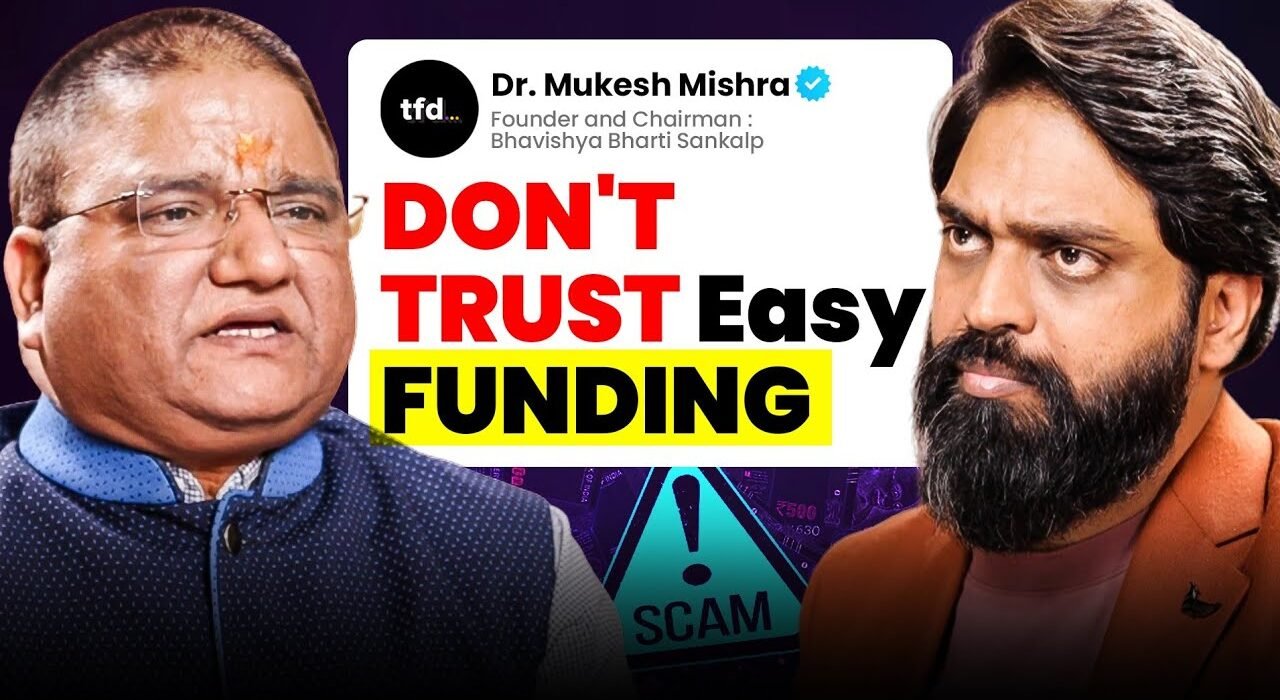
A funding offer at 4-5% interest sounds like a gift when the market rate is 8-9%. Host Abhishek Vyas opens this episode of The Founder’s Dream by asking finance professional Dr. Mukesh Mishra exactly why founders keep falling for offers like this — and the answer he gets is a masterclass in how startup funding India actually works behind the glossy pitch decks and five-star hotel meetings.
Dr. Mukesh Mishra has spent over 20 years in finance, starting in banking before moving into working capital, raw material finance and project funding for companies across Mumbai and beyond. In this conversation he lays out, step by step, how advance-payment scams are built, how foreign funding is supposed to actually work, and what genuine collateral-free funding looks like for a business that is already running.
The No Advance Payment Rule Every Founder Needs in Startup Funding India
Dr. Mishra’s core idea is simple: no legitimate funder should ever ask you to pay before they pay you. He calls it “No Advance Payment,” and he built it as a direct response to a pattern he says he has personally witnessed repeatedly.
Right now funding in India comes at 8-9-10%. If someone tells you they’ll fund you at 4-5%, and you think — okay, the terms look too easy, let me take the risk — that’s exactly when they get you. They’ll make an agreement with a clause that says the advance you pay is non-refundable.
He describes the mechanics in detail: a founder is told a large funding amount is available at an unusually low rate, but “processing fees,” “service charges,” “transaction charges” and even “insurance fees” have to be paid first — in writing, backed by an agreement. Buried inside that agreement is a clause marking the payment non-refundable, so even if the funding never arrives, the founder has no legal way to claim the money back.
What makes this dangerous, he says, is the escalation. He described watching scammers raise the offered amount repeatedly — turning a promised ₹100 into ₹500 — specifically to make the advance percentage look smaller and more acceptable, even though the absolute rupee amount keeps growing.
Flash RTGS, Cash Finance and the Five-Star Hotel Circuit
Beyond the advance-payment trap, Dr. Mishra walks through two other schemes he calls far more dangerous because they are harder to detect. The first is cash finance, where a founder is charged a “delivery fee” — he gives an example of 80 paise per ₹200, which on a large cash amount adds up to over a crore in charges alone before any real money changes hands.
The second, which he calls the most dangerous scam of all, is what he refers to as flash RTGS.
A credit message flashes into your account — “Mr. Vyas, your account has been credited with ₹100 crore.” You call the bank and they confirm the money has landed, but subject to documentation and formalities. It’s software money. It will show for 10, 15, 20 days and then disappear. In that window, they build a relationship with you and convince you to pay a small advance — 50 paise on ₹200 — for the “delivery.”
He connects this directly to the theatre around it — the five-star hotel meetings, the London and Singapore house visits paid for out of the founder’s own pocket, being invited to a scammer’s family functions. All of it, he says, is designed to build trust before the real ask for an advance payment comes in.
Foreign Investment and Why Documentation Decides Everything
Not all foreign funding is a scam — Dr. Mishra is clear that FEMA rules allow genuine cross-border investment into Indian companies, and government support exists for it. The difference between a real deal and a fraudulent one, he says, comes down entirely to documentation and verification.
He describes a three-layer checking process that any legitimate foreign investment must pass: where the money came from with the immediate source, where that source got it from, and one layer further back still. Agencies working with government bodies like RBI carry out this scanning, and if the three-layer check clears, he says, nobody can hold up the funds.
- Genuine funders never ask for an advance before releasing money.
- Real foreign funding routes through rated agencies whose due diligence is already recognised by government bodies.
- A founder only needs to provide the funding company’s name and profile — the agency itself scans and verifies the rest.
- Any clause marked “non-refundable” on a payment you’re making before funding arrives should be treated as a red flag.
Founders who want to understand how these funding conversations are structured on record, rather than picked up in fragments, may find it useful to browse other episodes on Best Hindi Business Podcasts in India, where similar finance-heavy conversations are indexed.
Collateral-Free Funding: What Genuine Support Actually Looks Like
Dr. Mishra also describes structures he works with for companies that are already running but need capital without pledging property. One example he gives is a non-convertible debenture concept: a company with a turnover of around ₹20 crore and a Triple B+ rating can potentially raise ten times its PAT without offering any property or advance.
You give me the company. Without any property, without any advance, I will raise the money for you. If I commit that in nine months you’ll get twice your turnover in funding, I will deliver it — in tranches, three months, two months, one month at a time.
He gives a concrete example of a Mumbai-based road contracting company with roughly ₹500 crore turnover that had won a project but lacked the property to secure financing for it — a case where he says he would arrange the property itself rather than ask the founder for an advance. He is also building an AIF (Alternative Investment Fund) structure — a ₹1,000 crore fund with an office planned in BKC, Mumbai, aimed at tech-based startups, with tickets ranging roughly between ₹10 lakh and ₹1 crore under what he calls A1 and A2 series.
On working capital more broadly, he frames every running business’s funding need around three points: raw material purchase, working capital for salaries and operations, and the gap between delivering goods and receiving payment. Real support, in his framing, means structuring funding around these three needs rather than around collateral alone.
Building the Right Entrepreneur Mindset After a Setback
Beyond funding mechanics, Dr. Mishra spends real time on what separates founders who recover from a bad deal or a failed launch from those who quit. His answer centres on an entrepreneur mindset built on continuous learning rather than ego.
Entrepreneurship is like holding a rope — it will hurt, it may even bleed. If you let go midway, you’ll regret it later and say “I gave up.” So you have to take the pain. But the pain should come from persistence, not from refusing to learn — if your idea launched and isn’t moving, that’s when you go back, ask what’s missing, and adjust.
He is direct about ego being the biggest blocker: thinking “I am who I am, nobody can teach me anything” closes a founder off from useful input — even from an office peon, in his example, who might have a genuinely useful idea. He also talks about actively building a new circle when your existing five relationships stop pushing your growth, rather than staying stuck with people who may — knowingly or not — hold you back.
On investment in startups in India more broadly, he flags a structural gap: strong products built in small towns often never reach buyers in markets like the UK or Dubai simply because the platform and guidance to take them there doesn’t exist yet — not because the product itself is weak.
What Founders Should Actually Check Before Saying Yes
Cutting through the specific scam mechanics, the practical checklist Dr. Mishra lays out for anyone thinking about how to grow business through external funding is fairly consistent:
- Any funding rate significantly below the current market rate (he cites 8-10% as typical) should raise a question before it raises hope.
- Read every clause for the word “non-refundable” before paying anything labelled a processing, service, transaction or insurance fee.
- Verify a bank credit message directly with the bank in person, not by phone — and ask specifically what “subject to documentation and formalities” means for your account.
- For foreign funding, ask which agency is running due diligence and whether that agency’s rating is recognised by government bodies.
- For collateral-free offers, understand exactly who is putting up the third-party guarantee and on what terms.
He is also candid that the industry has few immediate remedies right now, saying he plans to push for government advisories and even suggesting hotels display warnings about known scam suspects — an idea he frames as unlikely to stop fraud entirely but capable of slowing it down.
For founders who’d rather learn this kind of detail directly from people who work in finance and funding every day, episodes like this one are exactly why a founder podcast format works — long-form conversation surfaces the specific clauses and red flags a five-minute reel never will. Watch the full conversation with host Abhishek Vyas on The Founder’s Dream YouTube channel and subscribe for new founder interviews every week.
Frequently asked questions
What is the 'No Advance Payment' concept in funding?
It is Dr. Mukesh Mishra’s proposed standard where funders should never ask a founder to pay processing fees, service charges or transaction fees upfront before releasing the actual funding amount.
What is a flash RTGS scam?
It is a fake credit message showing a large amount in a founder’s bank account, which the bank will only confirm as ‘subject to documentation’ while the scammer pressures the founder to pay advance charges to release it.
Can foreign funding legally come into an Indian startup?
Yes, under FEMA and RBI guidelines, but Dr. Mukesh Mishra explains it requires a three-layer verification of where the money originated before it reaches an Indian company.
What does collateral-free funding look like in practice?
Dr. Mukesh Mishra describes structures like non-convertible debentures where a company with a strong turnover and rating can raise funds without pledging property or paying any advance.
Why do many Indian startups fail to scale globally?
According to the episode, it is often lack of platform, guidance and support rather than lack of quality — a good product made in a small town has no path to reach buyers in the UK or Dubai without the right push.

1 Comment