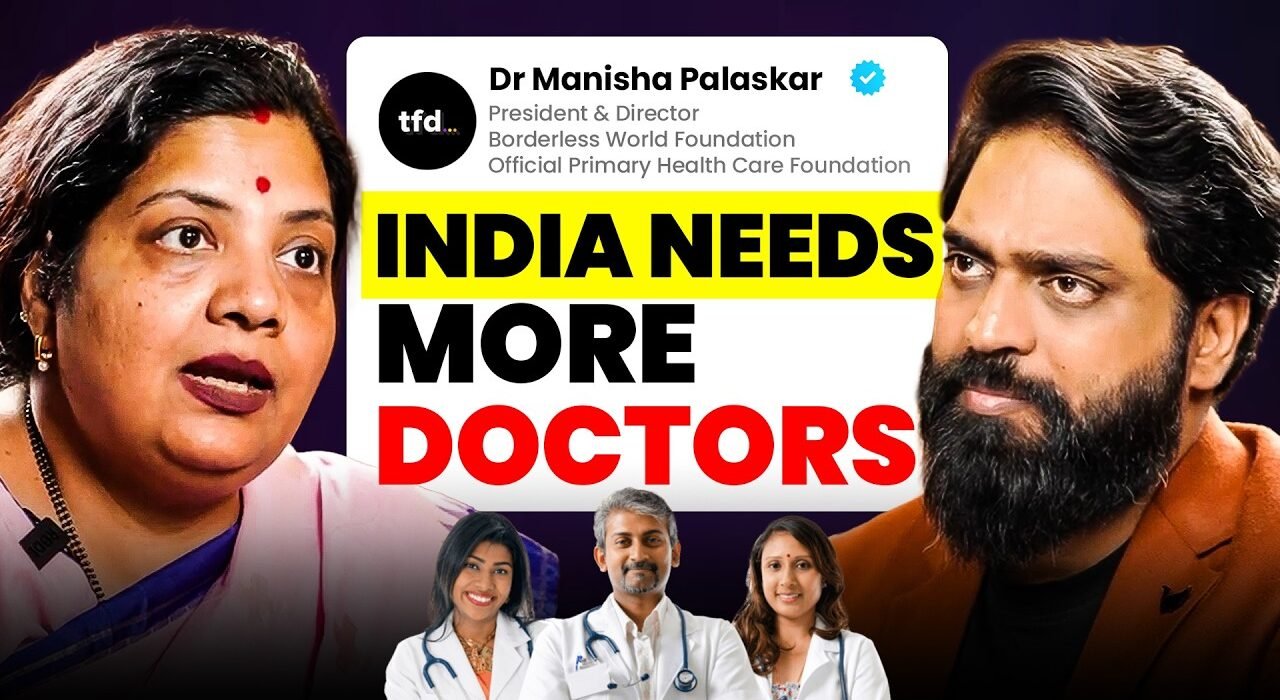
India builds ICUs, tertiary hospitals and mobile apps for healthcare, yet a young, otherwise healthy person can still die of a brain hemorrhage because nobody told them their blood pressure was dangerously high. That contradiction sits at the center of this Dr. Manisha Palaskar interview on The Founder’s Dream, where host Abhishek Vyas asks the founder of Primary Health Care Foundation why India keeps investing at the top of the healthcare pyramid while its base stays weak.
Dr. Palaskar isn’t a hospital administrator arguing for more beds. She is a public health leader who has spent years working inside government-run primary health centres, and her argument is blunt: fix the front door before building bigger back rooms.
Inside the Dr. Manisha Palaskar Interview: Why Primary Healthcare Matters
Her starting point is a number most people never think about. As she puts it, roughly 70% of patients first need primary healthcare, not a specialist or an ICU bed. Yet the system keeps expanding tertiary care while treating the primary layer as an afterthought.
She isn’t against building bigger hospitals. Her issue is with the order of priorities:
Primary healthcare is the base of the entire healthcare pyramid, where 70% of patients need care first. But we are not strengthening that — we keep building ICUs and tertiary hospitals instead. I’m not saying those aren’t needed, but why should a patient even have to reach that stage? If we strengthen primary healthcare itself, they won’t need to go further.
She backs this with cases that will sound familiar to anyone who lived through the post-Covid years: a healthy-looking 30-year-old who dies suddenly of a brain hemorrhage because undiagnosed hypertension was never caught; young people getting paralysis attacks; diabetic patients suddenly landing in renal failure and dialysis because nobody screened them early. None of these are rare stories in India — they are the direct cost of skipping prevention.
From Reactive to Responsive: India’s Preventive Healthcare Gap
Ask most Indians when they last got a full checkup without being sick, and the honest answer is usually “never.” Dr. Palaskar names this pattern directly:
Unfortunately, our health system doesn’t respond — it reacts. We only go to the doctor once we’re already ill. That reactive approach, not a responsive one, is the real problem. That’s exactly why our disease burden is so high — you know we’re number one in the country for diabetes.
She draws a sharp comparison to how companies already operate — most employers run a mandatory health checkup before hiring someone, precisely because they understand risk needs to be caught early. Her question back to listeners is simple: if you already accept that logic for your employees, why not for yourself and your own family?
Doctor-Patient Ratio and the Rural-Urban Divide
The infrastructure gap becomes concrete once you look at where India’s doctors actually work. Dr. Palaskar cites the doctor-patient ratio as the first, biggest item on any honest report card for Indian primary healthcare — more than 1,000 patients per doctor, against a WHO benchmark of at least one doctor per 1,000 people. On top of that, the overwhelming majority of India’s doctors are concentrated in urban areas, leaving rural primary health centres chronically understaffed.
This isn’t just a numbers problem — it shapes what actually happens inside a village clinic. She describes visiting primary health centres where the ceiling is falling apart, mold covers the walls, and surgeries are still being performed in that same compromised space, with no real infection-control practice in place. Her comparison is telling: unlike many African countries that lack basic health infrastructure altogether, India already has the physical structure — the gap is in what happens inside it and how care is actually delivered.
Primary Health Care Foundation Founder Story: What Panna Taught Her
The origin of her organisation is a good case study in how to actually fix something on the ground instead of just diagnosing it from a distance. While working on a project in Panna, her team learned that the local primary health centre was being locked up after 12 pm — doctors left because patients simply weren’t showing up, and patients stopped coming because they knew no doctor would be there. It was a self-reinforcing cycle of neglect.
Rather than escalate the complaint, they asked for a single room and started seeing patients themselves as a not-for-profit initiative. Slowly, they began running village camps. Within time, their own OPD load grew to around 100 patients a day — and that changed the local calculus entirely, because the government doctors and nurses at that centre started coming back too, once they saw patients actually returning.
That is the real answer to how Dr. Manisha Palaskar built Primary Health Care Foundation — not through policy papers first, but by showing up physically, understanding the exact bottlenecks, and then building a program around what she found. It’s also where she landed on the three-part diagnosis she now applies everywhere: infrastructure, capacity building of the health workforce, and clear accountability for outcomes. Miss any one of the three, she argues, and nothing actually changes.
Working With the System, Not Against It
Given how sharply she critiques government primary health centres, it would be easy to assume she positions herself as an outsider fighting the system. She rejects that framing directly:
I don’t want to work against the system. I am part of the system, and this is my country — I am a very strong nationalist. We cannot always work by opposing the system. My agenda is to work with the government and complement whatever strength we already have.
Her method, in practice, is to go into a district, understand the specific administrative challenges with the political and bureaucratic leadership already in place, then design a program that supports the government’s own initiative rather than duplicating it. She calls this an integrated rural primary healthcare delivery program — every component designed to plug a gap the local administration already knows exists, rather than build a parallel structure that competes with it.
One of her clearest asks is structural: she wants health moved from the State List to the Concurrent List in India’s constitutional framework, so that the standard of treatment available in one state doesn’t depend entirely on which state you happen to live in.
Fixing CSR and NGOs: From Mandates to Measurable Impact
Dr. Palaskar is equally direct about where corporate and NGO money goes wrong. Her core complaint isn’t that there’s too little money in the system — it’s that intent shapes outcome, and most CSR spending starts from the wrong intent:
If I’m spending on CSR just because it’s mandated and I’ll otherwise get a notice, that will never be successful. What a wonderful tool CSR could be to support government efforts — if instead I think about improving the system and doing complementary work with government, imagine the difference it would make to the outcome.
She points out that many CSR-funded projects skip monitoring and evaluation almost entirely — sometimes less than 1% of a project’s budget goes toward actually measuring whether it worked. A donated water cooler or a school board that nobody maintains isn’t impact; it’s a photo opportunity. Her suggested fix borrows directly from business thinking: just as a company tracks return on investment, CSR spending should be tracked as a social return on investment, tied to actual outcomes in a specific district.
She sees the same inequality creeping into the NGO sector itself — some NGOs now operate at massive scale while others are running hostels for tribal children on personal savings or insurance payouts, with no support structure connecting the two. Her advice to any founder allocating money for real change is the same discipline covered in habits of successful entrepreneurs on this podcast — pick one cause, build a monitoring system into the plan from day one, and don’t treat impact spending as an afterthought bolted onto the balance sheet.
What a Better Report Card Could Look Like by 2035
Asked what she wants to prove over the next decade, her answer stays close to the same theme that runs through this indian business podcast conversation: simplicity before scale. Strengthen the primary healthcare foundation, stop turning citizens into patients unnecessarily, then build the advanced systems on top of that solid base — not the other way around.
She also flags a quieter gap worth naming: nurses and ASHA workers are the backbone of India’s entire government health structure, yet very few women sit on the boards and decision-making bodies that shape health policy. She wants that changed too, alongside the constitutional shift on health she keeps returning to throughout the episode.
For founders and CSR leads wondering where to start, her message is consistent with everything The Founder’s Dream stands for — a show built, as explained on The Founder’s Dream’s own homepage, on grounded, first-hand founder experience rather than theory. Pick a real problem, understand it on the ground the way she did in Panna, and support the system instead of trying to replace it.
Watch the full Dr. Manisha Palaskar on The Founder’s Dream conversation with host Abhishek Vyas on The Founder’s Dream YouTube channel and subscribe for new founder interviews every week.
Frequently asked questions
Who is Dr. Manisha Palaskar?
Dr. Manisha Palaskar is a public health leader, policy advisor and founder of Primary Health Care Foundation, an organisation working to strengthen primary healthcare infrastructure and health worker capacity across rural India, including field projects in Panna.
Why does Dr. Manisha Palaskar say primary healthcare matters most?
She explains that around 70% of patients first need primary healthcare, but India keeps building ICUs and tertiary hospitals while neglecting the base of the healthcare pyramid, forcing citizens to become patients who could have been treated earlier.
What is India's doctor-patient ratio according to this interview?
Dr. Palaskar says India has more than 1,000 patients per doctor against the WHO recommendation of at least one doctor per 1,000 people, and that a large majority of doctors work in urban areas rather than rural India.
What did Dr. Manisha Palaskar's team do in Panna?
Her team found a primary health centre in Panna being locked after 12 pm because no patients came; after they started running camps and seeing patients themselves, daily OPD grew to about 100 patients and local doctors and nurses began showing up again.
What does Dr. Palaskar suggest about CSR spending on healthcare?
She argues CSR should not be spent just to meet a legal mandate but should be treated like a ‘social return on investment,’ with proper monitoring and evaluation instead of one-off donations like water coolers or boards that no one maintains.