
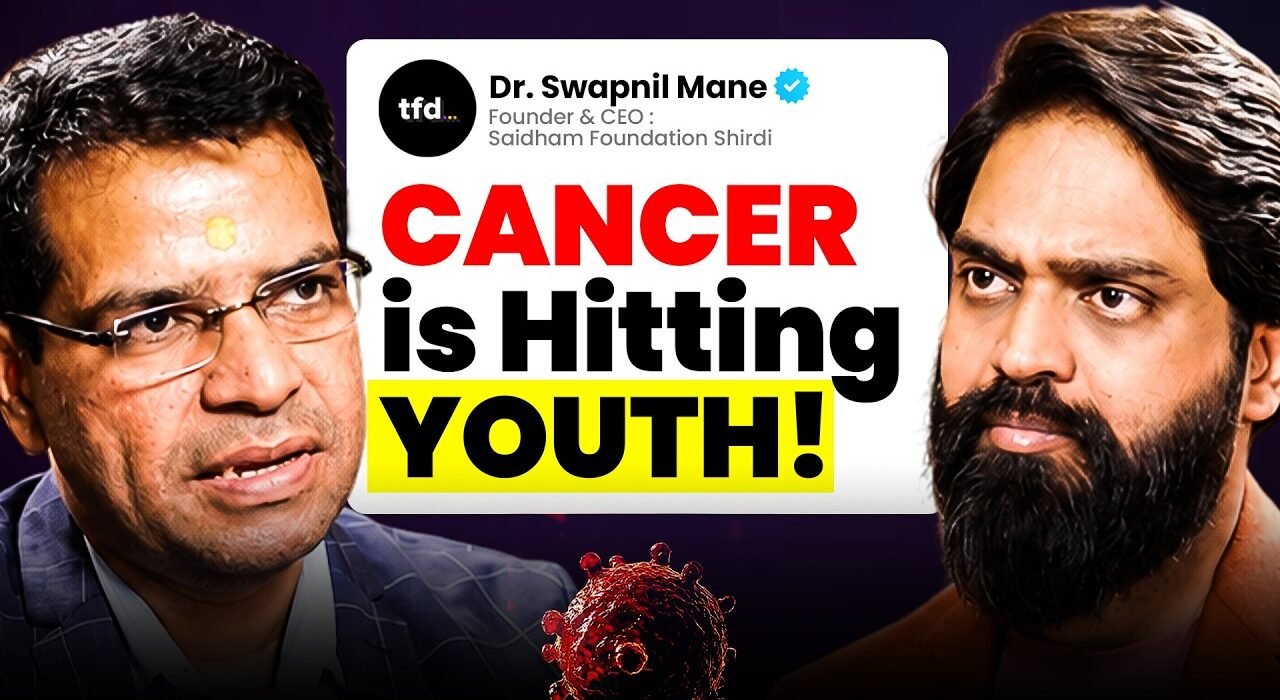
Cancer used to be talked about as something that happened to people in their fifties or sixties. In this Dr. Swapnil Mane interview on The Founder’s Dream, host Abhishek Vyas sits down with a doctor who left Tata Memorial Hospital to work in rural Maharashtra, and the numbers he shares are hard to ignore — people in their 30s are now showing up with cancer in villages that never used to see it.
Dr. Mane is the founder of Sai Dham Foundation, which has treated 16,000 cancer patients free of cost over 14 years and now runs community screening programmes across 13 states. This conversation covers why the disease is spreading into a younger generation, what tests actually catch it early, and why a vaccine that has existed for 15 years is only now getting attention in India. Dr. Swapnil Mane on The Founder’s Dream doesn’t just discuss the foundation’s scale — he explains exactly how it works, patient by patient.
Why This Dr. Swapnil Mane Interview Matters for Every Indian Family
Most awareness around cancer, Dr. Mane points out, spreads only when a celebrity is diagnosed. That leaves ordinary families — especially in villages — without basic information about a disease that kills an estimated 1,500 to 1,700 people every single day in India, second only to road traffic accidents. The gap isn’t the disease itself; it’s what people know about it.
What makes this Dr. Swapnil Mane interview worth sitting through is that he doesn’t stop at statistics. He walks through exactly which tests to get, what symptoms to watch for, and why waiting for pain is the biggest mistake patients make — because early-stage cancer rarely hurts.
From a Childhood Loss to Leaving Tata Memorial Hospital
Dr. Mane’s path to this work — and the Sai Dham Foundation founder story that would follow — started in 1992, when he was in fifth grade in a village near Shirdi. A neighbour, Godse kaka, was dying of lung cancer, and a corporate hospital in Pune had quoted a treatment cost the family couldn’t afford.
I asked my mother, “Why can’t we help him?” She said, “Son, we don’t earn enough to help him.” That is when I took a vow — I will become a doctor for the poor, a doctor for everyone, and dedicate my life to serving my country.
Years later, while working at Tata Memorial Hospital, he watched patients from villages travel long distances only to face queues, no place to stay, and months spent on footpaths outside the hospital. That was the moment he decided a single hospital, however good, couldn’t fix the problem — the work had to move into rural India itself. He started a 15-bed hospital in rented premises in Rahuri, a village near Shirdi, and it has now run for 14 years.
Why Cancer Is Rising Among Young People in India
The most striking claim in this Dr. Swapnil Mane interview is about age. Over the last seven to eight years, he says, cancer has quietly become a disease of people in their 30s and 35s in rural areas — not just older adults.
This generation, I’ve noticed, is under a lot more stress — about their careers, about their education. Eating outside food has increased a lot, junk food items that contain parabens, estrogen and phthalates, and these can contribute to cancer.
He also flags obesity as a shift worth noticing: around 15% of Indians were obese before independence; today he estimates 60-65% of the population is overweight or obese. Late nights, constant screen time, reduced physical activity, and rising tobacco, alcohol and drug use round out the picture. And this isn’t a city-only problem — he says junk food and the same lifestyle patterns have reached Tier 3 and Tier 4 towns and villages just as strongly.
It Isn’t Only a Disease of the Wealthy
It’s not that only the poor get it, or only the rich don’t — this disease can grip anyone, anytime.
Screening, Warning Signs and the HPV Vaccine
Dr. Mane compares body screening to servicing a car once a year — routine, not reactive. For women, he recommends CA-125, a pap smear for cervical cancer, CA 19-9 for colon cancer, CEA testing, and an annual sonography. For men, he recommends an oral examination by a dentist or cancer surgeon, a PSA blood test for prostate cancer, CA 19-9, and an ultrasound to check for kidney and liver cancers.
Cost is often the real barrier people cite. He addresses it directly: these tests are free at government and charitable hospitals, and around ₹4,000-5,000 a year if done privately.
- Lump or unusual hardness felt in the breast or underarm
- Unusual white discharge or heavy bleeding in women
- Sudden, unexplained weight loss and loss of appetite
- Persistent weakness and a drop in mental morale
- Mouth ulcers that keep recurring, or a change in voice
- A cough lasting more than 21 days
- Repeated stomach trouble or diarrhoea that doesn’t respond to medicine
On cervical cancer specifically, he’s direct about the HPV vaccine: two doses between ages 9 and 15 give strong protection, and up to three doses can be taken between 15 and 40-50 years, offering 80-90% protection. Sai Dham Foundation has vaccinated 5 lakh people so far. He’s also candid that this isn’t new science being pushed for the first time — vaccination against HPV has existed globally for 15 years, but government-level rollout in India only started recently.
How Dr. Swapnil Mane Built Sai Dham Foundation’s Free Treatment Model
The Dr. Swapnil Mane success story is really a story of scale — Sai Dham Foundation now works across 13 Indian states and five countries, focusing deliberately on Tier 3 and Tier 4 cities where government cancer hospitals and charitable hospitals partner with the foundation’s community teams to detect and follow up on cases. Twelve vans, largely funded through corporate CSR partners like Sun Pharma, run mobile screening camps — the foundation has covered 1,300 villages and screened roughly 10 lakh people so far.
Sai Dham Foundation’s business model rests on India’s existing healthcare schemes rather than pure donation dependency. Around 90% of patients are covered under Ayushman Bharat, PM Jan Arogya Yojana, Maharashtra’s Mahatma Phule Jeevandayee Yojana, or CM/PM Relief Funds; the remaining 10% who aren’t scheme-eligible are supported through CSR funding.
If we screen well for five years, spread awareness, build public consciousness, and screen every population properly, cancer rates in India could come down by 50 percent.
The foundation is also building a 100-bed cancer hospital in Shirdi on 22 acres of land, and runs a research wing recognised by the Department of Science and Technology, holding 28 patents and 57 published research papers — including low-cost surgical techniques designed to bring procedures that typically cost ₹1 lakh down to roughly ₹1,000. Readers following other founder journeys on entrepreneurial journey stories will notice a similar pattern here: a personal loss turning into a sustained, systems-driven mission rather than a one-time act of charity.
The Mindset Shift India Still Needs
Dr. Mane is blunt about what’s held back progress: people’s reluctance to leave home for screening, deep-rooted superstitions that getting tested somehow causes the diagnosis, and — in his words — a “loose attitude” at times from government follow-through, even as the underlying schemes exist and work well on paper.
He’s equally direct about misinformation. Roughly 90% of cancer-related content circulating on social media, he says, has no real basis, and it actively discourages people from getting vaccinated or screened. His advice is simple: rely on qualified doctors, not self-diagnosis videos.
We spent ten years studying to understand exactly what I’ve just told you. It isn’t something to work out from a video. Ordinary people can get a rough sense from the symptoms, but the final diagnosis has to come from a qualified doctor.
He also makes a point that deserves repeating for any family that has faced a cancer diagnosis: government packages under schemes like PM Jan Arogya Yojana are meant to cover a patient’s stay, food, and even travel allowance back home — benefits many families never claim simply because no one tells them these exist. For anyone building resilience through hard personal experience, the self growth lessons in this episode go beyond healthcare — they’re about persistence in the face of institutional gaps.
The closing message from this Dr. Swapnil Mane interview is the simplest one: cancer isn’t contagious, it isn’t a disease reserved for the elderly, and it isn’t a disease of the poor alone. It takes five to eight years, in most cases, to move from stage one to stage four — which means there is a real window to catch it, if people are willing to walk into a clinic before symptoms force them there.
Watch the full conversation with host Abhishek Vyas on The Founder’s Dream YouTube channel and subscribe for new founder interviews every week.
Frequently asked questions
Who is Dr. Swapnil Mane and what is Sai Dham Foundation?
Dr. Swapnil Mane is the founder of Sai Dham Foundation, an organisation he started after leaving Tata Memorial Hospital to provide free cancer screening and treatment in rural India, beginning with a 15-bed hospital in Rahuri near Shirdi.
Why is cancer increasing among young people in India?
Dr. Mane attributes this to rising career and education-related stress, an increase in junk food containing parabens and phthalates, late nights, screen addiction, reduced physical activity, and growing use of tobacco, alcohol and drugs among the young generation.
What cancer screening tests does Dr. Swapnil Mane recommend?
For women he recommends CA-125, a pap smear, CA 19-9, CEA blood tests and an annual sonography; for men he recommends an oral examination, PSA blood test, CA 19-9 and an ultrasound for kidney and liver cancers, done once a year.
Does the HPV vaccine prevent cervical cancer?
Dr. Mane explains that the HPV vaccine is a preventive measure, not a cure, and that two doses given between ages 9 and 15, or three doses up to age 40-50, offer 80-90 percent protection against cervical cancer.
How can someone get free cancer treatment through Sai Dham Foundation?
According to Dr. Mane, patients from anywhere in India, and even abroad, can contact Sai Dham Foundation directly, and the organisation connects them to government schemes like PM Jan Arogya Yojana or CSR support if they are not scheme-eligible.
1 Comment