
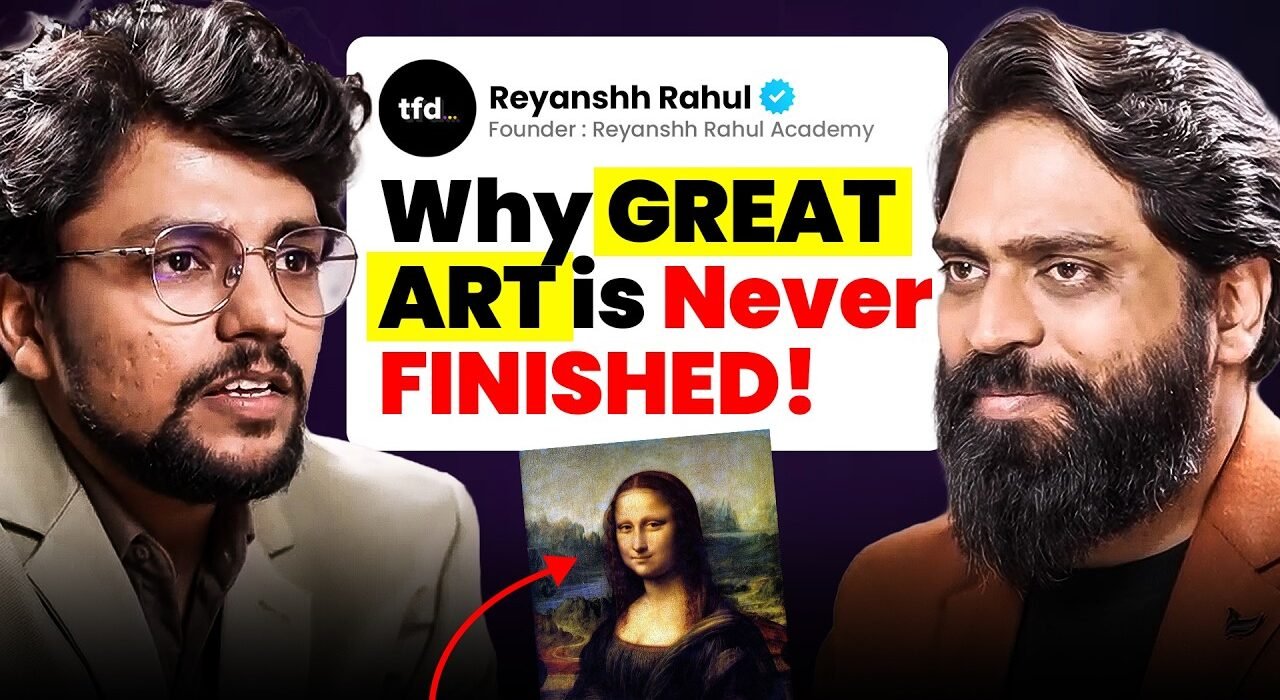
Most entrepreneur success story India conversations involve a product, a funding round, or a tech idea. Reyanshh Rahul’s story has none of that — it has a cancelled CA entrance plan, a family financial crisis in a new city, and a decision to teach children drawing simply to survive. On The Founder’s Dream, host Abhishek Vyas sat down with Rahul, founder of Reyanshh Rahul Academy, to unpack how a childhood hobby turned into a business that has trained thousands of students and produced a portrait commissioned for India’s Prime Minister.
From CA Student to Entrepreneur Success Story India Remembers
Rahul was drawing since he was three or four years old — his father kept buying him drawing books, and school competitions became his identity. But when it came time to choose a path after school, he picked commerce, then set his sights on becoming a Chartered Accountant. For two and a half years he pushed through CA preparation, until the feeling became impossible to ignore.
He describes the exact discomfort that made him quit:
I used to feel like I was just becoming part of the crowd. During school and college, art gave me a small identity of my own — but while studying CA, I felt I was losing that.
That missing “mazaa” — the simple word he keeps returning to — was the real signal. He told his parents, left CA, and returned to art. It’s a theme any reader exploring self growth lessons will recognise: the discomfort of fitting in versus the pull of doing the one thing that felt like yours.
Why Parents Hesitate — And What Changes Everything
Abhishek Vyas asked him directly why almost no parent in India says “my child will become an artist.” Rahul’s answer wasn’t about money — it was about generational information gaps. Parents grew up without social media, without visibility into other careers, limited to whatever their own village or town could show them. That environment hardened into a belief: stability is safety, and nothing beyond the known is worth risking.
But Rahul isn’t interested in blaming that generation. He’s interested in what happens when a parent simply says yes. In one of the episode’s sharpest moments, he said:
Nobody needs to go anywhere in the world, needs any mentorship, or needs money. I’m speaking directly to the fathers — if you can just tell your child, “Go do it, I’m here with you,” that one sentence can change that person’s entire life.
His own father fits this exactly. Despite relatives, school teachers, and even his principal openly questioning “what will you do, how will this work,” his father’s quiet support became the one constant that let Rahul keep going.
A Financial Crisis Became the Real Beginning
The turning point wasn’t a lucky break — it was a 2018 family move that triggered a serious financial crisis. His father’s work was unstable, the city was new, and Rahul, with no plan and no knowledge of social media, started teaching children to draw purely out of necessity. He admits he didn’t even enjoy teaching at first. But watching how low the situation could get removed his biggest fear: the option to quit.
That shift — from “maybe I’ll try something else” to “there is no option but this” — is a pattern worth noting for anyone reading entrepreneurial journey stories on this site. Constraint, not comfort, forced the commitment that built his career.
Is a Painting Ever Truly Finished?
The episode opens with a question every artist faces: how do you know a painting is done? Rahul brought up Leonardo da Vinci’s idea that a painting is never actually finished — an artist simply abandons it. He explained the emotional side of this: the first time you see any artwork, there’s a kind of magic, but the artist loses that magic early because they’ve been staring at the same piece through every stage of its creation.
However many times you look at a painting, you’ll always feel something more can be added. Technically, you can call it complete the moment you realise adding anything more stops making it better — that’s the point where you stop.
He used Leonardo da Vinci to make a larger point about mastery: da Vinci dissected cadavers to study the heart, built early working models for machines like helicopters, and spent close to ten to twelve years just on the lips of the Mona Lisa — a painting Rahul says was never considered complete. The lesson wasn’t about painting technique alone; it was about how deep technical study has to go before creativity even matters.
Art Doesn’t Sell — The Artist Sells
When Abhishek Vyas raised the obvious question — artists with lakhs of followers still struggling to earn — Rahul didn’t blame the platforms. He blamed how artists use them.
It doesn’t matter how many followers or likes you have. What matters is how many people trust you and feel personally connected to your content. Art doesn’t sell — the artist sells.
He pointed to Picasso’s Guernica and Jackson Pollock’s work as examples: audiences don’t just admire the final canvas, they connect with the person and the thought behind it. In an AI era where images can be generated in seconds, this human bond is the only real differentiator left. His advice for artists online is specific:
- Show the story and knowledge behind each artwork, not just the finished piece
- Build trust over chasing likes or follower counts
- Let people know the person behind the brush, because that’s what AI-generated art cannot replicate
How Artists Actually Get Paid
Rahul’s own first income didn’t come from teaching — it came from commission paintings, where a client specifies the subject and pays the artist to create it. He broke down how wide this market actually is: portraits, pet portraits, even house portraits for people deeply attached to a home they designed carefully. He noted the commission market is especially large in the US, though India has a growing base of clients too.
Beyond commissions, he flagged brand collaborations as a fast-growing opportunity — paint and brush companies, even car brands, now look for artists with a specialised audience to create artwork and reels around their product launches. On the education-versus-degree debate, his framing was blunt:
A degree is proof you took that education. But until your artwork justifies your degree, the degree has no value by itself. Nobody asks Arijit Singh for a certificate before listening to his song — they listen because they connect with the music.
Building Reyanshh Rahul Academy
The academy runs on two core goals, as Rahul explained to Abhishek Vyas: first, making every serious student technically strong, because technical weakness — not lack of creativity — is what he sees holding back Indian artists. Second, teaching the business layer most art schools skip entirely: social media, team building, hiring, content creation, and marketing. In practice, this means treating art as a business from day one — a student isn’t just taught to paint well, but to price commissions, pitch to clients, and build an audience the way any entrepreneur would.
The results he shared were specific. One student with zero art background got the opportunity to create a commissioned piece for India’s President. Another, a housewife in her 40s with an engineering background whose art had been shelved after marriage, now runs her own art school in Maharashtra, earns well, and heard her own parents — who once discouraged her drawing — say they regretted not supporting her sooner. A third student learned to paint while fighting cancer, calling herself grateful simply for the chance to learn in that situation. Rahul currently focuses the academy on learners aged 14 and above, deliberately keeping teaching methods for children separate from professional-track training.
What Success Looks Like to Him
Asked if he’s genuinely satisfied, Rahul didn’t hesitate. He measures life against three things — health, wealth, and relationships — and says all three are currently working for him, which is why he considers himself at the top of his own definition of success and happiness.
His advice echoes throughout the episode: don’t copy what’s selling in the market, a lesson he credits to sculptor Ram Sutar, who told him after seeing his Mona Lisa master study to stay loyal to what feels true rather than chasing trends. It’s a fitting note for any The Founder’s Dream podcast listener trying to separate noise from signal in their own field.
Watch the full conversation with host Abhishek Vyas on The Founder’s Dream YouTube channel and subscribe for new founder interviews every week.
Frequently asked questions
Who is Reyanshh Rahul?
Reyanshh Rahul is an artist, art entrepreneur, and founder of Reyanshh Rahul Academy, known for international commission artwork and for painting a portrait of India’s Prime Minister.
Can artists actually make money in India?
Yes, according to Reyanshh Rahul, through commission paintings, teaching, brand collaborations, pet and house portraits, and building a genuine audience rather than chasing followers.
Why do Indian parents hesitate to support art as a career?
Reyanshh Rahul explains that many parents grew up with limited opportunities and information, so they developed a belief that stability matters more than passion, which makes them cautious about careers like art.
What does Reyanshh Rahul Academy actually teach?
The academy focuses on two things: building strong technical art skills and teaching the business side of art, including social media, branding, and working with teams.
Is a formal art degree necessary to become a professional artist?
Reyanshh Rahul says a degree is only proof you attended a course, while skill is proof you can actually do the work, and clients care far more about the latter.
1 Comment