
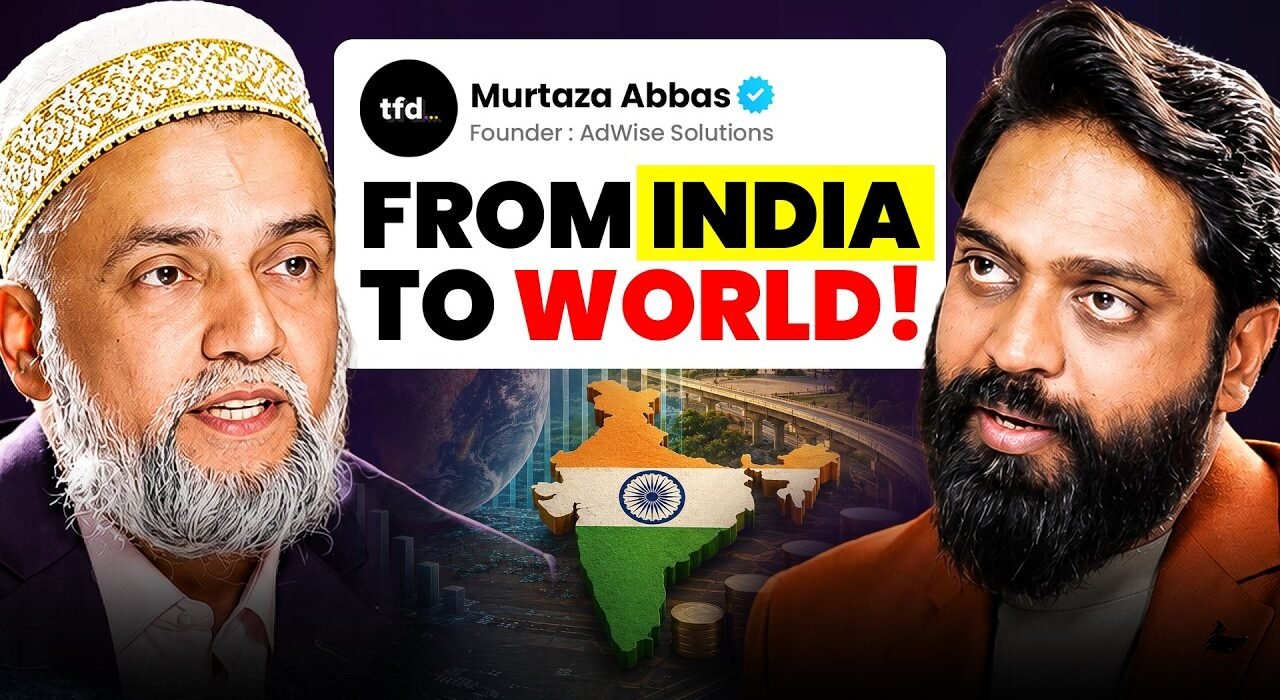
Most founders know they need to scale. Very few know what actually breaks when they do. On this episode of The Founder’s Dream, a founder podcast hosted by Abhishek Vyas, he sits down with Murtaza Abbas, a management consultant and business growth strategist, to talk about how to grow business from India without losing control of leadership, cash, or quality — and why he thinks the real ceiling for an Indian manufacturer isn’t India at all.
Murtaza spent 18 years in a corporate career before walking away from it. He explains the decision simply:
India has a lot of talent and a lot of people who can grow — if they get some guidance and some planning, they activate much faster, and their growth speeds up. I saw that gap, and I thought, why not contribute to the nation by growing companies and increasing our country’s exports.
Ten years later, he’s worked with manufacturers across engineering, lighting, food and FMCG — taking one client from a single customer to more than 30, and one company from three people to over 55 employees. What follows is what he told Abhishek about leadership, investors, exports and the mindset shift that separates a trader from a manufacturer.
How to Grow Business When Leadership Hasn’t Kept Pace
Murtaza’s first big insight is about timing. Leadership problems don’t show up when a company has 10 people — they show up when it crosses 100, 200, 250 people. That’s when the founder’s personal way of thinking has to transfer into the organisation, or growth stalls.
The founder’s thought process has to sync with leadership. Whatever we’re able to explain clearly to enough employees automatically starts showing down the line — and then the leader makes another leader.
He points to a lighting company as a concrete example. When his team started working with them, there were only three people, including the founder. Today there are more than 55 people on the team, and — as he puts it — the owner doesn’t even need to go to the factory anymore. That shift didn’t happen by accident; it came from aligning team members around clarity, training and a shared vision, until the organisation could run without the founder physically present.
This is also where an entrepreneur mindset becomes a team-wide property rather than a personal trait. Murtaza is blunt that leaders aren’t readymade — they’re created inside the organisation through clarity, transparency and a clearly communicated company culture. Founders weighing whether to bring in a partner to share this load might find useful context in this piece on whether you need a business co-founder, which covers a related but distinct decision: sharing ownership versus building leaders under you.
What Investors Actually Look For Before Writing a Check
Asked how the right investor gets matched with the right business, Murtaza doesn’t talk about pitch decks or growth projections. He talks about bookkeeping.
The most important thing is how you maintain your accounts, how you maintain your processes. If all of this is visible on a dashboard, if the data stays clean in front of you, investors automatically get attracted.
His argument is that transparency in paperwork and operations is what makes a company “investable” — not ambition. He also pushes back on the idea that getting investor alignment solves everything. Challenges, he says, never actually disappear; they’re part of the business itself. His own journey went from lab-scale production to pilot models, to commercial models, to full turnkey projects — each stage bringing its own new problem to solve. He even tells his own team that if a day goes by without a problem to fix, something is wrong:
If you don’t have a problem every single day, what have you built? Every single day there should be some challenge — that’s what keeps the energy alive in the work, and it shows up in your team.
From Trading to Manufacturing: The Mindset Shift
A large part of the conversation is about why so many Indian business owners stay traders — buying from a factory and reselling — rather than becoming manufacturers. For Murtaza, the first requirement isn’t capital. It’s ambition at the thought level.
If you want to go from a normal regional level to a global level, you first have to bring a bigger thought into yourself — that I have to sell my goods in the whole world. The day you decide that, your journey toward going global actually begins.
He’s equally clear about the most common mistake he sees business owners make when they finally try to set up manufacturing: jumping in because they saw someone else do it, without first analysing and defining their own market. Skipping that step means guessing at scale — buying a machine too small or too large for the actual demand — and that miscalculation eventually puts a brake on growth. His process instead starts with an honest assessment of where the organisation stands today, before any machinery purchase or financial commitment is made.
On the Upkar brand — a small pickle manufacturer from Rajasthan mentioned in his client list — Murtaza notes that while it was already a small manufacturer, the quality and standards of its pickles were well known in the country, and the work was about scaling that existing credibility rather than building a brand from zero.
Exporting: Quality, Consistency and the Government’s Role
This is where Murtaza’s philosophy becomes a line that’s easy to remember:
I always say once you are into manufacturing, then the world is the market. Every country needs manufacturing, needs exports, needs foreign currency — and we can help them achieve that.
He makes a specific point about pricing that’s worth sitting with: a product selling for ₹10 in one country doesn’t have to stay at ₹10 everywhere — it could sell for ₹100 in a different market, if the business identifies where its quality earns more value. His advice to manufacturers is to stop asking only what the nearest customer wants, and instead keep pushing toward peak quality: “the day you go to your peak quality, that’s the day you reach the highest-value market.”
For markets like the Middle East and Africa, though, he draws a distinction: those buyers don’t always demand the absolute best quality — they demand consistency in whatever quality tier they’re buying.
Consistency is the key to success in any business.
He ties this directly back to systems: if sourcing, processing, storage, quality checks and delivery are all standardised, consistency stops being a goal and becomes the default outcome. Where Indian manufacturers get stuck internationally, in his experience, is research and development — companies that copy an existing product rather than innovating in packaging or the product itself tend to hit a ceiling abroad. On government support, he credits India’s infrastructure progress over the last five to ten years — ports, airports and connectivity — along with government data now showing businesses that their own product is already being exported, nudging owners who never considered it.
The Four-Step Growth Process: Diagnose, Design, Deploy, Dominate
Murtaza describes his consultancy’s method in four stages, and it’s worth breaking down because it explains how he approaches every client, regardless of industry:
- Diagnose — understand the company’s current state in detail before suggesting anything.
- Design — build a roadmap to take that specific company to its next level.
- Deploy — work alongside the team to implement the roadmap, not just hand over advice.
- Dominate — once deployed, push the business toward global market dominance.
He’s also direct that his firm — he’s reachable on Instagram as mac.adwise — stays focused on manufacturing specifically, and will even help a service business restructure itself to adopt manufacturing-style systems. His reasoning: manufacturing gives you control over quality, control over delivery timelines, and eventually a brand image that pulls customers toward you instead of you chasing them. That’s a sharper answer to how to grow a company than most generic growth advice offers, because it’s tied to a repeatable operating model rather than a single tactic. Readers who want to see how systems and automation intersect with this kind of scaling might also find this conversation on growing a business with AI automation useful as a complementary read.
His closing message to aspiring founders listening to this Indian business podcast was short and unambiguous: come into manufacturing, treat the world as your market, and aim to dominate it.
Watch the full conversation with host Abhishek Vyas on The Founder’s Dream YouTube channel and subscribe for new founder interviews every week.
Frequently asked questions
Who is Murtaza Abbas?
Murtaza Abbas is a management consultant and business growth strategist who left an 18-year corporate career to help Indian companies scale, build leadership and move from trading into manufacturing and exports.
What is the four-step process Murtaza Abbas uses with companies?
He calls it Diagnose, Design, Deploy, Dominate: first understanding a company’s current state, then designing a roadmap, then deploying it alongside the team, and finally helping the business dominate globally.
What do investors look for before funding a business, according to Murtaza Abbas?
He says transparency and clean data are the deciding factors; if a company’s accounts, processes and client dealings are clearly visible on a dashboard, investors are naturally attracted.
What is the biggest mistake businesses make moving from trading to manufacturing?
Murtaza Abbas says most traders jump straight into building a factory after seeing others succeed, without first analysing and defining their market and scaling stage by stage.
Why does Murtaza Abbas say manufacturers should think about exports from day one?
He believes once a business is in manufacturing, the world becomes its market, and products priced low in one country can command far higher value elsewhere if quality and consistency are maintained.

1 Comment