
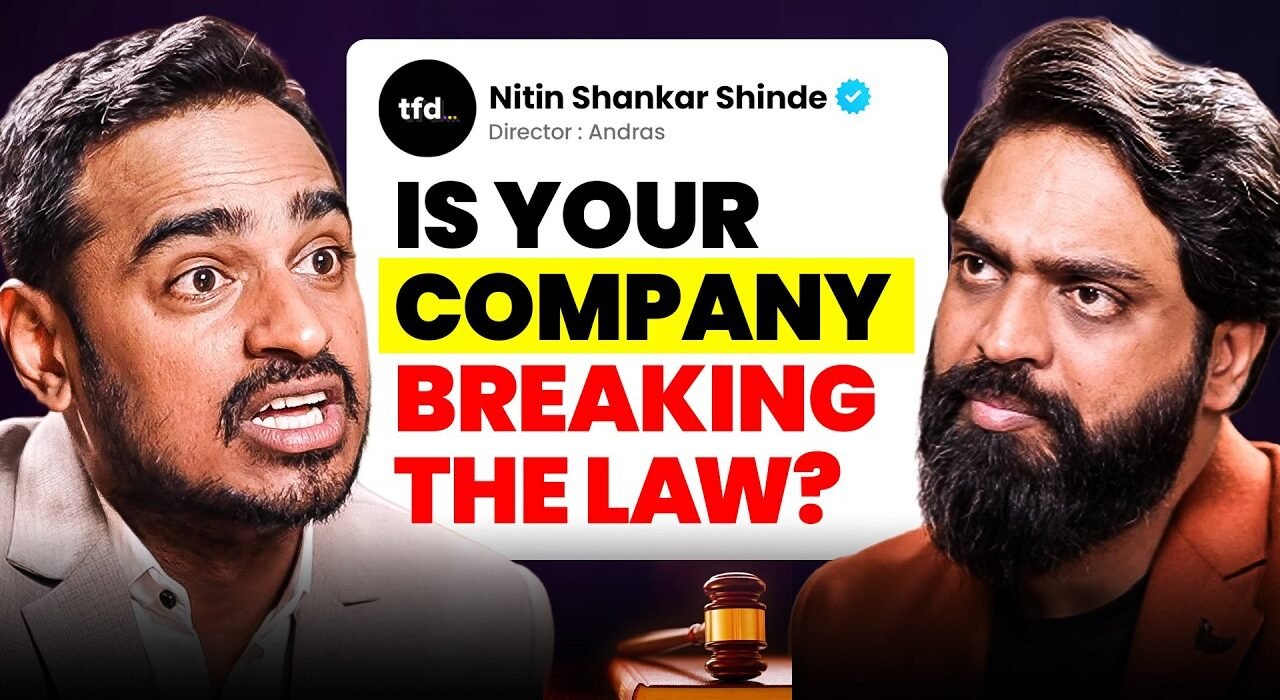
A government notice rarely arrives at a convenient time. In this Nitin Shankar Shinde Interview on The Founder’s Dream, a founder podcast that brings founders face-to-face with real operators, host Abhishek Vyas sits down with Labour Law Strategist, Role Architect and Compliance Expert Nitin Shankar Shinde to unpack why so many founders discover their compliance gaps only after a notice lands on their desk — and what it actually takes to fix that.
Shinde has spent years helping companies manage labour law, payroll and corporate compliance, and he opens with a line that sets the tone for the entire conversation.
A small compliance mistake can turn into a big legal risk for your business.
Nitin Shankar Shinde Interview: Why Compliance Can’t Wait for Small Businesses
Abhishek’s first question gets straight to the point founders ask most often — why does a small business even need to think about labour law? Shinde’s answer is that size isn’t the real factor; applicability is.
Labour law doesn’t really distinguish between a small company and a big one. What matters is when it becomes applicable to you — and applicability depends entirely on the number of employees you have.
He lays out the thresholds plainly. Professional Tax is deducted state-wise and applies even if you have a single employee. Cross five employees and the Labour Welfare Fund kicks in, requiring a small biannual deduction. Cross ten, and ESIC, Maternity Benefit, Gratuity and POSH become applicable. Cross twenty, and almost every act — including Bonus and PF — applies to your company.
- 1 employee or more — Professional Tax (state-wise slab)
- 5+ employees — Labour Welfare Fund (LWF)
- 10+ employees — ESIC, Maternity Benefit, Gratuity, POSH
- 20+ employees — Bonus, PF, and almost all remaining acts
He’s careful to separate genuine mistakes from willful violations. “If something happens because you genuinely don’t know, that’s forgivable. But once you cross a certain level, you can’t keep ignoring it — you have to follow compliance,” he says.
POSH Compliance: The Internal Committee Isn’t Optional
A large part of the conversation centres on POSH — the Prevention of Sexual Harassment at Workplace Act, 2013. Shinde explains that any organisation with more than ten employees falls into the “organised sector” and is legally required to form an Internal Committee (IC), draft a POSH policy, and conduct training.
If you haven’t formed the IC committee, haven’t built the policy, haven’t done the training — and you default on even one of these — the government has the right to fine you up to ₹50,000. Repeat the same default, and your license can be cancelled.
As a certified POSH trainer, Shinde says the most insecure questions during training sessions almost always come from men, who ask why the law is framed around women specifically. His answer is simple: ask yourself who you’d send downstairs late at night if both your son and daughter were home — most people instinctively protect the daughter, because the discomfort around women’s safety is real. At the same time, he’s direct about misuse, citing a Goa case where a false harassment complaint was filed against a male employee and later dismissed after inquiry by the IC and an external member.
This Act is made only for you — please don’t misuse it.
He also brings up the Maharashtra government’s notification issued after the TCS Nashik matter, where a complaint to the Internal Committee was allegedly ignored. Following the reputational damage that followed, the state empowered around 4,000 area officers across Maharashtra to forcibly enter offices, check POSH compliance on the spot, and issue fines immediately — with no grace period for missing data, unlike PF or ESIC inspections.
New Labour Codes 2025: Inspectors as Facilitators
One of the more reassuring parts of the episode covers the new Labour Codes, introduced by the government in November 2025. Shinde explains that the intent behind the new codes is to shift the role of the inspector from pure enforcement to guidance.
Whoever comes as the new inspector will be more of a facilitator and less of an inspector. He will guide you — tell you that yes, this mistake happened, but here’s how to correct it.
He’s candid that the law states this clearly, but admits that how it plays out depends on the individual inspector’s mindset. He also references a recent example of the system working against founders unintentionally — a Professional Tax department glitch sent notices to almost every founder asking them to produce PT payment data, simply because of a technical error on the department’s end.
What to Do When a Government Notice Arrives
Abhishek pushes Shinde on why nearly every founder seems to discover compliance gaps only after a notice shows up. Shinde says there’s no secret here — it comes down to priorities in the early stages of a business.
In the starting phase, founders are busy growing the business. Their priority is revenue, sales, generating business. Compliance quietly gets left behind — not ignored on purpose, but it just doesn’t stay a priority.
By the time a notice arrives, it can ask for records going back years, since the law allows departments to go back up to five years. The problem, Shinde notes, is that by then the finance and legal staff who handled those years have usually moved on, leaving the founder alone to answer for records nobody remembers. That’s exactly why he recommends maintaining a minimum of five years of compliance records — regardless of whether the government’s own systems stay intact.
He also walks through what to actually do if an inspector visits:
- Identify which specific department the officer represents — PF, ESIC, PT, LWF, Bonus — since one officer typically checks only their own department’s compliance
- Don’t panic — ask the officer to put the data request in writing on their letterhead
- You can request time (usually 8–10 days) if your HR or data isn’t immediately available
- Check applicability first — for example, ESIC applies above 10 employees, except in hazardous factories where it applies from employee one
On the specific issue of PF defaults, Shinde doesn’t mince words:
If you cut someone’s PF from their salary and keep it with yourself without depositing it, that’s a criminal offense. You are doing something very wrong.
He advises employees to check their PF passbook on the UMANG app, email HR if deposits aren’t visible, and escalate to the PF Grievance Portal if there’s no response. He also flags a less obvious problem — PF deposited against the wrong UAN — which can trap an employee’s funds until a lengthy ECR revision process is completed with the department.
Layoffs, Dual Employment, and Documentation
The conversation also covers mass layoffs. Shinde is clear that there’s nothing inherently wrong with letting employees go if a business is genuinely struggling — the key is documentation.
Compliance is like your company’s insurance. You can grow a business without it, but you can’t sustain it without it.
He outlines three valid routes to dismiss someone: immediate termination for misconduct or POSH violations, immediate termination for fraud, and a performance-based exit that requires formal notice and a documented improvement plan before any final decision. On dual employment, he’s equally direct — a regular employee cannot hold two jobs simultaneously, though freelancing outside working hours is allowed unless the appointment letter explicitly restricts it.
From a Friend’s Referral to Building a Consultancy
The episode closes with Shinde’s own path. He started his practice in 2014 after years of working as a compliance specialist inside companies, holding a Diploma in Labour Law. When he decided to go independent, he had no client base — just a decision to try.
I didn’t have anything with me. All I had in my mind was that I had to do something.
He messaged his network directly, and his first real client came through a friend, Praful, who was working as HR at a company manufacturing welding rods and needed compliance support. Shinde also credits BNI — the networking platform where his chapter, “Super Achievers,” has been part of his growth since 2018 — for building market trust through word of mouth rather than advertising. Readers who enjoy this kind of grounded, experience-led story can find more in the entrepreneurial journey stories on the site, alongside practical self growth lessons from other founders who’ve built businesses the hard way.
Looking ahead, Shinde’s goal is straightforward: he wants his consultancy to be the first name that comes to mind whenever a founder in India needs labour law compliance support, as the new codes make the rules stricter and more technical every year. As one of the more detail-driven indian business podcast conversations this year, this episode is worth revisiting whenever compliance questions come up.
Watch the full conversation with host Abhishek Vyas on The Founder’s Dream YouTube channel and subscribe for new founder interviews every week.
Frequently asked questions
At how many employees does labour law compliance start applying to a business?
Professional Tax applies even with a single employee; the Labour Welfare Fund applies once you cross five employees; ESIC, Maternity Benefit, Gratuity and POSH apply after ten employees; and almost all acts including PF and Bonus apply once a company crosses twenty employees.
Is POSH Internal Committee formation mandatory for small companies?
Yes, under the POSH Act 2013, any organisation with more than ten employees falls under the organised sector and must form an Internal Committee, create a POSH policy, and conduct training, or face a fine of up to ₹50,000 for non-compliance.
What changed with the new Labour Codes introduced in November 2025?
The new codes state that government inspectors will function more as facilitators than enforcers, guiding employers to correct mistakes instead of simply penalising them on the first visit.
What should a founder do if PF is deducted from salary but not deposited?
Employees should first check their PF passbook or the UMANG app, email HR for clarification, and if there is no response, file a complaint on the PF Grievance Portal, since withholding deducted PF is a criminal offense.
How long should a business keep its compliance and employee records?
Nitin Shankar Shinde recommends maintaining at least five years of compliance records, since government notices can go back that far and departments do not always accept that files or data were lost.

1 Comment