
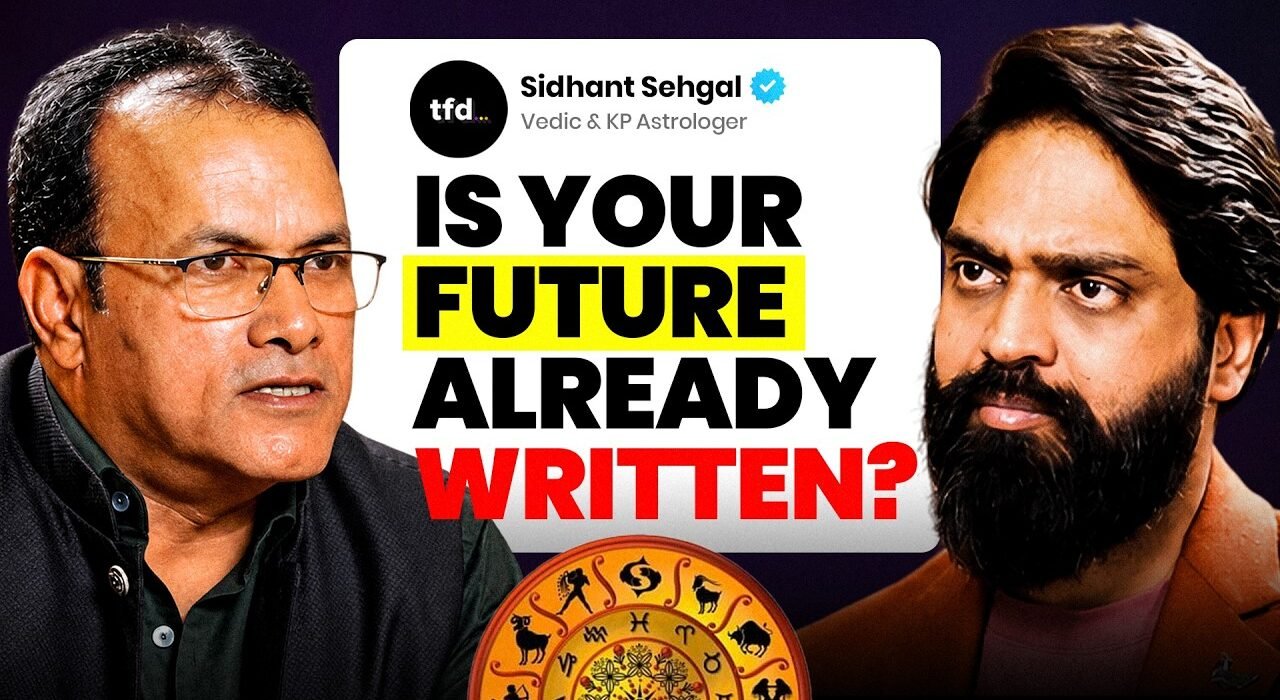
Can a planet’s position really tell you whether a government will survive its full term? That question sits at the center of this Sidhant Sehgal interview on The Founder’s Dream, where host Abhishek Vyas pushes a KP astrologer and political analyst to defend his craft against the skepticism it usually gets — and against the parts of the industry he himself calls out as a “million-dollar business.”
Sidhant Sehgal has been practicing since 1998, with his study of astrology going back to the mid-1980s. He works with both Vedic astrology and Krishnamurti Paddhati (KP), and across the conversation he does something unusual for the genre: he names which popular beliefs he thinks are manufactured, and which ones he stands behind with calculation.
Inside the Sidhant Sehgal Interview: Manglik Dosha vs Kaal Sarp Yog
The episode opens with a direct question — what are Manglik Dosha and Kaal Sarp Yog, and do they actually affect people’s lives? Sehgal’s answer is blunt.
This is a million-dollar business. I’m not saying these things don’t exist at all — I don’t believe Kaal Sarp Dosha is real, but I do believe in Manglik Dosha.
His reasoning is specific. He says no classical text — not Parashar Shastra, not Brihat Parashar Hora Shastra — mentions Kaal Sarp Dosha by that name. According to him, the planetary pattern it describes (all planets clustered on one side of Rahu-Ketu) was historically called Paal Yog, Chhatra Yog or Nauka Yog depending on which houses were involved, not a “dosha” at all. Manglik Dosha, on the other hand, he accepts because Mars genuinely represents anger and conflict, and when it sits in the lagna, 4th, 7th, 8th or 12th house it can affect temperament and married life. What bothers him is how some astrologers stretch the same dosha to the Moon sign and then to Venus, until, in his words, almost everyone in a population of 140 crore would show up as Manglik.
KP Astrology vs Vedic Astrology — Why Sehgal Picked Calculations Over Belief
Asked why he leans on Krishnamurti Paddhati, Sehgal breaks down the technical difference plainly. Vedic astrology looks at which house a planet occupies. KP astrology goes further — it looks at which nakshatra the planet sits in, who the lord of that nakshatra is, which house that lord rules, and where that lord itself is placed in the chart.
So from your point of view, this is a completely calculation-based system? Absolutely — it doesn’t run on spiritual things or belief.
He adds a line about how client expectations shape readings in the broader industry: people’s existing beliefs often get repeated back to them because that is what keeps clients satisfied, regardless of accuracy. This is also where he introduces the idea of “desh kaal paatra” — country, time and the individual — explaining that a yoga for owning a gun might exist in a chart, but whether it plays out depends on whether the person lives in a country where that is even legally possible. For readers curious about how different belief systems and prediction methods get discussed on the show, this conversation pairs well with other interviews in the self-growth section of The Founder’s Dream, which approaches personal development from several different angles.
Gemstones Over Mantras: Sehgal’s View on Remedies
When Abhishek Vyas asks whether Sehgal prescribes expensive remedies, the answer narrows quickly to one thing.
As far as remedies go, I actually trust stones. Only stones. You can chant a mantra five lakh times, ten lakh times — it won’t remove the deficiency that exists in your chart.
His logic for why stones work differently from mantras is almost sociological: a gemstone can be given to a Christian or a Muslim because it works on a universal planetary effect, whereas a Hindu mantra is tied to a belief system the receiver may not share. He is careful to say mantras are not useless — repeating them regularly functions as a form of meditation that builds discipline, and that discipline indirectly raises a person’s success rate. But he draws a sharp line against one popular narrative: a 20-year-old spending three to four hours a day on rituals, he told one father directly, needed practical life skills far more than more prayer, especially since her chart did not show a marriage yoga to begin with.
Karma and Destiny: Why His Predictions Are “90%, Not 100%”
Sehgal makes a clear distinction between fixed destiny and what he calls “kriyamaan karma” — the actions a person takes right now. This tension between karma and destiny is, in his view, what separates a chart’s potential from what actually unfolds. He uses a simple example: if he tells someone their next year is excellent, but that person walks out and slaps someone more powerful than them, that golden period turns to dust. Free will, in his framing, decides how much of a good or bad period actually gets realized.
To some extent destiny is fixed, but it isn’t fixed the way people imagine it. Current actions travel along with you — that’s why I say 90%, not 100%.
This is also why he claims a 90% success rate rather than the 100% some astrologers advertise — he calls that kind of claim misleading. He gives a concrete illustration: predicting someone will get married within a window, only for the person themselves to reject a match out of personal preference, meaning the “yoga” existed but the outcome didn’t follow because of a human choice. Readers who want a broader sense of how founders and experts on the show frame long-term decision-making may find the entrepreneurial journey interviews on The Founder’s Dream a useful companion to this discussion.
Can Astrology Predict India’s Political Future in 2027?
This is where the episode’s political predictions astrology segment earns its title. Sehgal says he has been making political predictions publicly since around 2017-18, and claims his 2019 and 2024 Lok Sabha forecasts were accurate — he says he was among the very few predicting that the ruling party would fall short of a majority in 2024, when most were forecasting 400-plus seats.
My prediction is for a mid-term election. For the last three years, since the government formed in 2024, the chances of a mid-term election have been rising — and 2027 looks more likely.
He goes further, forecasting what he calls a bigger revolution around 2027 — not confined to India.
The conflict between those in power and the public is going to increase. 2027 will be harder for most governments — for both the government and the public.
He also points to Donald Trump, saying he predicted Trump’s 2020 loss and 2024 win against the majority view among Indian astrologers at the time, and now forecasts that Trump’s political strength will decline after November 2027. But Sehgal is equally quick to say what astrology cannot do: predict which individual will become Prime Minister. With coalition arithmetic in play, he argues, even a leader with ten MPs could end up in the top seat if the government cannot form without them — a call that depends on political numbers, not planetary charts alone.
Becoming an Astrologer Takes Years, Not a Weekend Course
Sehgal is dismissive of shortcut astrology courses. He says genuinely learning the field — not just reciting doshas and remedies, but knowing all 27 nakshatras, which rashi each falls in, and the exact degree each one starts at — takes real years of study, not three-month certificates.
You wouldn’t tell someone to become their own doctor. It isn’t possible to become an astrologer through a three-hour or three-month course.
He mentions he used to teach astrology but stopped around 2022-23, partly because most students only wanted shortcuts for predicting marriage dates or job timing, not the deeper calculation work the field demands.
For listeners who enjoy long-form conversations on Indian belief systems and prediction methods, this episode sits comfortably alongside other interviews on the The Founder’s Dream homepage. Watch the full conversation with host Abhishek Vyas on The Founder’s Dream YouTube channel and subscribe for new founder and expert interviews every week.
Frequently asked questions
What is the difference between KP Astrology and Vedic Astrology according to Sidhant Sehgal?
Sidhant Sehgal explains that Vedic Astrology looks at which house a planet sits in, while KP Astrology also factors in the nakshatra the planet is placed in, who rules that nakshatra, and where that ruling planet itself is placed, making it a more calculation-heavy system.
Does Sidhant Sehgal believe in Kaal Sarp Yog and Manglik Dosha?
He does not believe in Kaal Sarp Yog, saying no classical text like Parashar Shastra mentions it and that it was historically called Paal Yog or Nauka Yog, but he does believe in Manglik Dosha because Mars genuinely signifies anger and conflict from the ascendant.
What remedies does Sidhant Sehgal actually recommend?
He says he only trusts gemstones among remedies, arguing mantras and rituals do not remove a planetary weakness in the chart but help indirectly by building discipline in a person’s routine.
What does Sidhant Sehgal predict for India's politics around 2027?
He predicts a strong chance of a mid-term election in 2027 and describes it as a period of a bigger revolution, with rising conflict between those in power and the public, in India and in other countries.
Can astrology really predict who will become India's Prime Minister?
Sidhant Sehgal says this cannot be predicted reliably because outcomes depend on alliances and numbers in Parliament, not just one chart, so even an MP with ten seats could end up as PM if a coalition needs them.
1 Comment