
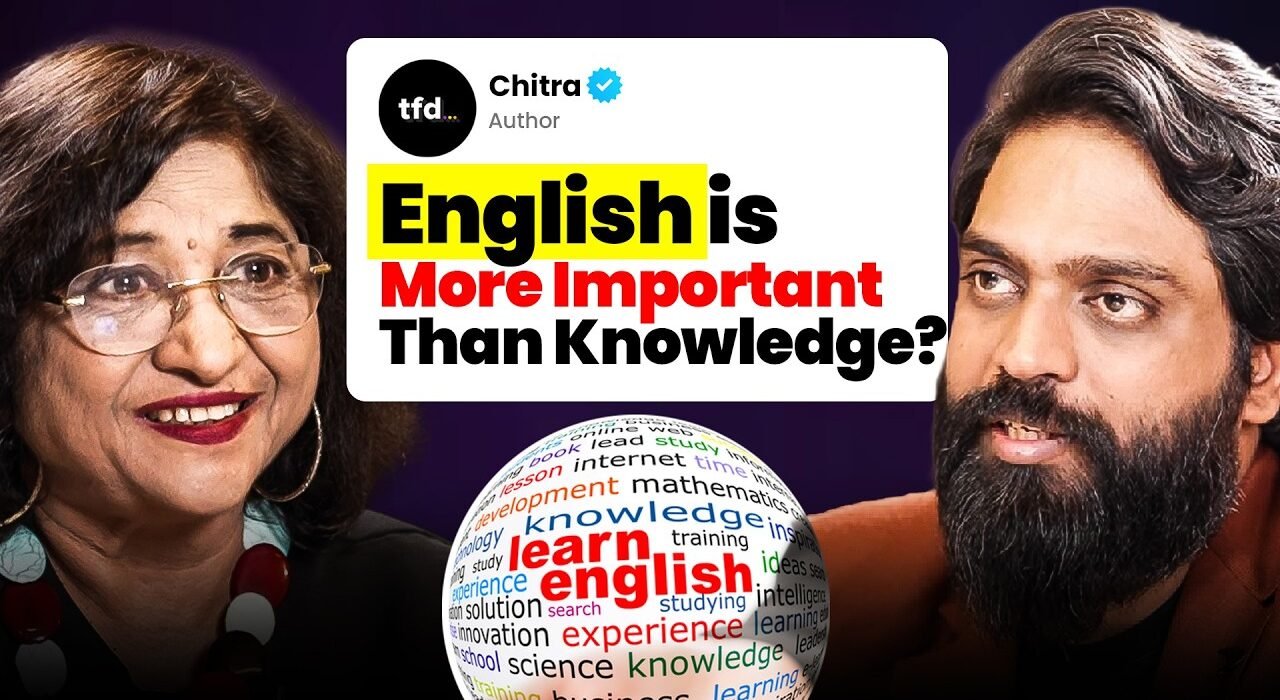
On a recent episode of The Founder’s Dream podcast, host Abhishek Vyas sat down with author and content creator Chitra Garg for this Chitra Garg interview, which moves from Hindi literature to artificial intelligence to a question more Indian households are quietly sitting with: why are some women choosing careers over motherhood? The Chitra Garg success story — 134-plus books, 600-plus articles, a Hindi YouTube channel crossing 1.5 lakh subscribers — was not built on a single big break. It was built one newspaper clipping, one Doordarshan script, one late-night manuscript correction at a time.
The Chitra Garg success story: from a small-town college run to the President’s office
Chitra Garg grew up in Faridpur, a small town where the only school for girls went up to the twelfth grade. College meant a 20-kilometre commute by taxi or bus, leaving home at 7 am and returning by 3 or 4 pm — something no girl in her town had done before her. Her father pushed for it anyway.
Never think that you cannot do something just because you are a girl — whatever work comes your way, you have to do it.
That same push got her into university-level athletics, where she ran the 100m and 200m and collected several cups, at a time when girls from her background were not expected to build careers at all. Her writing career started almost by accident in 1974 — she read a newspaper article, felt she could write something better, sent it to a few local papers, and all of them published it the same week. Writers in the family used to tease her about it; nobody, including her, expected it to become a life’s work.
A Hindi Taekwondo book and a meeting with the President
In 1996, Garg wrote what was likely one of the first Hindi-language books on Taekwondo — a sport she had only encountered because her young son was training in it and she accompanied him daily. At the time, Judo and Karate had books in Hindi; Taekwondo, which relies on leg techniques rather than hand strikes, did not. Once the book was published, she walked into the President’s office on her own, without any contact or introduction, and asked to present it personally to then President Dr. Shankar Dayal Sharma.
She got an appointment quickly, met him with family in tow, and watched him formally inaugurate the book. It was covered in newspapers afterward — a moment she still describes as one of the proudest of her writing life, and a marker of how far a self-initiated effort can travel when there is no plan beyond belief in the work.
Why Hindi still carries a stigma that English doesn’t
A large part of the conversation returns to a double standard Garg has lived with professionally: mistakes in English are treated as understandable slips in a foreign language, while mistakes in Hindi are mocked.
It really is a strange thing — in our minds, English has become such a high standard that if someone speaks English, we assume they’re very intelligent, very well-read. Every parent wants their child to speak English; it’s become a kind of mental slavery, where we’ve decided English is simply the better language.
She points to her own channel as proof of the gap: her Hindi-teaching videos get genuine engagement — thousands of watch hours a month — but platforms categorise and monetise them far below equivalent English content. She does it anyway, for the satisfaction of the response, not the earnings. Interestingly, she notes that Hindi is gaining ground internationally — Singapore has made it a compulsory language option for children, and her own videos get unexpected traction from viewers in Brazil and Argentina, numbers that surprised her when she checked the analytics.
Books versus reels: why the format war isn’t really about value
Garg is unambiguous that books are not losing relevance, even if reading habits are shifting toward screens. Her reasoning is about retention, not nostalgia.
Whatever you’ve written down becomes a permanent record for you. On a computer, you looked at something for a while and then it’s gone — if you need that same knowledge again, you have to go searching for where it was. A book stays with you; it becomes, you could say, a golden collection of knowledge that stays gathered in one place.
This belief shaped her own channel, Logic Touch, which she originally built to teach both English and Hindi before audiences pulled it firmly toward Hindi grammar — explaining, for instance, the logic behind when a “chandrabindu” is used versus a plain “bindi,” or why a word like “anirudh” is so often misspelled. Her subscriber base, she points out, skews toward adults aged 25 to 45, including working teachers who use her videos to brush up before teaching children themselves.
Why are some women choosing careers over motherhood?
This is the question the episode is built around, and Garg treats it carefully, acknowledging upfront that it is a sensitive, widely argued topic before giving her own view plainly.
I have seen many women who are not having children because a child brings responsibility along with it, and that changes family life. To make their working life smoother, or to call it successful in their field, they are putting off having children — or not building their family life forward at all.
Asked directly whether this trend is right or wrong, she doesn’t hedge.
In my view, it is wrong — because how did any of us come into this world? If parents had thought the same way, how would our society move forward, how would our legacy continue? You can try to establish your career for some years, sure, but family life matters too, eventually.
She also connects this to her own unfulfilled ambition: she had wanted to go into politics — she contested college elections, campaigned for her father who was a local municipal chairman, and dreamed of reaching far — but marriage into a family with no interest in politics, and the full-time demands of raising children, meant that path quietly closed. She doesn’t frame this with bitterness; she frames it as a trade-off that needed a supportive family to even be considered, and one she made peace with by channelling the same ambition into writing instead.
Can AI replace a human writer? Garg’s answer from 134 books in
With decades of writing behind her, Garg uses AI tools in her own process — mainly to find reference material or visuals when she’s stuck on a subject — but draws a hard line on what it can and cannot do.
AI can never replace a human. You can take help from AI when something isn’t clear to you, but you have to explain it yourself — only then will the explanation actually be right. AI can generate figures, pull out content, do everything for you, but there’s a real difference: it cannot replace a human, and a person should never become so dependent on AI that it ends up damaging their own future thinking.
She worries specifically about the next five to six years, when AI-generated writing and speech may become indistinguishable from human output, and argues that leaning on it for everything — including something as basic as deciding what to do next — will shrink people’s own capacity to think. It’s a theme that runs through much of the self growth lessons shared across this podcast: tools can support effort, but they can’t substitute for it.
What the Chitra Garg success story actually teaches
Strip away the awards and subscriber counts, and a few practical lessons stand out from this conversation:
- Consistency compounds — a hobby that produced ₹100-per-article paychecks in the 1970s eventually produced 134 books, simply because she never stopped writing.
- Credibility is built by showing up uninvited — she walked into the President’s office herself, with no contact and no introduction, because she believed in the work.
- A niche done honestly outperforms a trend chased half-heartedly — her Hindi channel earns less per view than English content would, and she keeps making it anyway because the response is real.
- Family support isn’t automatic; it has to be negotiated — her own career and her shelved political ambitions both depended on whether the people around her made room for it.
For anyone tracking entrepreneurial journey stories on this show, Garg’s path is a reminder that a body of work can be built slowly, in a language the market undervalues, and still end up respected — a President accepted her book, readers across continents watch her Hindi grammar lessons, and none of it required chasing the format or language that was supposedly “better.”
Watch this episode of Chitra Garg on The Founder’s Dream, hosted by Abhishek Vyas, on The Founder’s Dream YouTube channel and subscribe for new founder interviews every week.
Frequently asked questions
Who is Chitra Garg?
Chitra Garg is an award-winning Indian author, writer and content creator who has written more than 134 books and over 600 articles, starting her writing career with her first published article in 1974.
What is Chitra Garg's YouTube channel about?
Her channel, Logic Touch, started out teaching both English and Hindi but gradually became a dedicated channel for teaching Hindi grammar, spelling and usage, and has crossed 1.5 lakh subscribers.
What did Chitra Garg say about women choosing careers over motherhood?
She said she has seen many women delay or avoid having children because of the responsibility that comes with it, and that in her view prioritising career establishment over family life for too long is not the right choice, though she acknowledged it is a sensitive and widely debated subject.
Did Chitra Garg meet a President of India?
Yes, after writing one of India’s first Hindi books on Taekwondo in 1996, she personally approached the President’s office and presented the book to then President Dr. Shankar Dayal Sharma, who accepted it and inaugurated it.
What does Chitra Garg think about AI replacing human writers?
She believes AI can assist with ideas or help when something is unclear, but it cannot replace human thinking or explanation, and she cautioned that over-dependence on AI can weaken a person’s own ability to think and create.
1 Comment