
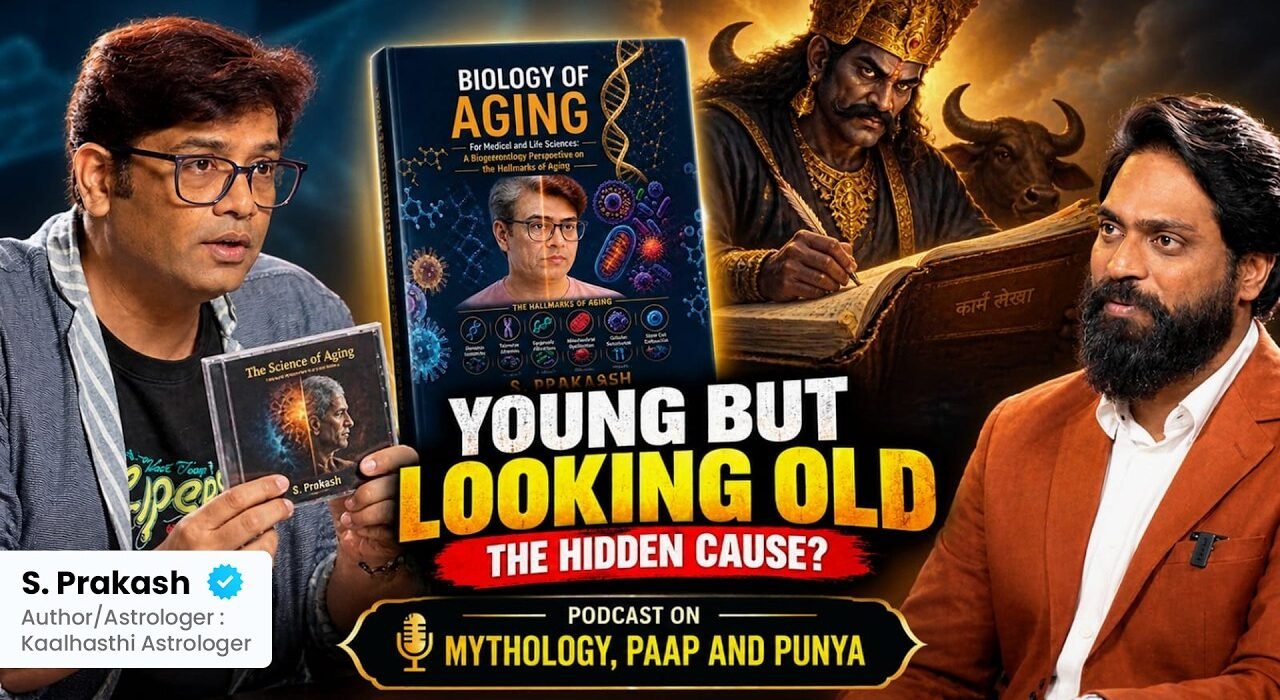
Can a 35-year-old look 50, and can a horoscope explain why? That question sits at the center of this S. Prakash interview on The Founder’s Dream, where astrologer S. Prakash sits down with host Abhishek Vyas to talk about karma, destiny, reincarnation, and — somewhat unexpectedly — the molecular biology of aging.
Prakash comes from an IT background that gradually gave way to astrology, then medical astrology, and eventually a serious personal study of biology and biochemistry. The conversation moves between the Mahabharata and mTOR, between Chitragupta’s ledger and David Sinclair’s aging lab at Harvard, without ever feeling like two different podcasts stitched together. If you are curious about how a practicing astrologer thinks about free will, suffering, and anti-aging science in the same breath, this episode — and this S. Prakash interview recap — is for you.
Karma, Destiny and the Paradox Prakash Can’t Resolve
Abhishek opens with a direct, almost mischievous question: what sins and good deeds did Prakash commit in his past life? Prakash’s answer reframes the whole discussion — he says he has no memory of a past life, but he knows exactly what he is doing right now, today, and that creates a strange incentive problem.
If I knowingly commit a sin, and I’m meant to remember in my next life that I committed this sin and that’s why I’m being punished, then I should at least remember what I’m being punished for. In a strange way, it would almost be easier to become a sinner today — this is one of life’s real ironies, a paradox I can’t get past.
He illustrates this with the Mahabharata story of Dhritarashtra asking Krishna why he was given a hundred sons and a throne, yet never got to enjoy either — his children died, and he was blind from birth. Krishna’s answer, as Prakash retells it, is that Dhritarashtra’s accumulated karma across a hundred past lives was mixed together: good deeds earned him the throne, but blinding a bird and destroying its hundred eggs in an earlier life meant blindness and the loss of his own hundred sons. He pairs this with the story of Bhishma Pitamah, who unknowingly threw a snake into a bush as a child, causing it to suffer a thousand thorn wounds — and was pierced by a thousand arrows in his own death, even though the act was unintentional. “Courts today look at intent,” Prakash says, “but God did not spare Bhishma Pitamah.” Listeners interested in how other guests on the show have wrestled with karma and the Gita can also check out the Suresh Bhawan interview on Kriya Yoga, Karma and the Gita, which covers similar ground from a different spiritual tradition.
“We Are Made To Do It” — Prakash on Free Will
Partway through, Prakash makes a claim that reframes the entire destiny-versus-free-will debate: he doesn’t believe anyone truly chooses their actions.
We don’t actually do anything ourselves. We are made to do it. We are forced to do things — try holding your breath for two minutes, or stopping your car mid-drive without touching the brake. You simply cannot. Everything runs on autopilot.
He extends this to his own career, describing the past ten years of his life as a “roller coaster” he didn’t consciously engineer — from a 2016 starting point to a 2021 transformation to running a growing team and multiple podcasts today. He’s candid that his conscious mind often wants something different from what he ends up doing, and frames this as evidence that destiny, not deliberate choice, drives most outcomes. Even so, he admits the fear of being held accountable — the Garuda Purana’s vision of Chitragupta and Yamraj reviewing one’s account before a packed assembly — keeps him from acting on the “everything is written anyway” logic. It’s the same dichotomy, he says, as a driver stuck in traffic with no idea which signal will turn green, surrounded by other drivers whose aggression or patience will shape the ride regardless of his own intentions.
From IT to Medical Astrology: Why Prakash Started Studying Biology
The turning point in Prakash’s practice came when he began teaching students organ-specific astrology — heart, kidney, liver — and realized he couldn’t teach it well without understanding how those organs actually function. That pushed him into medical science as a parallel discipline, starting with insulin resistance, on which he has also written a book, and the gut-brain axis.
This same curiosity eventually pulled him toward a much bigger question: why does aging happen at all, and why do some people look far older than their actual age? That question became the seed of his book on anti-aging and longevity, grounded in the twelve hallmarks of aging listed on its cover.
The Science Behind the S. Prakash Interview: Why We Age
To explain aging, Prakash leans heavily on the work of David Sinclair, a Harvard genetics professor with his own biosciences lab. Sinclair’s analogy, which Prakash walks through in detail, compares human cells to a DVD player and a CD. Every cell in the body carries the same DNA — the same twenty thousand genes — but a liver cell, kidney cell, and heart cell each need to “read” different parts of that information to produce the right proteins, such as troponin in the heart or albumin in the liver.
The problem isn’t in the DNA itself — the information is intact. The problem is the epigenome, the software reading that information, getting confused. It’s like a CD player that can no longer read the CD properly.
That “epigenetic noise” — caused by diet, lifestyle, stress, environmental toxins, UV exposure, oxidative stress, and mitochondrial dysfunction — leads to the wrong genes getting activated, such as inflammation genes switching on when a repair gene should have. Over time, molecules the body needs, like NAD, glutathione, nitric oxide, and hormones such as testosterone and melatonin, are produced less efficiently. Prakash also mentions a related but opposing school of thought using the Jurassic Park dinosaur-DNA analogy, where damaged genetic information is patched using outside material — versus Sinclair’s camp, which argues the original information was never damaged in the first place, only unreadable. He also references Sinclair’s lab reportedly securing an approval in January 2026 for an experiment aiming to reverse glaucoma, after first testing in mice in 2020 — framing it as an open hypothesis still being tested, not a settled result.
Food as a Signal: mTOR, AMPK and Calorie Discipline
Asked whether some magic detox drink explains why celebrities look younger, Prakash is measured — he credits personal nutritionists and consistent habits over any single drink, and refuses to endorse specific detox routines without professional backing. What he’s confident about is the underlying biochemistry.
Food is more than just food. Food is a signal — it’s information. When you eat protein, it breaks down into amino acids, and that activates a signalling pathway called mTOR.
He explains that excessive animal protein — particularly leucine, an amino acid found in red meat — overactivates mTOR, which is linked to faster aging markers, while calorie restriction or time-restricted eating activates a counterbalancing pathway called AMPK, triggering autophagy, the process that clears out damaged or misfolded proteins. He also brings up the “thrifty gene” hypothesis from James Neel, proposed decades ago, suggesting our ancestors’ bodies adapted to famine cycles — a stress response, or “hormesis,” that fasting and practices like cold exposure can still trigger today. Readers who enjoy this blend of astrology and wellness thinking may also want to browse the Best 10 Astrology Podcasts in India on TFD Hindi Podcast list for more conversations in this space.
Teaching Astrology Without the Hype
Prakash is equally direct about how he runs his astrology academy, Kaal Hasti Astrology. He tells students not to get fixated on labels like Panch Mahapurush Raj Yoga or Gaj Kesari Yoga, because clients rarely walk in asking about yogas — they ask when they’ll get a job or get married, and timing of events matters far more than textbook combinations. He also rejects the idea that planets have enemies, friends, or exaltation in any mystical sense, calling it “only an astronomical phenomenon” with no real bearing on prediction. His academy runs three semesters — predictive astrology, medical astrology, and DNA astrology — with course and consultation fees listed on his website, and he commits to staying available to students for a year or two after the course if they run into difficulty with a chart.
A Grounded Conversation for an Indian Business Podcast
What makes this episode worth hearing in full is that Prakash never claims certainty he doesn’t have — on karma, he openly says there’s no clean answer; on aging science, he’s careful to call Sinclair’s reversal work a hypothesis, not a cure. For an indian business podcast like The Founder’s Dream, that honesty is the real takeaway, whether you come for the astrology or the biology.
- Karma and destiny, in Prakash’s view, operate together — not as opposites but as an unresolved paradox he lives with personally.
- Medical astrology, as he practises it, points toward organ-specific risk areas but never replaces a doctor’s diagnosis.
- Aging is explained through epigenetic drift — the “software,” not the underlying DNA — getting confused by stress, food, and lifestyle.
- Food functions as a biochemical signal, with mTOR and AMPK acting as two sides of the same metabolic scale.
- His astrology teaching strips out mystical labels in favor of timing-based prediction.
Watch the full conversation with host Abhishek Vyas on The Founder’s Dream YouTube channel and subscribe for new founder and expert interviews every week on TFD podcast.
Frequently asked questions
Who is S. Prakash?
S. Prakash is an astrologer who transitioned from an IT background into Vedic astrology and later specialised in medical astrology, writing books on insulin resistance, the gut-brain axis, and the biology of aging.
What is medical astrology according to S. Prakash?
He describes it as using a person’s horoscope to point toward organ-specific health vulnerabilities, such as heart, kidney, or liver issues, while being clear that it cannot replace a doctor’s diagnosis or treatment.
Why did S. Prakash write a book on aging?
He wanted to explain to his astrology students why aging happens biologically, so he studied genetics, epigenetics, and researchers like David Sinclair, and turned that study into a book built around the twelve hallmarks of aging.
What does S. Prakash believe about karma and free will?
He says he personally struggles with the paradox between believing everything is destined and still feeling accountable for his actions, describing it as a dichotomy he cannot fully resolve but accepts as part of his philosophy.
Does S. Prakash believe diet affects aging?
Yes, he explains that food acts as a biological signal that activates pathways like mTOR and AMPK, and that calorie intake, protein type, and eating patterns influence how fast a person’s body shows signs of aging.
1 Comment