
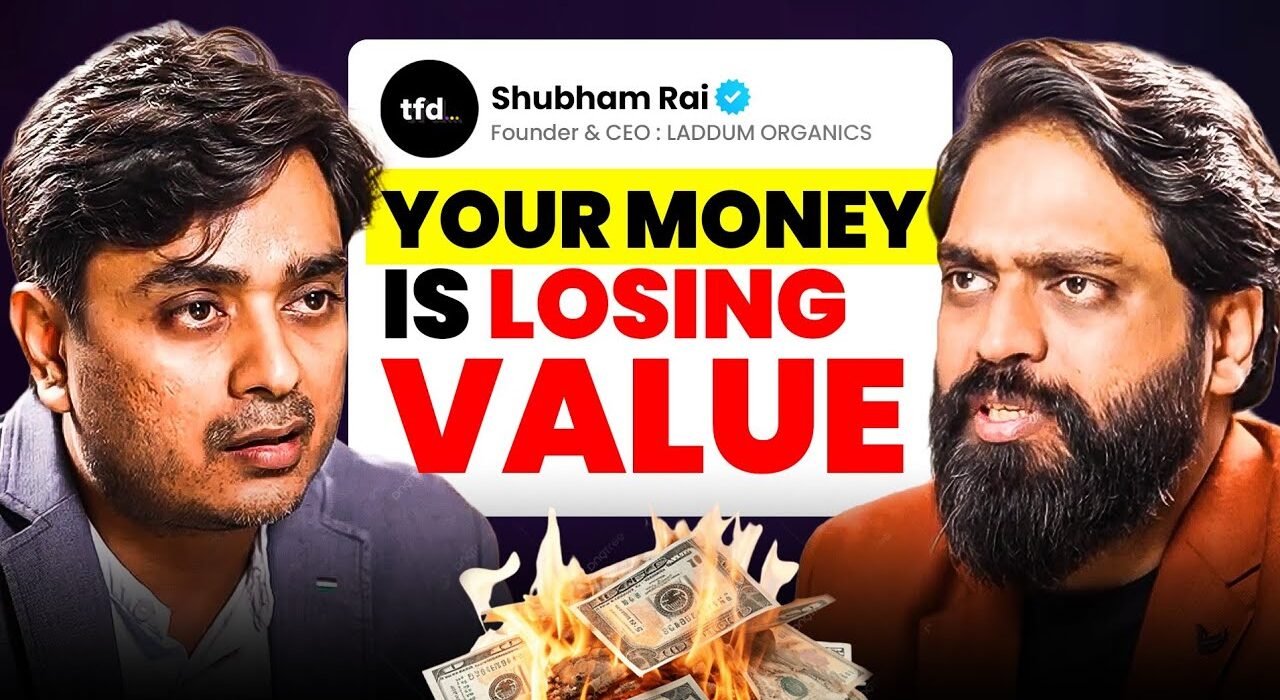
Shubham Rai spent years managing multi-thousand-crore railway signalling projects before he walked away from a stable corporate career to sell laddoos. On this episode of The Founder’s Dream podcast — a founder podcast that has become one of the more candid indian business podcast destinations for founder conversations — host Abhishek Vyas gets Shubham to unpack the resignation dispute that went to the High Court, the financial planning he started years before he actually quit, and the entrepreneur mindset that made the leap possible. This is not a story about lucky timing — it’s about someone who decided, well before Covid forced the issue, that he did not want to depend on anyone for his income again.
From 5G Railway Projects to a Resignation That Went to High Court
Shubham worked on the European Train Control System (ETCS) technology being introduced on Indian Railways, a project he had been part of since 2018. He managed the entire 4G and 5G rollout for signalling under his own control, reporting up a hierarchy but effectively running the technical side himself.
When he decided to resign, his employer refused to accept it and instead tried to transfer him to South India — even though the project’s stakeholders, and his own family with a very young baby, were in Delhi. What followed was a month of pressure and office orders before he took the matter to the High Court, where two hearings ruled in his favour and his resignation, along with full benefits, was finally accepted.
When you’re in a job, decisions keep getting delayed. You need a point where you can exit, but that point doesn’t come by your own choice — some invisible power brings you that point.
He is candid that the comfort of a job — the salary, the good city, the facilities, the lease — is exactly what makes people delay the decision to leave. In his case, an external dispute forced the timing his own planning had already prepared him for.
Why an Entrepreneur Mindset Starts With Refusing Dependency
Shubham traces his shift in thinking back to a simple observation: the food and education sectors were once considered recession-proof, until Covid showed that even food went down. Working on fast-changing signalling technology taught him the same lesson from another angle — if a new OEM releases 6G tomorrow, his knowledge on 4G and 5G becomes dependent on someone else’s training schedule.
I decided at that point that I didn’t want dependency on anyone. Independent means I study it myself, I understand it myself, and I earn from it myself.
That is the core of the entrepreneur mindset he describes throughout the conversation — not a slogan, but a practical decision to stop outsourcing your financial future to an employer, a market cycle, or a piece of technology you don’t control. It’s also why he pushed back on the idea that founders are automatically “free.” He points out that once you start earning profit, tax, GST notices and compliance become their own quiet pressure — a sword hanging over you that most people only notice four or five years in.
Twenty Years to Take Every Risk
Shubham frames his own working life in blunt terms: pick roughly 20 years and use them to take every risk worth taking. He’d rather fail having tried than sit at 60 or 70 regretting the things he never attempted — a mindset he pushes on every founder he talks to.
Financial Planning: Why Saving Alone Won’t Beat Inflation
Long before he resigned, Shubham used the Covid lockdown to sharpen his stock market skills and build a proper financial plan. He decided he would never take anything on EMI again and would instead plan around profit — building a corpus large enough that whenever he did leave his job, he could do whatever he wanted.
If you keep your money in a savings account and inflation is running at seven percent, your money’s value is shrinking every day, even at a fixed deposit rate of six and a half percent.
He walks through a simple example: a photo circulating online showed a burning one-crore note, illustrating how ₹1 crore today could be worth roughly ₹3.5 lakh in real terms 15–20 years from now if it just sits idle. His point isn’t to panic but to actually invest — in blue-chip stocks, mid-cap or flexi-cap mutual funds depending on your time horizon, moving money into debt instruments or a Systematic Withdrawal Plan as your goal date approaches. It’s a skill, he says, that has to be learned properly rather than picked up overnight.
The Laddoom Organics Founder Story
The idea for Laddoom Organics came from family, not from a business plan. Shubham’s father-in-law, a now-retired Ayurvedic doctor, and his small team made traditional postpartum laddoos — the kind new mothers are recommended to eat, packed with ajwain, saunf and gond. When Shubham’s wife had their baby and visitors were served these laddoos, the reaction was strong enough that he saw a gap: in most metro cities, finding a genuinely good, customisable gond laddoo is surprisingly hard.
His father-in-law’s version was already different from the regular market laddoo — gluten-free, made with urad and moong dal instead of flour, and higher in protein. That became the starting point for a brand built around clean ingredients and full customisation: customers can choose desi khand, jaggery, or vegan options, and requests for lower sweetness or specific herbs like Brahmi (for memory) or Ashwagandha get built through a proper SOP rather than guesswork.
Ten months into direct-to-consumer sales, Laddoom Organics is live on Amazon and JioMart, with unexpectedly strong summer demand from South India, where awareness around health and nutrition is already high. Shubham is now pushing north, doing in-person exposure events to shift a stubborn perception problem: people still see laddoos as “just mithai” rather than the wholesome nutrition his grandmother’s generation intended them to be.
Our grandmothers didn’t make laddoos just for taste — they made them for complete nutrition, so the body got something wholesome. That tradition got lost as families moved to nuclear setups and both parents started working outside the home.
He’s also moving into B2B — corporate gifting around festivals like Diwali, and early conversations in the wedding industry — while keeping the postpartum and elderly-nutrition segments that first proved the product worked.
When Should You Actually Leave Your Job?
Asked directly what advice he’d give someone stuck in a job they want to leave, Shubham is unambiguous: frustration by itself is never the answer. You first have to identify whether you’re frustrated with the work itself or with your surroundings, and only then decide whether a business — not just quitting — is genuinely the solution.
He describes his own frustration turning into fuel: an hour or more each way commuting on Delhi’s DND flyway or the metro, arriving home too exhausted to build anything of his own. That daily waste became the trigger, not a single dramatic moment.
Keep at it — the path finds itself. If you’ve entered the founder’s world, exiting isn’t really an option, because anything worth building takes time to settle.
He also pushes back gently on people who chase funding first. His advice is to plan the niche and the execution before you go looking for investors, because — as he puts it about the difference between a corporate project and a startup — in a big company resources arrive first and execution follows, while in a startup you have to prove execution before resources show up at all.
What Founders Can Take From Shubham Rai’s Success Story
- Start financial planning years before you plan to quit — don’t wait for a crisis to force the timing.
- Treat inflation as a real threat to idle savings, not background noise; a fixed deposit alone won’t protect your money’s value.
- Identify whether frustration is about the job or the environment before deciding a business is the fix.
- Build customisation and SOPs early if customers start asking for variations — don’t improvise on quality.
- Accept that founders aren’t free of obligations either; profit brings its own compliance and tax responsibilities.
Shubham’s account of dragging a resignation through the High Court, then building Laddoom Organics from zero to listings on Amazon and JioMart, sits alongside the kind of entrepreneurial journey stories this podcast keeps returning to — where the real turning point wasn’t a grand plan but a refusal to keep depending on someone else’s system.
Watch the full conversation with host Abhishek Vyas on The Founder’s Dream YouTube channel and subscribe for new founder interviews every week.
Frequently asked questions
Who is Shubham Rai and what is Laddoom Organics?
Shubham Rai is a former corporate project manager who worked on railway signalling technology before founding Laddoom Organics, a clean-nutrition brand that makes traditional Indian laddoos such as postpartum, ajwain and khandai laddoos using ingredients like desi khand, jaggery, urad and moong dal instead of refined flour.
Why did Shubham Rai's resignation go to the High Court?
His employer did not accept his resignation and instead tried to transfer him to South India while his stakeholders and young family were based in Delhi, so after a month of pressure he approached the High Court, where two hearings ruled in his favour and his resignation was accepted.
What does Shubham Rai mean by an entrepreneur mindset?
He describes it as refusing to depend on any employer, technology or system for your income, and instead building the skills and financial habits to learn, understand and earn independently, especially after seeing the food sector itself slow down during Covid.
Is a savings account enough to beat inflation, according to Shubham Rai?
No, he explains that if inflation runs around seven percent while a savings account or FD gives roughly three to six and a half percent, your money’s real value keeps falling even as the number on paper stays the same or grows slowly.
When does Shubham Rai say someone should leave their job to start a business?
He says frustration alone is never a reason to quit; you must first identify whether you are frustrated with the job or the surroundings, then plan the business, the niche and the finances properly instead of jumping out on emotion.
1 Comment