

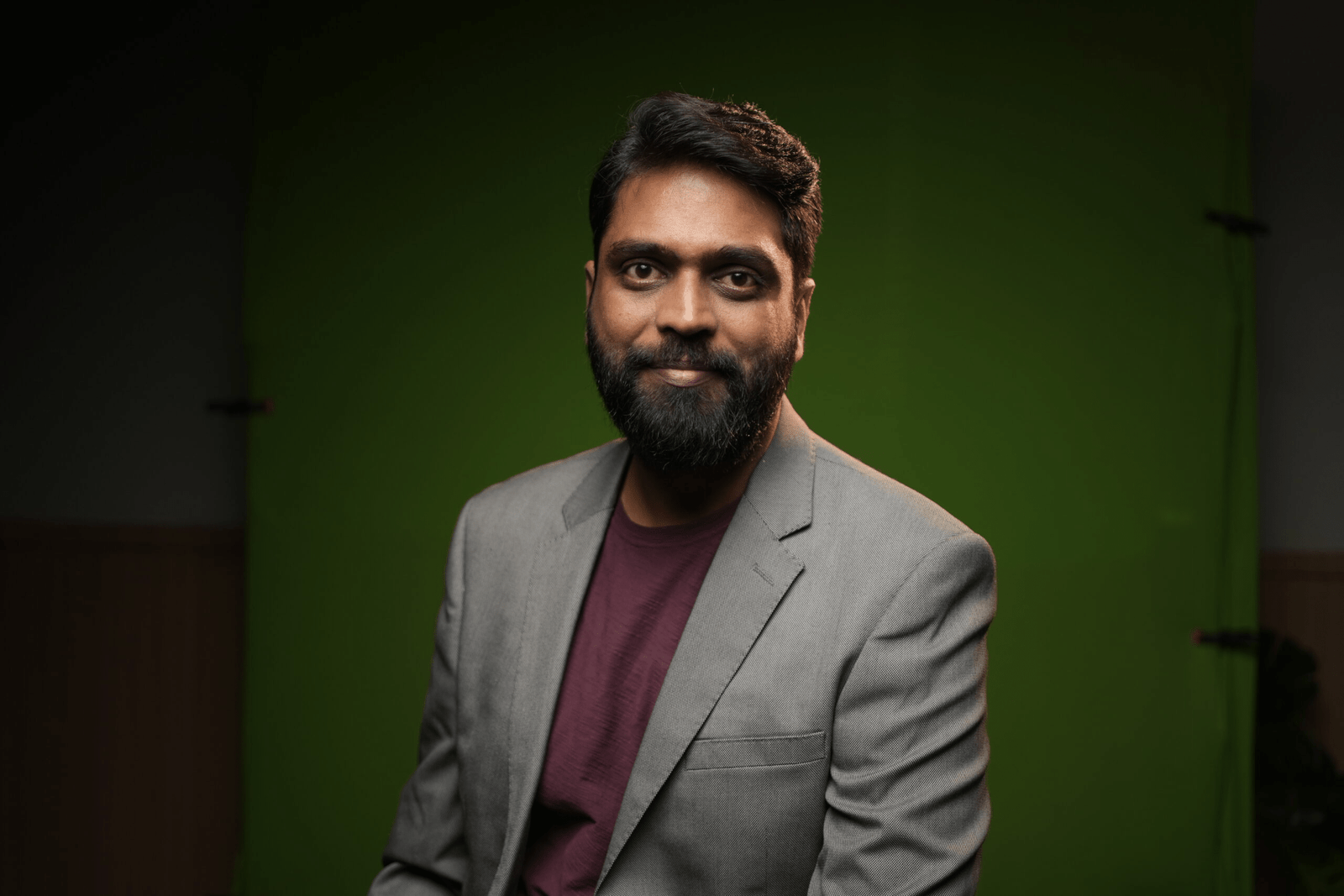
Some podcast conversations are about funding rounds and go-to-market strategy. This one is not. In this Vipul Shah interview on The Founder’s Dream (TFD podcast), host Abhishek Vyas sits down with an author who spent two decades studying Jain philosophy, ancient cosmology, and comparative religion, and asks him a question most of us never stop to examine: is Kalyug really the worst era to be alive in?
Vipul Shah is not a full-time monk or a career spiritual teacher. By day he is a Director at Walmart; by instinct, he is a researcher who has spent years reading the Jain Tattvartha Sutra, the Bible, the Torah, Islamic texts, and the Puranas side by side, looking for patterns. What he found shapes everything he talks about in this episode — from the meaning of the Rudraksha around his neck to why he believes one good deed today outweighs lakhs of good deeds in an earlier age. In many ways, the Vipul Shah success story is less about career milestones and more about an entrepreneur mindset applied to decades of personal research — treating ancient texts the way a founder treats a hard problem, worked at patiently until the pattern reveals itself.
A Childhood of Extremes Before the Vipul Shah Interview
Before any of the philosophy, Vipul Shah describes a childhood that swung between two poles. As a boy of eleven or twelve, he grew close to a Jain Acharya Muni and studied the Tattvartha Sutra and the practice of Pratikraman so seriously that he was, in his words, on the verge of taking Diksha. Soon after, the same intensity turned romantic — he says his first proposal came at the age of six or seven, and in ninth grade a strong infatuation with a girl from a different faith, opposed by his family, pushed him to run away from home.
He is candid about what that period did to the people closest to him, describing a night when his brother sat beside him crying after one of his attempts, holding his bandaged hand. That memory, more than any scripture, is what he returns to when he talks about resilience:
Believe in second chances. The people around you are always there, even when it feels like no one is — give life a second chance, start from zero today, and live for someone else who truly believes in you.
It’s a theme he connects straight back to his research. He says he does not regret the extremes he lived through because they are, in his view, what eventually made him who he is — someone who had to understand suffering before he could write about meaning.
What the Rudraksha and the Multiverse Have in Common
Early in the conversation, Abhishek Vyas points out that both he and Vipul are wearing a Rudraksha, which gives Vipul an opening to explain what he calls its most striking quality. Press a Rudraksha firmly with your thumb, he says, and look closely at the imprint it leaves — you will find the shape of Om inside it. He frames this less as magic and more as vibration: chanting Om, he argues, creates a sensation of internal cleansing, as if the universe inside a person is being purified.
That idea of an inner universe becomes the bridge to a much bigger claim. Vipul connects the “Om Soham” concept from texts like the Vishnu Purana and Bhagwat Purana to the modern idea of the multiverse, arguing that each person is carrying their own cosmos and their own version of time:
Sitting in the very same place, you could be living in Satyug while I am living in Kalyug — it all depends on one’s own point of view, like an ant looking at an elephant’s foot and finding it enormous, while a hawk flying above sees the same elephant as tiny.
It’s this line of thinking that sent him to Ujjain the same night the podcast was recorded, chasing a more scientific explanation for an idea he believes ancient Indian cosmology — particularly the concept of Jambudveep and Bharat Kshetra — already laid out long before modern physics gave it a name.
Is Kalyug Really the Worst Era? Rethinking the Four Yugas
This is the question that gives the episode its title, and Vipul’s answer is not a simple yes. He acknowledges that Kalyug is described as the era where spirituality declines so sharply that, as Gautam Buddha reportedly told his disciples, it cannot even be taught or written down — it has to come from within. But he immediately flips the framing:
In Kalyug, it is said that a single good deed carries lakhs of times more value than it would in Treta Yuga or Satyug — because here you are constantly surrounded by distraction and negativity, so doing good in such a time is worth that much more.
His argument is that Kalyug’s chaos — the murders, the distractions, the manipulation — is precisely what makes small acts of goodness disproportionately valuable. He extends this to today’s information environment, pointing out that social media has become one of the most powerful tools for polluting people’s minds, and framing his own writing as “one small good deed” trying to counter that pollution.
Why Every Religion Says the Same Thing
Vipul says he has read the Bible, Old and New Testaments, the Torah, and Islamic texts closely, alongside the Upanishads and Jain scriptures compiled around Chandragupta Maurya’s time. His conclusion, stated plainly:
The further I went back into history, the more I found that every faith, every religion, has been trying to say the same thing — believe in humanity, do good for humanity.
He argues none of the original texts, as far as he could trace them, preached conflict against non-believers — that language, he suggests, was layered on later by rulers rewriting history to suit their rule. He illustrates this with Christianity’s history: when Johannes Gutenberg’s printing press first produced a printed Bible, people reportedly discovered it never actually instructed them to hand their wealth to the Pope to wash away sins — a revelation he says split the faith into Catholics and Protestants. This kind of long-arc thinking is also explored in the site’s conversation on the real meaning of Brahm Vidya, another episode that digs into how ancient Indian knowledge gets reinterpreted over centuries.
Max Muller, Dr. Ambedkar, and the Decision to Write Fiction
Vipul traces his own author journey back to two historical figures. The first is Max Muller, who studied the Upanishads and Tattva Sutras and published them as the “Sacred Books of the East” around 1884 — a body of work Vipul says was later weaponised by the British to build their Aryan invasion narrative, and which Hitler later drew on to call himself an Aryan too. The second is Dr. B.R. Ambedkar, who, after failing to win Dalits the right to enter the Kalaram temple in Nashik in 1935, spent roughly twenty years studying Islam, Sikhism, Christianity and Jainism before writing Navayana — a modernised retelling of the Buddha’s life designed for a new generation.
Both stories pushed Vipul toward the same conclusion about his own work: knowledge kept to oneself, he says, is an injustice to the world, but knowledge delivered in a format nobody reads is just as useless. That’s why his Jambudveep series wraps real cosmological concepts — including figures drawn from Islamic and Christian end-time narratives like Yajuj-Majuj and Gog-Magog — inside a superhero story aimed at readers who, in his words, are “way too close to Marvel and DC comics” to sit through a textbook. Readers curious about the range of thinkers featured on the show can browse The Founder’s Dream guest list for more conversations in this vein.
Gen Z, Attention, and Using AI Without Losing Yourself
The conversation closes on more contemporary ground. Vipul, who leads a team at Walmart, says the simplest test of whether you understand your own work is whether you can explain it to your parents in plain language — something he still practices with his father, who runs an electrical switchgear business. He brings the same discipline to artificial intelligence, describing how he insisted on learning what an AI coding agent was actually doing in the background rather than letting it run unseen:
Try to use AI as your assistant, not something that turns you into a handicap — never lose your own creativity.
On Gen Z, he’s less forgiving of the trend he sees than of the generation itself, pointing to viral moments like a young woman invoking her “Gen Z” identity while arguing with the Indian Army at a border checkpoint. His read is that attention has become scarce and must now be earned loudly — through outfits, labels, and provocation — rather than through sustained effort. He credits his own nieces, one working with survivors of domestic violence and another in cancer research, as proof that the same generation is also capable of serious, quiet work.
- A single good deed in Kalyug is said to outweigh lakhs of good deeds performed in Satyug or Treta Yuga.
- Every original religious text Vipul studied converges on the same message — do good for humanity.
- History gets rewritten by whoever rules at the time, which is why comparing multiple faiths side by side matters.
- AI should remain an assistant you understand, not a replacement for your own thinking.
- Attention-seeking behaviour among youth often comes from attention being hard to earn, not from a lack of substance.
Watch the full conversation with host Abhishek Vyas on The Founder’s Dream YouTube channel and subscribe for new founder and thinker interviews every week.
Frequently asked questions
Who is Vipul Shah, the guest on this episode of The Founder's Dream?
Vipul Shah is an author and a Director at Walmart who has spent years researching Jain philosophy, ancient Indian cosmology, and comparative religion, and now writes the Jambudveep book series based on this research.
What does Vipul Shah say about Kalyug in this interview?
He explains that in Kalyug a single good deed is believed to carry lakhs of times more value than the same deed performed in Treta Yuga or Satyug, because the current era is full of constant distraction and negativity.
What is the significance of the Rudraksha that Vipul Shah explains?
Vipul Shah says that if you press a Rudraksha bead firmly with your thumb, the imprint it leaves resembles the Om symbol, and he connects this to the calming vibration of Om itself.
What is Vipul Shah's Jambudveep book series about?
It is a fiction series built on real ancient cosmological concepts like Jambudveep and Bharat Kshetra, written as a superhero-style story so younger readers engage with ancient knowledge without the text itself being altered.
What does Vipul Shah say about Gen Z and social media?
He argues that many young people are chasing attention because it has become hard to earn, which pushes them toward loud behaviour and labels, and he urges them to build a presence through genuine effort instead.
1 Comment