
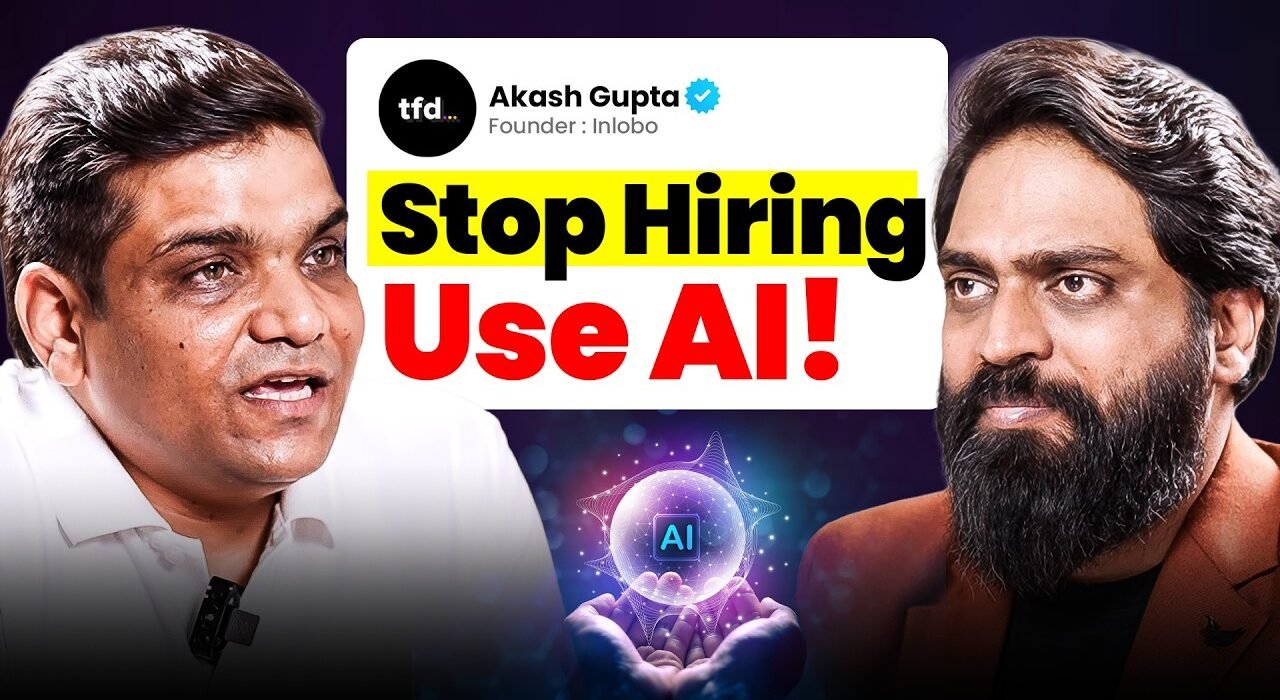
Most founders don’t lose business because their product is bad. They lose it because a lead comes in at 9 PM, nobody replies until the next morning, and the customer has already booked with someone else. That gap — between a lead arriving and a human reacting — is where Akash Gupta, founder of InLobo AI, built his entire company. In this Akash Gupta interview on The Founder’s Dream, host Abhishek Vyas gets him to break down how to grow your business using AI without pretending the technology does the thinking for you.
Akash’s earlier venture, Pro How Point Tech Solutions, built InLobo as a brand under it — much like TCS and Tata Motors sit under the Tata umbrella. The first product was PropTag, a real estate platform, which later expanded into home inspection services now running in 28 cities across India. It was while trying to get customers for that home-inspection business that Akash ran headfirst into the expensive, frustrating world of lead-generation agencies — and that pain is the actual InLobo AI founder story, not a pitch deck or a business-school case study, but a bad experience with agencies that he decided to fix himself.
How to Grow Your Business With AI: What AI Actually Does Differently From Humans
Before getting into tools and funnels, Akash lays out a simple framework for thinking about AI versus human effort. He doesn’t treat AI as magic or as a threat — just as a mirror of whoever is using it.
AI is not some kind of magic. The real difference between AI and a normal person comes down to one thing — who is learning more, every single day. A normal human learns, gets a job, and assumes that knowledge will carry them forward. AI keeps learning continuously, as long as you keep feeding it data.
His point is practical, not philosophical: a business owner who stops learning will get overtaken by one who doesn’t — AI or no AI. He’s blunt that AI only repeats what it’s given through prompts; it can’t absorb the real-world struggle a human picks up through years of working, failing, and adjusting. That’s the part of the sales process, he argues, that still belongs to people.
The Expensive Lesson That Led to InLobo AI
Akash doesn’t dress up his early experience with marketing agencies. His home-inspection business needed customers, so he turned to Meta ads, first through a full-service agency.
We trusted an agency completely. We ran it for two to three months and about ₹3.5 lakh went out of our pocket, but no real result came. The lead cost stayed close to ₹350 — and this wasn’t even for real estate, it was for something as ordinary as home inspection.
A freelancer charged ₹25,000 a month and just ran ads without managing what happened after a lead came in. A third vendor took money and delivered nothing. Lead cost never moved. At that point Akash did what a lot of founders avoid doing — he pulled a team member aside, paid for an online course, and had him learn to run ads directly. Results started coming within days, not because the ad skill was extraordinary, but because someone finally owned the process end-to-end. This same discipline echoes across other founder stories on The Founder’s Dream’s entrepreneurial journey archive — automation only works once a human has actually understood the problem it’s solving.
Why Lead Speed Matters More Than Lead Volume
The single idea Akash repeats most through the conversation is that a lead has an extremely short shelf life. Once Meta’s algorithm registers a delay in response, it treats that lead — and future leads like it — as lower value.
- A lead left unattended for more than a few minutes loses most of its conversion value.
- Agencies and software can hand over leads, but if nobody reacts in real time, the ad spend is wasted.
- Akash’s own lead cost for the home-inspection business dropped from roughly ₹350 to around ₹35 once response speed and audience targeting on Meta improved.
- Google ad leads in competitive categories can cost ₹2,500–₹3,000, making a slow response even more expensive to waste.
This is the exact gap InLobo AI was built to close — pulling leads out of Excel sheets, WhatsApp forwards, and disconnected CRM systems and putting them into one real-time dashboard where a manager can see how fast each team member reacts.
The Five-Step System Behind InLobo AI
Akash breaks the platform down into five steps that together form a sales funnel: running Meta ads for the business, fetching leads centrally instead of through scattered Excel sheets, engaging each lead through a WhatsApp API bot, qualifying the lead automatically, and then monitoring and recording the human conversation through two-way calling. Taken together, this five-step sequence is essentially the InLobo AI business model — a single app replacing the patchwork of agencies, freelancers, and spreadsheets Akash struggled with early on.
The WhatsApp layer isn’t just an autoresponder. Akash describes a nurturing sequence built into the app — a lead that goes cold gets a reminder the next day, then follow-ups over three days, then a check-in after 21 days, with longer-term triggers for festivals or offers. He’s specific about why 21 days matters:
If you push a customer too hard too often, they’ll simply block you. Three days of reminders is enough. After that, you wait — 21 days later, then two months, then six months, or whenever there’s a real reason like a festival or an offer.
On the calling side, every conversation runs through a virtual, masked number so a salesperson’s personal number stays hidden, and the call is recorded and translated for review. Keywords trigger alerts — if a salesperson starts behaving oddly or asks for a personal number, the business owner knows immediately. Akash calls this a “Detective Mode,” built so a founder or manager can see exactly how long a lead sat before being called, not just whether it eventually converted.
Can AI Calling Replace a Salesperson?
This is where Akash is most cautious, and most honest. InLobo AI has already tested AI calling on its own home-inspection leads, but he’s clear it isn’t a plug-and-play replacement for a sales team.
Direct selling through AI calling is genuinely difficult. We’re testing it for things like qualifying a lead — telling you this one is ready to be called — but don’t expect it to close deals on its own. I think the right use of AI calling right now is customer support, handling inquiries for people who are already customers, not cold selling to someone who isn’t one yet.
He adds that training a single AI calling model properly takes three to four months minimum, and a full system can take closer to a year, with real cost attached. His advice to small business owners tempted to go all-in on AI calling immediately is to slow down — human psychology defaults to negative expectations first, and jumping into an expensive, unproven system often confirms that fear rather than disproving it.
Process Before Scale: How to Grow Your Business Without Burning Cash
Akash’s advice for anyone starting out mirrors his own path, and it comes down to process-driven selling: don’t hire a big sales team or dump lakhs into ads on day one — build a process with what you have, prove it works, then scale.
Start winning small. If you have two or three people on your team and you call every lead at the right time, deals start converting and money starts coming in. One month, then two — by the third month, bring on two more people, train them to your level, and let them grow the business further.
He’s equally direct about new Meta ad accounts: expecting results from day one is unrealistic, since the algorithm needs one to three months to understand an audience. Businesses that panic and quit after burning a lakh or two in the first week make, in his words, “the biggest mistake.” A minimum spend of ₹1,000–₹1,500 per category, run consistently for six months with a real process behind it, delivers far better results than a large burst spend followed by a shutdown — a pattern echoed across the self-growth conversations on the same channel.
The Takeaway for Founders
- Treat AI as a process layer, not a replacement for sales judgment — it only performs as well as the data and effort you put into it.
- Respond to leads within minutes, not hours; delayed response is the single biggest reason ad spend fails to convert.
- Use WhatsApp for structured nurturing sequences, not mass blasting — it’s built for relationship-building, not instant conversion.
- Record and review sales calls to train new hires faster instead of waiting weeks to diagnose why they aren’t converting.
- Build a small, working process before hiring a large team or spending heavily on ads.
Akash closes the episode with a line that sums up his own journey better than any pitch could: “Your mind takes small wins and motivates itself — nobody else is coming to motivate you.” For founders trying to figure out how to grow your business in a crowded, ad-heavy market, that’s a more useful starting point than any software subscription.
Watch the full conversation with host Abhishek Vyas on The Founder’s Dream YouTube channel and subscribe for new founder interviews every week.
Frequently asked questions
What is InLobo AI?
InLobo AI is a sales automation platform built by Akash Gupta that centralizes lead fetching from Meta ads, routes leads to sales teams in real time, and combines WhatsApp bots, two-way calling, and follow-up tracking in one app.
Can AI replace human salespeople, according to Akash Gupta?
No. Akash Gupta says AI is a supporting hand that processes whatever data and prompts it is given, but the actual judgment, relationship building, and direct selling still rely on humans.
Why did Akash Gupta build InLobo AI?
After his earlier company kept losing money to marketing agencies that charged heavily for poor-quality leads, his team built its own lead-fetching and follow-up system, which they later turned into a product for other businesses.
What does Akash Gupta mean by a lead's five-minute expiry?
He explains that once a lead comes in through Meta ads, its value drops sharply if a business does not respond within a few minutes, because Meta’s own algorithm treats delayed leads as lower priority.
Is AI calling ready to close sales on its own?
Akash Gupta says his team is testing AI calling for lead qualification, but direct selling through AI calling is still difficult, and right now it works best for customer support and inquiry handling rather than cold selling.

1 Comment