
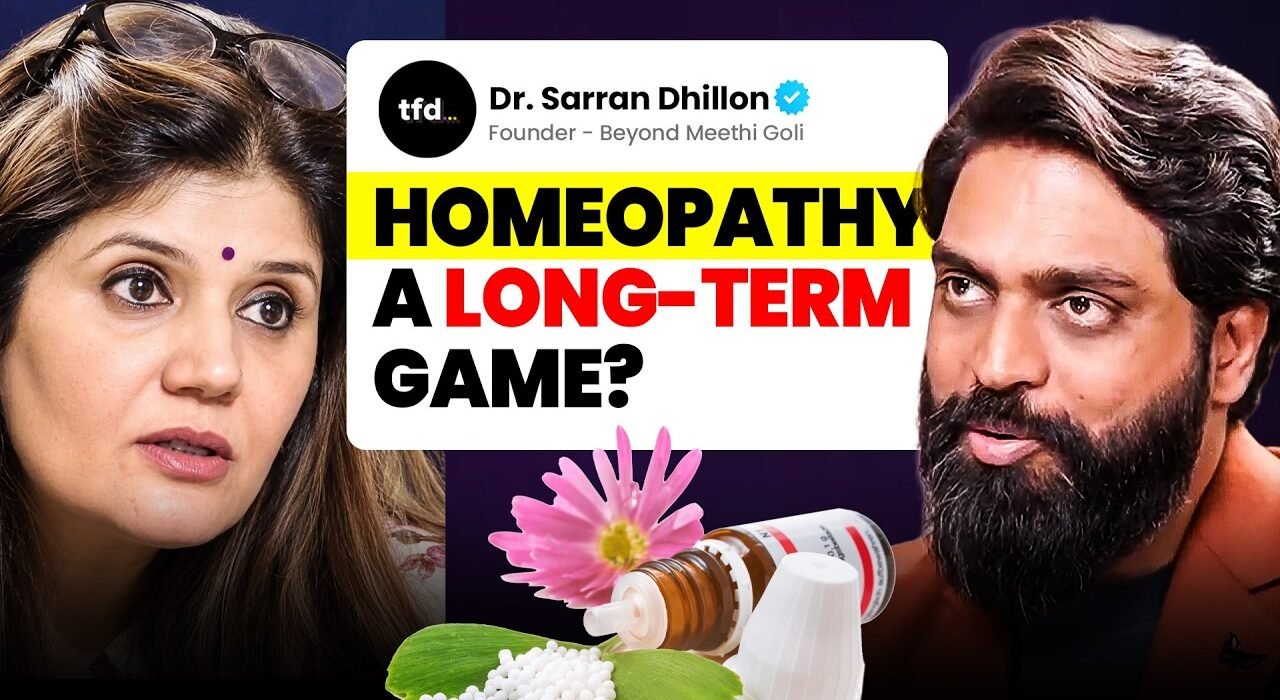
Most people equate health with a clean medical report. In this Dr. Sarran Dhillon interview on The Founder’s Dream, host Abhishek Vyas pushes back on that assumption, and Dr. Dhillon — founder of Dr. Sarran’s Homoeopathy Clinic with over 25 years of clinical practice — spends the conversation explaining why a normal report and a healthy person are not always the same thing.
Dr. Dhillon treats patients across every age group, from pregnant women to infants to geriatric patients, and her clinical approach keeps circling back to one idea: health is a state of balance between mind body and soul, not merely the absence of a diagnosed disease.
Dr. Sarran Dhillon Interview: What Does It Mean to Really Be Healthy
Early in the episode, Dr. Dhillon makes a distinction that shapes everything else she says. She argues that people have come to believe disease-free equals healthy, when in her view health is something larger.
Health is beyond disease. What we understand as health today, we think disease-free is health — no, health is something more than that.
She describes a real state of health as being able to sleep properly, digest food comfortably, balance your emotions, and negotiate life’s situations without being overwhelmed by them — “like the weight of your clothes, so light you don’t even feel it.” When sleep, nutrition and lifestyle are aligned, she says, you’re in that healthy state — and neither your career nor your health has to be compromised for the other.
Why Your Normal Lab Reports Don’t Guarantee You Feel Well
Abhishek asks her directly whether diagnosis is increasing or whether disease itself is increasing. Her answer is nuanced: she says diagnosis is increasing, and in a way that’s good because it brings us closer to identifying real causes. But she flags a gap many patients know personally.
Many times, despite the numbers matching up perfectly on paper, a patient walks around and doesn’t feel healthy. You may have noticed this too — your pathological report is quite normal, but from inside, you’re not feeling well.
Her point is that until the root cause is identified and addressed, that “not feeling well” sensation doesn’t go away just because a report looks fine. This is the gap she says homeopathy’s case-taking process is built to close.
Same Diagnosis, Different Patient — Why Homeopathy Studies the Individual
To explain how this works in practice, Dr. Dhillon gives a concrete comparison. Two patients can carry the exact same diagnosis of rheumatoid arthritis, and yet live completely different realities with it.
One patient has always been living with it and can’t even get out of bed. Another patient also has rheumatoid arthritis but is doing all her normal work. The diagnosis of both is the same, but how each one is dealing with that particular condition and disease is totally different — so how can I give the same medicine to both patients?
She traces the difference back to personal history: one patient may have dealt with a past grief, another with long chronic stress, and both pressures eventually precipitate into the same named condition through different emotional roots. That’s why her clinic studies a patient’s patterns, lifestyle, nutrition, gastrointestinal health and sleep before arriving at what she calls the “similimum” — the individualized remedy matched to that person, not just their diagnosis label.
This same philosophy of looking past the surface label and understanding the person is something The Founder’s Dream touches on repeatedly across its entrepreneurial journey stories, where founders describe learning to read what’s underneath the numbers in their own businesses too.
Mental Health, Stress and the Body’s Early Warning Whispers
Asked whether she talks about mental health more than physical health, Dr. Dhillon rejects the separation outright.
We cannot separate mental health from physical health at all. Every condition precipitates from the mind first — the mind gets hurt first, and later it manifests somewhere in the physical body as a pathological condition.
She says that hurt can come from anything — a long chronic grief, a broken relationship, an emotional disappointment — and if it isn’t addressed at the right time, with the right remedy, it gradually shows up as a physical condition: asthma, migraine, rheumatoid arthritis, any autoimmune disorder. She also pushes back on the idea that stress is a modern invention: “Stress was always there. It’s not that stress has increased now — it was always there.” What’s changed, she says, is how much we glorify exhaustion instead of addressing it.
She uses a simple image for this build-up: the body “whispers” before it shouts. Headaches, hair fall, low stamina, constant fatigue, poor digestion — these are small signs. Ignore them long enough, and a headache gets handled by a painkiller, gas by an antacid, fatigue by a tonic, while the real cause never gets addressed — until it eventually surfaces as a much bigger condition. “Nothing happens suddenly in the body,” she says. “It happens gradually, over the years.”
For emotional distress specifically — fear, lack of confidence, heartbreak, grief, unspoken conflict with a boss or family elder — she points to Bach Flower remedies alongside individualized constitutional medicine.
These medicines are actually very good, especially for emotional and mental health. I say there can’t be a better treatment for mental health than this.
She connects this directly to today’s youth: with both parents working and even grandparents absorbed in mobile phones, she says children often have no one to talk to, and unspoken stress accumulates until it takes a more serious shape later.
The Biggest Immunity Mistake Parents Make With Children
When the conversation turns to immunity — a topic parents obsess over for their children and themselves — Dr. Dhillon’s answer is blunt.
Immunity does not come in a bottle. We are giving everything in a bottle now, even food in a bottle. Our grandmothers never taught us that — we can still give ourselves healthy food and break those bottle patterns.
Her specific caution for children is about the first several years of life. She recommends keeping kids away from unnecessary conventional chemical drugs for at least the first five years so that proper brain and physical development isn’t interrupted, pointing out that parents who later complain their child’s height isn’t growing often don’t connect it to the steroids and antibiotics given early on. She also notes that a child’s temperament is tender up to around age seven, and that whatever parents say or do in front of children — including their own phone habits — shapes development and behaviour later.
On women’s health specifically, she observes that women go through more physiological change than anyone else — adolescence, pregnancy, menopause — while also carrying the household and family load, and consistently put themselves last. “She will always put herself in a secondary position,” she says, which is part of why women’s health became a particular focus area for her practice.
Collaboration, Not Competition: Where Homeopathy Fits With Modern Medicine
Asked where homeopathy fits against conventional medicine, Dr. Dhillon doesn’t claim it replaces everything. She’s specific about where it doesn’t belong: accident cases, fractures, anaphylactic shock — anything requiring emergency intervention — need conventional medicine first. But once the acute phase passes, she argues patients shouldn’t be on lifelong steroids for chronic conditions, and that’s where homeopathy’s individualized treatment aims for a permanent resolution rather than ongoing dependence.
We are not here for any competition — we are here for collaboration. There is so much drug dependence on the other side, and we break that cycle of drug dependence.
She also addresses the common myth that homeopathy only works slowly over months while allopathic pills resolve things in five to seven days, calling it a framing she’d rather not keep fighting. Her ask to skeptical patients is modest: give a chronic condition six months with proper case-taking before judging the result. She shares her own origin story here too — as a child with rheumatic heart disease, she was told she’d need lifelong steroids, until her parents consulted a homeopath who weaned her off them entirely; she’s had no recurrence since and credits homeopathy with saving her life, which is part of why her father encouraged her to build a clinic and “give it back to society.”
This kind of personal-history-to-practice arc is a recurring thread across self growth lessons shared by other guests on The Founder’s Dream — people who built their work around solving the problem that once nearly broke them.
Watch the full conversation with host Abhishek Vyas on The Founder’s Dream YouTube channel and subscribe for new founder and expert interviews every week.
Frequently asked questions
What is the main message of this Dr. Sarran Dhillon interview?
That health is more than the absence of disease and normal lab reports — true health is a balanced state of mind, body and soul, and homeopathy treats the individual behind the diagnosis rather than just the diagnosis itself.
What is the biggest immunity mistake parents make, according to Dr. Sarran Dhillon?
She says parents look for immunity in bottles and syrups instead of building it through sleep, nutrition and lifestyle, and she cautions against exposing young children to unnecessary chemical drugs in their early developmental years.
Does Dr. Sarran Dhillon think homeopathy can replace conventional medicine?
No, she is clear that in emergencies like accidents, fractures or anaphylactic shock, conventional medicine is necessary, and she advocates collaboration between homeopathy and allopathy rather than competition.
Why did Dr. Sarran Dhillon become a homeopathic physician?
As a child she had rheumatic heart disease and was told she would need lifelong steroids; homeopathy treated her condition, and her father encouraged her to give that back to society, which led her to found Dr. Sarran’s Homoeopathy Clinic.
Can homeopathy help with mental health and stress, as discussed in the episode?
Dr. Sarran Dhillon says mental and physical health cannot be separated, and she uses individualized case-taking along with remedies like Bach Flower medicines to address stress, grief, fear and relationship-related emotional issues.
1 Comment