
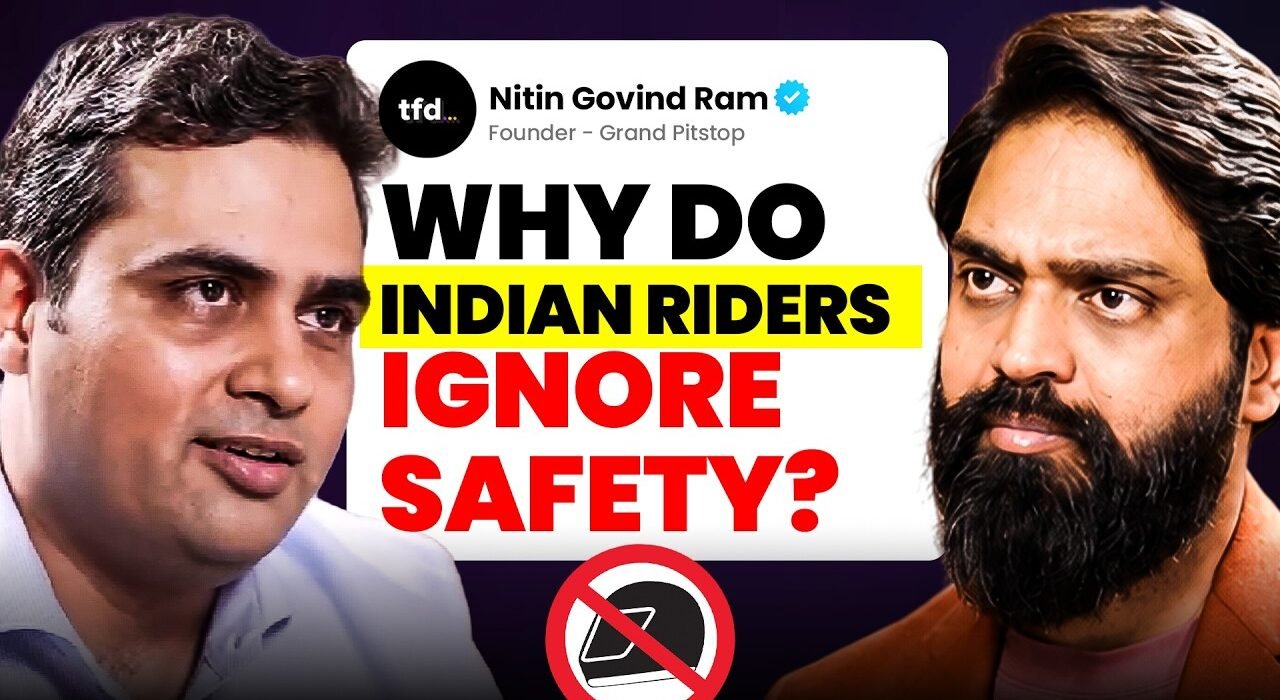
Every year, tens of thousands of motorcycle riders are killed on Indian roads, and most of them never had a chance to protect their first point of impact. That single fact sits at the center of the Grand Pitstop founder story — the journey of an IIT-trained engineer who turned a decade of riding across India, the US and the Middle East into a business built on one idea: a safer rider is a more visible rider. This Nitin Govind Ram interview, recorded for The Founder’s Dream podcast, finds host Abhishek Vyas sitting down with Nitin Govind Ram, founder of Grand Pitstop, to talk about motorcycle airbags, helmet culture, blind spots, and why Indian and international riders behave so differently on the road.
The Grand Pitstop Founder Story: From Sahranpur to IIT to Global Patents
Nitin grew up in Saharanpur, a small town near Haridwar, in what he describes as a happy, sports-filled childhood with “no regrets at all.” His older brother, an IIT Delhi graduate, pushed him toward engineering, and Nitin cleared JEE to study at IIT Delhi, where he co-founded the institute’s robotics club. A pivotal personal moment shaped his drive: his mother was diagnosed with cancer when he was eighteen, and the experience of family and strangers coming forward as blood donors left a lasting mark on him.
After IIT, he worked at a French oil-sector company that took him to the US and Saudi Arabia. Wherever he traveled, he rented and rode motorcycles using an international driving license, and he kept noticing the same gap everywhere.
Cars have gone from one airbag to two, and now an entire car is covered with sensors and airbags on every side. But the two-wheeler sector still hasn’t seen that kind of innovation, largely because most motorcycle manufacturers compete on price and leave safety accessories for the rider to figure out later.
That observation — repeated across continents — became the seed of Grand Pitstop.
Why Motorcycle Safety Is Still a Challenge on Indian Roads
Nitin is blunt about a habit he sees constantly in India: riders treat the helmet as elbow protection rather than head protection.
It’s unfortunate, but the focus a normal rider should have on safety simply isn’t there yet. If you meet any biker, the first question people ask is which bike you ride — not which helmet you wear. The helmet becomes secondary.
He points to certification as the easiest fix: Indian ISI marks are mandatory, but European safety certifications go further in testing how well a helmet protects the skull on impact. His advice is simple — buy from a shop with a warranty card so you know the helmet is genuine, not a roadside piece bought mainly to avoid a traffic fine.
Beyond gear, Nitin’s bigger argument is about awareness. Riders get hurt, he says, when they stop tracking their surroundings — whether they’re sitting in a car’s blind spot, whether other drivers can see them, and whether they’re maintaining a safe following distance. These three factors, more than the bike itself, determine how much risk a rider is carrying at any moment.
Patents, Airbags and the Grand Pitstop Business Model
Grand Pitstop’s first patent was for side-mounted airbags for motorcycles — a concept Nitin explains in very practical terms.
If you’re falling, the airbag comes in from that side and protects you from your first impact, which is the most important moment in a crash. When a rider starts to skid, the natural tendency is to lean toward one side, so that’s exactly where the airbag needs to be.
He’s careful to note he isn’t the first to attempt motorcycle airbags — Honda’s Gold Wing has a frontal airbag — but Grand Pitstop’s side-mounted design targets the skidding motion specific to how most falls actually happen. The company holds roughly 25 international patents across categories like airbags and blind-spot mirrors, filed in geographies including the US, India and China, and Nitin estimates 80% of those patents have already made it into real products sold under the Grand Pitstop name.
On the business side, Nitin was clear about positioning from day one: no white-labelling finished goods from China and slapping a brand sticker on them.
The background of the company from day one was innovation. We didn’t want to make helmets or jackets that are simply white-labelled from China and sold in India — coming from a good engineering background, that doesn’t sit right with me. We wanted customers to know us for our own engineering, not a copy of someone else’s.
Today Grand Pitstop sells across roughly 12–15 product categories, keeps about 95% of manufacturing within India, and ships products that reach riders in the US, UK and Europe in addition to India. Readers interested in how founders build differentiation from scratch will find similar patterns across our entrepreneurial journey stories on the podcast.
India vs. the West: It’s a Culture Gap, Not a Rider Gap
Asked about the difference between an Indian rider and someone cruising a wide-open American highway at 200 kmph, Nitin reframed the question entirely.
I think it’s less about the rider and more about a difference in culture. In the US or Europe, you’re not even allowed to own a superbike until you’ve earned specific licenses — there are separate categories like A1 and A2 based on your age and the motorcycle you’re qualified to ride. In India, one license covers everything, so you can buy a superbike today and be on the road tomorrow, whether or not you actually know how to handle it.
He also points to a deeper behavioral difference: abroad, car drivers slow down for pedestrians and bikers out of a shared sense of looking out for the more vulnerable road user. In India, he says, that responsibility mostly falls on the rider to protect themselves. He does see this shifting slowly — citing small, specific changes like younger drivers now saying “thank you” after someone lets them merge, something he says he barely noticed even two or three years ago.
Visibility, Night Riding and Everyday Safety Accessories
Nitin’s personal rule is simple: he avoids night riding and night driving altogether when he can, because Indian highways still lack the consistent street lighting he’s used to abroad. When night riding is unavoidable, he shares a trick — tucking in beside a car and using its headlights to boost his own visibility rather than weaving in and out of traffic for a marginal time saving.
This “more visible, more safe” philosophy shows up directly in Grand Pitstop’s product line: helmet lights that blink to compensate for a motorcycle’s low-mounted tail light, a backpack with a built-in hazard flasher, and gloves with embedded LED lights so hand signals remain visible after dark. For long rides, he also uses gel or air seats to reduce fatigue, pays attention to handlebar positioning to protect his back, and deliberately shifts his body position and footpeg placement during a ride to avoid stiffness — small habits anyone can borrow regardless of what bike they own. For riders working on their own habits and discipline on the road, it overlaps with broader self growth lessons about patience and awareness that show up repeatedly in founder conversations too.
Advice for Parents and First-Time Riders
With more than 80,000 motorcycle accidents and a comparable number of deaths recorded in India in 2024, Nitin’s advice to parents buying a first bike for a newly graduated child is direct and specific.
If you want to keep your child safe from the risk of an accident, first make them understand — I’m not getting you a 600cc or 1200cc bike. I’ll get you something under 350cc first. Ride it around, go to office and back on it, and once you genuinely feel the passion for riding, then we upgrade.
He backs this with a story from his own riding circle: a rider bought a new 750cc Harley without working up to it gradually, underestimated how much wider its turning radius was compared to a smaller bike, and went straight into a barricade on a turn he couldn’t make. Nitin’s framework for progression is a ladder — from a commuter bike, to a Royal Enfield-class 350cc, to 500cc, and only then toward higher-capacity machines — because, as he puts it, in the beginning “the motorcycle drives you” before you ever get to drive it.
- Start under 350cc and build real hours in the saddle before upgrading
- Choose a helmet with a European safety certification, bought from a shop with a warranty card
- Maintain visibility and following distance — especially around trucks, where braking power is strong and your visibility is weakest
- Prefer daytime riding where possible; if riding at night, use nearby vehicle lights and keep a minimum safe distance
- Treat fatigue seriously on long rides — gel seats, posture and small body movements reduce next-day strain
Nitin’s closing point is that none of this innovation matters if intentions aren’t clear first: build for rider safety, and the products and revenue follow from that, not the other way around. That focus on substance over hype is a big part of what makes the Nitin Govind Ram success story worth studying for any founder building a product-first brand.
Watch the full conversation with host Abhishek Vyas on The Founder’s Dream YouTube channel and subscribe for new founder interviews every week.
Frequently asked questions
Who is Nitin Govind Ram?
Nitin Govind Ram is an IIT Delhi engineer, motorcyclist and the founder of Grand Pitstop, a company that builds safety-focused motorcycle and car accessories including patented airbags, blind spot mirrors and visibility gear.
What does Grand Pitstop make?
Grand Pitstop makes motorcycle and car accessories such as side-mounted airbags, blind spot mirrors, helmet lights, LED gloves, hazard-flasher backpacks, and gel and air seats, with most products designed and manufactured in India.
Does Grand Pitstop make motorcycle airbags?
Yes, Grand Pitstop holds a utility patent on side-mounted motorcycle airbags designed to protect a rider’s first impact point when skidding, and the company has filed this patent in both the US and India.
What bike should a beginner start with according to Nitin Govind Ram?
Nitin Govind Ram advises beginners to start with something around 350cc, gain real riding experience, and only move to bigger capacity bikes gradually rather than starting directly on a 500cc or higher motorcycle.
Why does Nitin Govind Ram say daytime riding is safer in India?
He says Indian roads and highways still lack consistent street lighting and visibility infrastructure, which makes night riding riskier, so he personally prefers riding and driving during the day.
1 Comment