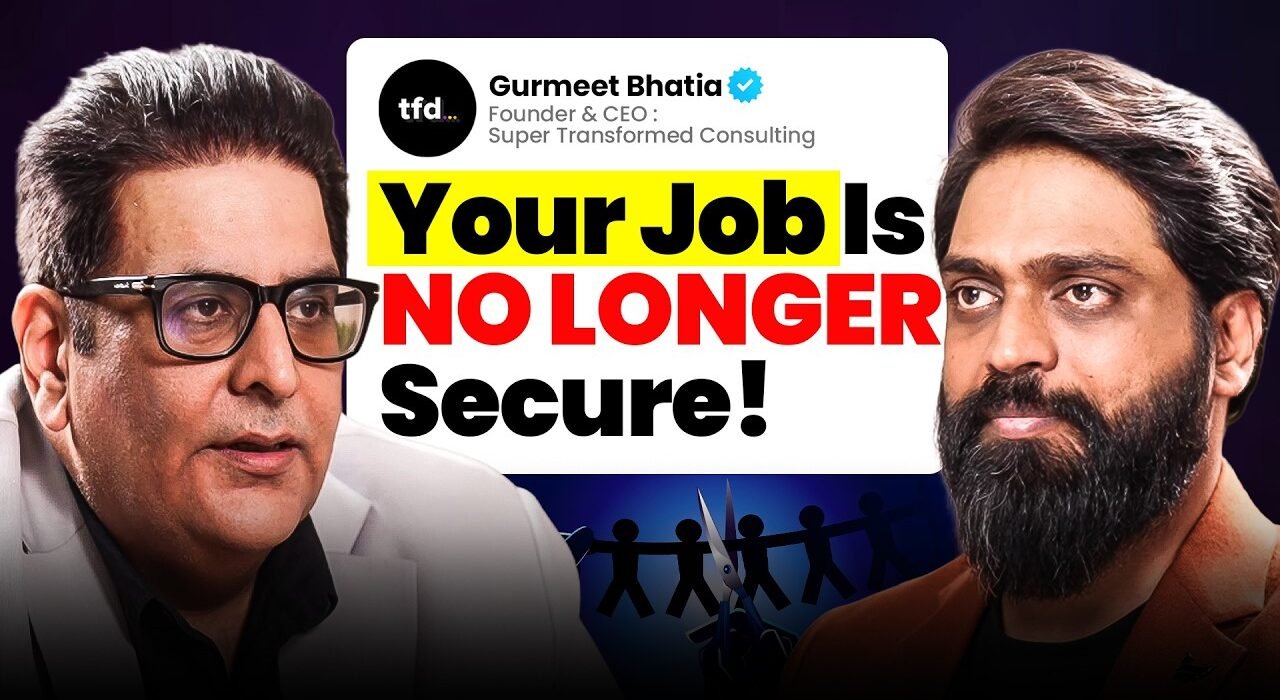
A 42-year-old director gets a message from his company: resign, because you haven’t upgraded, because you’re no longer aligned with where the company is headed. He can’t say this to his wife. He can’t say it to his father. He can’t even say it to his own children. This is the scenario host Abhishek Vyas puts in front of career coach Gurmeet Bhatia early in this Gurmeet Bhatia interview on The Founder’s Dream, and it sets the tone for a conversation about why retirement at 45 has quietly become a corporate reality rather than an exception.
Gurmeet Bhatia isn’t a motivational speaker reciting slogans. He spent years working directly under Ratan Tata on the Tata Indica project — India’s first indigenously developed car — and later with B.V.R. Subbu, before moving into India’s first private insurance company and eventually building a coaching practice around neuroscience and behavioral change. His argument through this episode is specific: talented, technically sound professionals are getting stuck and pushed out not because they lack intelligence, but because of patterns in how the brain resists change.
Why This Gurmeet Bhatia Interview Centres on Retirement at 45
Bhatia traces his interest in this subject back to watching his own engineering and MBA peers fall into career stagnation while he rose quickly into senior roles in his 30s. “I thought that these people are extremely competent. Why are they so frustrated? Why are they getting stagnated?” he says, describing the question that eventually led him to read Tony Robbins’ Awaken the Giant Within and start studying neuroscience as it applies to careers.
His answer to Abhishek Vyas’s direct question — why is retirement at 45 becoming a corporate reality now — is unromantic. It isn’t an HR conspiracy. It’s arithmetic.
The Payroll Math Behind the Layoffs
Bhatia breaks down a typical organisation of 100 employees: roughly 70 at the frontline, 25 in the middle, and five at the top. The frontline’s combined wage cost runs around 35–40% of payroll. The middle layer of just 25 people costs a near-identical 40%. The top five account for only 20%.
- One mid-manager can cost four to five times what a frontline employee costs.
- Automation has taken over the “communication window” role middle managers once played between leadership and frontline staff.
- Professionals typically enter middle management around their late 30s — and if they’re still there by 45 without moving toward leadership, they become the most expensive, most easily automated layer.
This is the arithmetic now driving middle management layoffs across corporate India. “Companies are not doing this because there is an agenda, but it is business acumen,” Bhatia says. A lean company without heavy middle-management cost simply outcompetes one that isn’t. That’s the impact of AI on jobs and automation playing out in payroll decisions, not in some distant future.
Lessons From Ratan Tata That Shaped His Coaching Philosophy
Working on the Indica launch, Bhatia says there was “no playbook available” for building India’s first mass-market indigenous car. What stayed with him wasn’t a specific decision Tata made, but how he made them. Rather than labelling a call right or wrong, Tata would ask what assumptions the decision rested on, and whether those assumptions had been tested.
That habit — pushing ownership back onto the person making the decision — became a model Bhatia later built into his coaching work. He left Tata after five years for a conversation that changed his path: an ICICI executive remarked that selling insurance was harder than selling cars, and Bhatia disagreed on the spot, arguing that understanding customer need matters more than the product category. That exchange led to an offer to join India’s first private insurance company, and from there eventually into entrepreneurship and coaching.
Why Smart, Capable People Get Stuck
One of the sharper observations in the episode is counterintuitive: Bhatia says he sees more intelligent people getting stuck in their careers than people he calls “simple-minded.”
I see the more intelligent people getting stuck more than people who are maybe a little more simple-minded… intelligent people are very good at giving reasons to what is happening in their life. Whatever they see, they will intellectualize it, they will assign a reason to it, and they will have resistance to change.
He illustrates this with a sales example — a highly capable, articulate caller who overthinks every rejected call versus someone simpler who just asks to be connected to the right person and moves on. The simpler approach often wins because it carries no “hang-ups,” as he puts it.
He also points to a close friend in the automobile industry who had mastered combustion-engine technology so thoroughly that he dismissed electric vehicles — and is now struggling to stay relevant as the industry shifts under him. Bhatia’s conclusion is blunt:
It is important that if you do something well, you move on to the next level of that game as well. You do not continue just staying where you are.
Motivation Isn’t Transformation
Bhatia draws a hard line between the two, based on his own experience sitting through corporate training programs full of “yelling and yes, we will do this” energy that evaporated by Monday morning.
Motivation without behavioral transformation is expensive entertainment.
His explanation is rooted in neuroscience: the brain optimises for familiarity, even familiar suffering, over unfamiliar growth. Real change, he says, requires sustained, deliberate repetition — not a single workshop. Readers interested in which specific capabilities are worth building for this shift can find more in The Founder’s Dream’s piece on the skills successful business leaders are learning for 2026, which complements Bhatia’s point that technical competence alone stopped being the differentiator a while ago.
He describes the coaching process as five layers: awareness and pattern recognition, nervous system regulation, identity reconstruction, behavioral rewiring, and finally identity expansion — where the new behavior becomes simply who you are, not something you’re trying to do. According to Bhatia, neuroscience research shows that behaviors practiced consistently for 60 days and beyond start to reprogram neural patterns, with visible results typically showing by around day 90.
Rebuilding Strategic Visibility Without Quitting Your Job
Asked directly whether weekend courses can genuinely help a stuck mid-career professional, Bhatia’s answer challenges the instinct to collect more certificates. Most people who’ve reached middle management already have strong technical skills — that’s how they got there. Piling on more courses, he says, is “icing on a cake” when the cake itself — the underlying behavioral foundation — is still weak.
His recommended framework has three parts:
- Simplify complexity — develop a genuine problem-solver mindset rather than just executing tasks.
- Get into the room — participate in critical business decisions and build visibility both inside the company and across the industry, not just within a narrow technical circle.
- Create measurable value — tie your work directly to outcomes the organisation cares about.
He adds a line that reframes the whole loyalty-versus-merit debate many mid-career professionals quietly carry:
Loyalty alone will not make you rise to the next level. It is your competence and your adaptability which will take you to the next level.
This same theme of staying relevant through reinvention runs through broader conversations about how media and public attention are shifting — a shift The Founder’s Dream has also examined in its piece on how podcasts are affecting traditional media, where older formats either adapt or get bypassed, much like the professionals Bhatia describes.
Handling the Emotional Side of Being Let Go
When Abhishek Vyas asks what a director actually feels when told to resign with no one to talk to, Bhatia pushes back on the assumption that layoffs are primarily a financial blow.
A lot of people feel layoffs is about financial impact. Actually, financial impact se zyada important jo hai emotional impact. Because what happens is when somebody is laid off, his identity shifts. He starts questioning himself, his skills, his abilities. He starts to lose self-respect.
His advice is to treat restructuring as course correction rather than a verdict on personal worth — and to seek outside perspective early, since friends, spouses, and former bosses are often the hardest people to be honest with about career struggle. His closing line in the episode sums up the entire argument:
Till you evolve, you will stay stuck.
He also leaves one practical nudge for anyone weighing whether to act now or wait: “Don’t wait for a crisis in your career before you start seeking guide. Seek it proactively so you can grow faster.” One promotion earned a year earlier, he notes, compounds into meaningfully more wealth over a career — a cost most people underestimate when they keep postponing.
Watch the full conversation with host Abhishek Vyas on The Founder’s Dream YouTube channel and subscribe for new founder interviews every week.
Frequently asked questions
Who is Gurmeet Bhatia?
Gurmeet Bhatia is a career coach who worked directly with Ratan Tata on the Tata Indica project and later with B.V.R. Subbu, before moving into the private insurance industry and eventually starting his own career coaching practice focused on behavioral transformation.
Why is retirement at 45 becoming common in private companies?
According to Gurmeet Bhatia, companies are automating the coordination work that middle managers used to do, and since middle management costs significantly more per employee than frontline staff, it becomes the first layer organisations trim when they restructure.
Can weekend courses fix career stagnation?
Gurmeet Bhatia says most stuck professionals already have strong technical skills, so adding more weekend courses is like icing on a weak cake; the real work is behavioral transformation, which requires consistent internal change rather than external shortcuts.
How long does behavioral transformation take according to Gurmeet Bhatia?
He explains that neuroscience shows consistent behavior patterns practiced for 60 days and above start to reprogram neural pathways, with visible results typically emerging by around the 90th day of sustained effort.
Why do intelligent people get stuck in their careers more often?
Gurmeet Bhatia observes that intelligent people are skilled at rationalising their circumstances, which makes them more resistant to questioning their own patterns and identity, while simpler, less self-justifying approaches often adapt faster.