
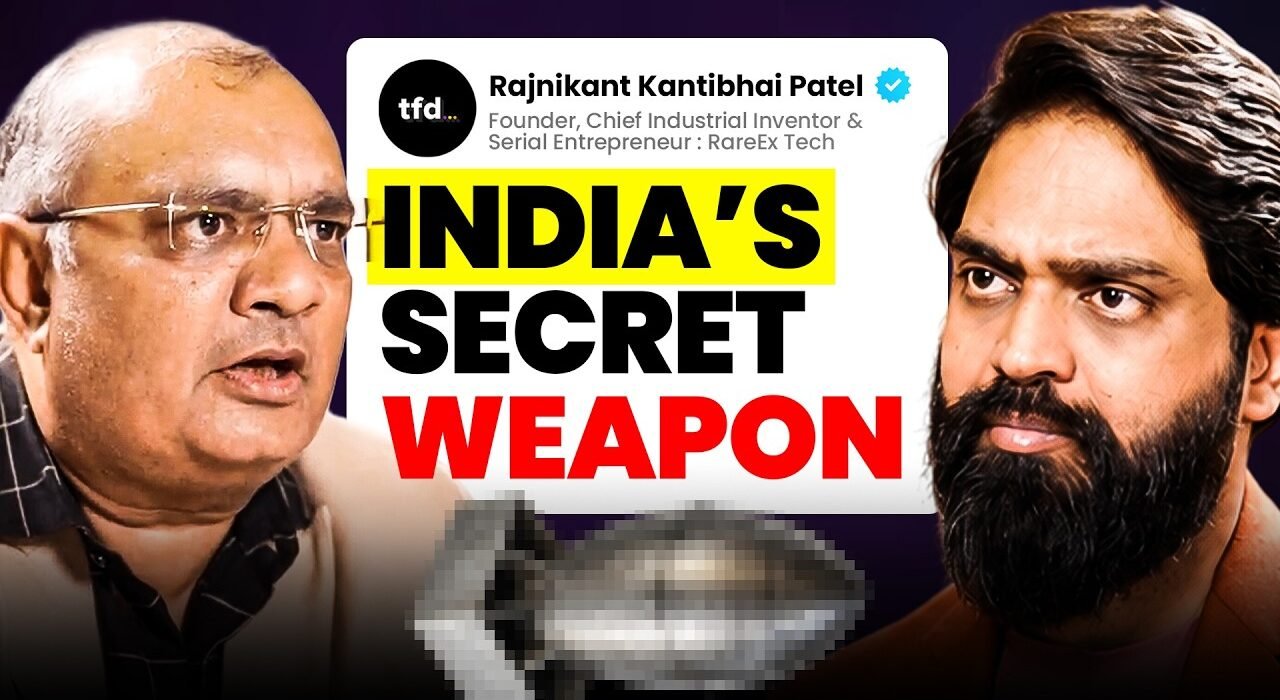
Nearly every chip, sensor, and 5G device in the world depends on one element that almost nobody outside a lab has heard of — gallium — and China controls about 98% of its global supply. In this Rajnikant Patel interview with host Abhishek Vyas on The Founder’s Dream, an Indian business podcast, the Gujarat-based entrepreneur explains how he has been extracting gallium and other critical minerals not from mines, but from coal ash, marble waste, and clay mining slurry sitting unused across India — a textbook case of waste to wealth innovation born out of necessity.
Who Is Rajnikant Patel and What Led Him to Critical Minerals
Patel is not a trained scientist. He describes himself as a commerce graduate who reads late into the night — sometimes until 3 or 4 a.m. — and that habit of reading research articles is what pulled him into R&D long before “critical minerals” became a buzzword in India. He says his real trigger was hearing the Prime Minister speak about India needing self-reliance in critical minerals.
Of the 17 elements classified as rare earth minerals, he points out that India currently extracts only four or five, and most of what is available domestically — like cerium — is low-value because it is easy to find. The real demand, he says, sits in minerals like zinc, copper, neodymium, and gallium, where India’s own production is close to nothing despite heavy domestic need.
Inside the Rajnikant Patel Interview: How Gallium Extraction Works From Industrial Waste
Patel’s process started almost by accident. Testing coal ash through what he describes as a roughly 57-step process, his team found cerium first, then gallium, selenium, thallium, rhodium, and indium — six or seven critical minerals surfacing from a single enriched batch. Among all of them, he is clear about which one matters most.
Nothing in the world today is possible without gallium. It goes into computer chips, 5G equipment — whatever chip is being made needs gallium, needs it, needs it. Every sensor being manufactured needs it too.
His current output is still lab-scale — about 119 grams of gallium per tonne of raw material, refined down to roughly 94 grams after acid leaching. To put that in perspective, he says 90–100 grams of pure gallium is enough to produce around 2 lakh small chips, roughly 500 IoT-grade chips, or 1,500–2,000 heavier chips like CPUs. He also claims gallium-based radar components can multiply detection capacity fivefold compared to current materials — which is why defence applications come up repeatedly in the conversation.
What makes his method different, he says, is yield efficiency. The global standard for acid leaching processes 100 kg of ash to recover value from it; his physical process reportedly narrows that down so that the usable output matches what would otherwise require processing a much larger volume — a claim he says has drawn interest from international experts, including someone he describes as a US defence advisory specialist who told him his 94 ppm extraction could make him the biggest gallium producer outside China.
India’s Dependence on China and What’s at Stake
Patel is blunt about the scale of the problem: if 100 kg of gallium is produced anywhere in the world, 98 kg of it is processed by China. That single statistic frames everything else in this Rajnikant Patel interview — India’s semiconductor ambitions, its 5G rollout, and its defence modernisation all run through a supply chain controlled almost entirely by one country.
He argues India has the raw material advantage already. By volume of rare earth resources available globally, he places India among the top five countries — but says if you count industrial waste, ash, and slurry as a mining category, India could rank first. The gap isn’t geology. It’s extraction capability and the policy environment needed to scale it.
Permissions, Funding, and the Uranium Problem
Ask Patel what’s stopping him from scaling up, and the answer isn’t technology — it’s paperwork. Importing equipment runs into government restrictions, and every stage of the process requires separate clearances.
They call it a single-window system, but to find that single window, we have to go through a thousand windows first. Only then can we actually get anything done.
Then there’s a complication specific to his material. His enriched output carries detectable uranium — around 23 ppm, or 23 grams per tonne — which pulls the entire project under Atomic Energy regulations, triggering a completely different compliance regime. He says he has approached the relevant government-linked company asking them to simply take the uranium-bearing fraction while he processes the rest, but has not received a response.
This is where the realities of startup funding India become clear. The government has declared a scheme of around ₹1,500 crore for secondary-source critical mineral recovery, with support capped at ₹20 crore per innovator or startup. But Patel says the scheme requires innovators to route their technology through one of three designated institutions via mandatory MoU — meaning the funding goes to the institution, not directly to the person who built the technology. For comparison, he estimates that matching China’s capacity at scale would require investment closer to the ₹22,000 crore the government has separately earmarked for the sector, far beyond what any single innovator can self-fund.
This is the kind of structural friction that stories on entrepreneurial journey stories on this podcast keep surfacing — brilliant technical work slowed down less by ambition and more by systems that weren’t built with independent innovators in mind.
Beyond Gallium: Green Ammonia, Seawater Lithium, and Defence Tech
Gallium isn’t Patel’s only project. He’s also developed a green ammonia process aimed at cutting cargo shipping emissions — he claims his technology can deliver 1.5–2 tonnes of capacity for roughly ₹1 crore, compared to existing five-tonne plants that start at ₹75 crore. For green hydrogen, which is typically produced under extremely high pressure and carries explosion risk, he says his alternative works at near-atmospheric pressure and costs about 10% of conventional setups — trading some output efficiency for safety.
He’s also working on extracting lithium from seawater using a specially developed membrane, a project he took to companies in China, Japan, and the US after finding limited engagement within India. The Chinese firm, he says, responded fastest once he shared specifications. On the defence side, he mentions a project called Shiva Kranti and provisional patents tied to cement technology that removes the need for sand — one variant, he says, can absorb seismic shock up to a 5–6 magnitude earthquake without cracking.
None of this has come without personal cost. Patel describes self-funding much of this research with support from his family, including a brother who sold a limited-edition car to help cover costs.
Nobody in my house tells me no for R&D, no matter how much money it takes. My father always says — even if nothing else comes of it, at least the country will benefit.
What This Rajnikant Patel Interview Tells Founders About Deep-Tech in India
- Raw material isn’t India’s constraint in critical minerals — extraction technology and regulatory speed are.
- Government schemes exist, but fund flow is often structured through intermediary institutions rather than directly reaching innovators.
- Byproducts like trace uranium can pull an entire waste-recovery project into a completely different regulatory category overnight.
- International validation can arrive before domestic institutional support does — Patel found faster technical engagement abroad than at home on his lithium membrane work.
- Diversifying across multiple R&D tracks (minerals, green fuels, defence, cement) can hedge against any single project stalling on permissions.
Patel’s story sits somewhere between invention and frustration — a reminder, consistent with the self growth lessons this podcast often draws out, that building something genuinely new in India frequently means outlasting the system rather than being carried by it.
Watch the full conversation with host Abhishek Vyas on The Founder’s Dream YouTube channel and subscribe for new founder interviews every week.
Frequently asked questions
Who is Rajnikant Patel?
Rajnikant Patel is an entrepreneur and technology innovator who develops processes to extract gallium and other critical minerals from industrial waste such as coal ash, marble industry waste, and clay mining slurry, alongside work in green ammonia, green hydrogen, railway technology, defence innovation, and cement alternatives.
Why is gallium important for India?
Gallium is a critical mineral used in computer chips, 5G equipment, sensors, and radar systems, and in this Rajnikant Patel interview he explains that nearly all of the world’s supply currently comes from China, leaving India and the rest of the world dependent on imports.
What is the biggest challenge in scaling gallium extraction in India?
According to Rajnikant Patel, the biggest obstacles are not technical but regulatory — getting import permissions, navigating multiple government approval windows, and the fact that enriched material containing even trace uranium falls under Atomic Energy norms, which changes the entire compliance process.
Does the Indian government fund critical mineral innovators like Rajnikant Patel?
The government has declared large critical minerals schemes, but Rajnikant Patel says funding comes with conditions — such as mandatory technology transfer to designated institutions — that make it difficult for individual innovators to directly access the money.
What other technologies has Rajnikant Patel worked on?
Beyond gallium, he has worked on green ammonia and green hydrogen production, extracting lithium from seawater, a high-capacity railway freight technology, a defence innovation called Shiva Kranti, a disease-detection device called Safe Dot, and cement alternatives that do not require sand.

1 Comment