
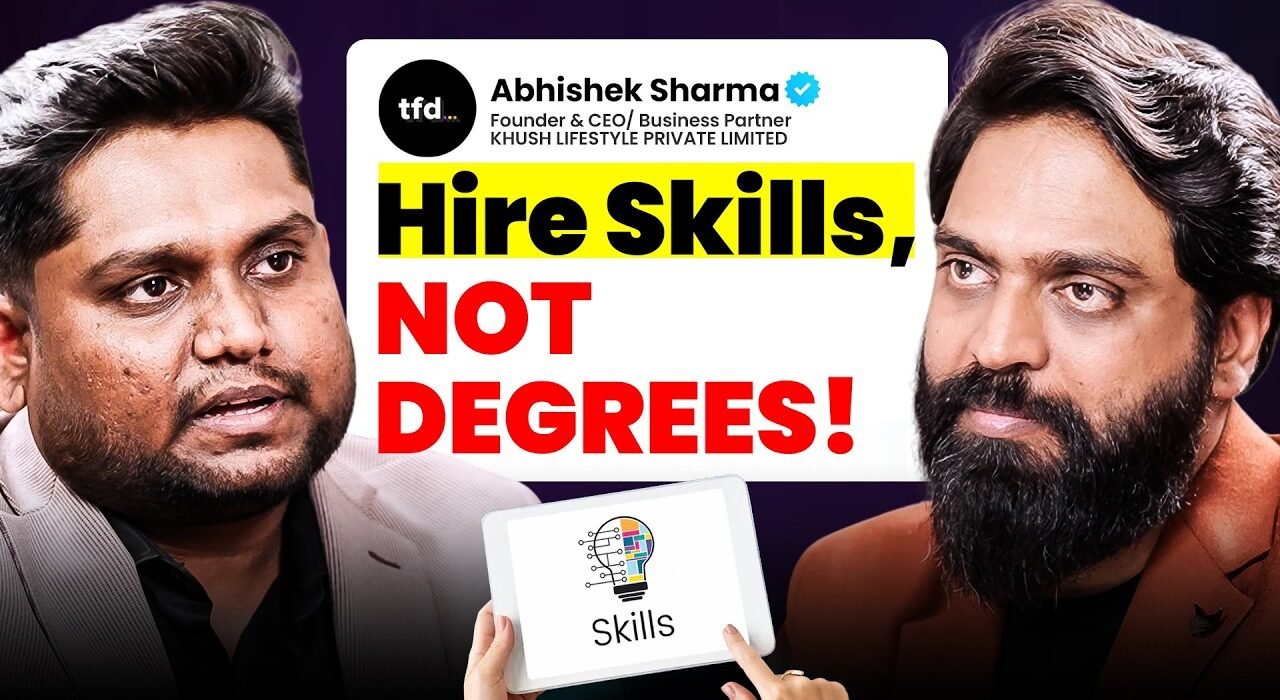
Most founder interviews talk about funding rounds and growth hacks. This one, recorded for The Founder’s Dream podcast — an indian business podcast hosted by Abhishek Vyas — talks about something more basic: whether a piece of paper called a degree should decide who gets hired. Abhishek Sharma, co-founder of Khush Lifestyle, walks through his own entrepreneur success story india founders and job-seekers alike can learn something from — one that started with ₹500 in his pocket and now runs across education, IT, fashion, and community platforms. As founder podcast episodes go, it’s less about pitch decks and more about what actually built the man.
An Entrepreneur Success Story India Can Learn From
Sharma grew up in Kanpur in a financially tight household. He didn’t dramatise it, but he was direct about what it meant growing up:
We suppressed our desires from childhood itself. My parents didn’t fail to love me, but sometimes when Diwali came there were no new clothes, and when Holi came there was no money for colours. I lived my whole childhood inside that loop.
He started earning while still in class 12 — teaching English speaking classes, running summer camps, doing job consultancy work, and even opening a small café. None of it felt satisfying, so he moved out of Kanpur, worked briefly in Delhi, and then started a freelancing agency offering data entry and graphic design to international clients. That agency eventually became Fussy Panda Private Limited, his IT company today. The Abhishek Sharma success story, at this stage, is really just a series of odd jobs refusing to add up to nothing.
The turning point he shared on the podcast was blunt. When he was 18, he interviewed at American Express in Gurugram and left his graduation status off his resume. The interview went well — until the end.
They told me everything about you is good, sir, you’re just not a graduate. So if everything else is good and the only issue is that I’m not a graduate, how is that the deciding factor?
That rejection is the reason skill-based hiring became a personal mission rather than just a business talking point for him.
Why Skill-Based Hiring Matters More Than Degrees, According to Sharma
Sharma didn’t argue that degrees are worthless. He argued that the education system feeding those degrees is broken. His core claim: India doesn’t have a jobs shortage, it has a skills-mismatch problem.
The only problem is that the skill companies need, you simply don’t have. It isn’t taught in schools, it isn’t taught in colleges. Companies want kids with practical knowledge, but schools are only teaching theory.
He backed this with a claim from his own ed-tech company, Learning Sync: he says B.Tech and M.Tech graduates regularly enrol there for full-stack development courses because, in his words, they spent four years on a degree and two more on a master’s without learning to code or build a real project. Learning Sync, he says, drives roughly 90% of his group’s revenue and includes a six-month internship component so students have something concrete to show employers.
His fix isn’t “scrap the syllabus” — it’s “teach it differently”:
The syllabus isn’t wrong. We just teach it through theory. If we taught it practically, people would understand far more. That’s the only thing wrong here, nothing else.
He extended the same logic to his own hiring. Across his companies he says he currently has more than 250 people working for him, and by his estimate 70% of them don’t hold formal degrees — yet he says their output matches or beats degree-holders, simply because they were given the opportunity he wasn’t.
What Sharma Says Founders and Governments Should Actually Change
- Shift classroom teaching from theory-heavy to practical, hands-on learning from school age.
- Companies should adopt skill-first hiring for private-sector roles, reserving degree requirements for government jobs where they still carry weight.
- Build platforms specifically for people from backgrounds where formal education wasn’t accessible.
- Judge people on demonstrated skill rather than pedigree — what he called moving away from “league-ism.”
Khush Lifestyle Business Model: Community and Designer Royalties
Khush Lifestyle is the fashion brand Sharma runs with his wife and co-founder, Khushi Sharma. It positions itself around variety and affordability rather than competing head-on with big labels, dropping new collections every Monday. The idea, Sharma explained, came from Khushi’s own frustration as a shopper who kept seeing repeated collections everywhere she went.
Two upcoming features define where the brand is headed next. The first is a community feature launching within two to three months, meant to fix a real shopping pain point — polished studio photos that don’t match how a garment actually looks once it arrives. Creators will be able to post real photos and videos of purchases, earning commissions on resulting sales and on views, similar to how Instagram or YouTube compensate creators.
The second, and the one Sharma called genuinely unprecedented, is a royalty program for designers:
For the first time in the world, we are bringing an option to our app that will benefit every single person. Whenever any design uploaded to our app is sold, it will show “designed by” that person’s name, and for a lifetime, whenever that piece sells, the designer gets a royalty.
Crucially, this isn’t limited to in-house designers — Sharma described it as an open platform where any designer can create a profile, submit designs, and if approved, earn a small percentage on every future sale, giving independent designers a portfolio and a passive income stream they don’t currently have anywhere else.
Building a Business as a Couple
Khushi Sharma joined the conversation to explain how the two of them split decisions at Khush Lifestyle. Her honest answer: there’s no fixed hierarchy.
There’s no ego between us about who gets to decide. Whatever is better for the company, that view wins. We look at sales, production numbers, how many designs got approved — decisions are based on data, not on who said it.
She also credited the speed of the venture — more than 100 staff and over 50 lakh in sales within four months of launch, according to Sharma, alongside a plan to roll out 90-minute fashion delivery in Delhi NCR before expanding nationally. It’s a useful reminder for anyone reading founder entrepreneurial journey stories that partnership businesses can move fast precisely because decisions get made on shared data rather than debate.
What’s Next: EV Two-Wheelers and a Platform for the Muslim Community
Sharma’s group — branded Abhishek International and including Learning Sync, Fussy Panda, Vigor, and Khush Lifestyle — has two future ventures in early stages. One is an EV segment starting with two-wheelers, with cars planned roughly five years out. The other is a marketplace platform modelled loosely on Amazon or Flipkart, but built specifically for the Muslim community — covering abayas, hijabs, prayer mats, caps, and other products currently scattered across small, disconnected websites.
He was equally candid about the harder years. In 2024, Learning Sync hit a point where cash flow wasn’t managed properly and, by his account, nearly everyone around him suggested shutting it down.
I thought, no, in life you should take one shot. We didn’t want to leave it there — this might just be our turning point.
The Bigger Message for Founders
Asked what he’d tell someone starting out, Sharma didn’t talk about funding or market size. He talked about priority:
You have to make every title secondary — whether that’s relatives, relationships, or marriage. You have to put yourself first, and your desires first. When that hunger shows up, nothing in the world can stop you.
He tied it back to his own arrival in Noida with just ₹500, contrasted against running more than six companies today. It’s a fairly common arc in an self growth sense — the emphasis on discomfort now versus regret later — but it lands harder coming from someone who names the exact number he started with. That relentless entrepreneur mindset, putting hunger above comfort, is the thread running through every company he’s built since.
FAQ
The episode covers a lot of ground for anyone researching skill-based hiring, ed-tech in India, or Khush Lifestyle specifically — the questions below reflect what the conversation actually answers.
Watch the full conversation with host Abhishek Vyas on The Founder’s Dream YouTube channel and subscribe for new founder interviews every week.
Frequently asked questions
Who is Abhishek Sharma of Khush Lifestyle?
Abhishek Sharma is a serial entrepreneur from Kanpur who runs multiple companies including Learning Sync, an ed-tech firm, Fussy Panda, an IT company, Vigor, a social platform for the LGBTQIA+ community, and Khush Lifestyle, a fashion brand he co-founded with his wife Khushi Sharma.
What is the royalty program for designers at Khush Lifestyle?
Khush Lifestyle is launching a feature where any designer, not just in-house ones, can submit designs through an open platform on the app, and if the design is approved and sold, the designer earns a lifetime royalty every time that product is purchased.
Does Abhishek Sharma believe degrees matter for hiring?
He believes degrees still have value in government jobs, but for most companies, skills should count more, and he says over 70 percent of the people in his own organisation of 250-plus employees do not hold formal degrees yet outperform those who do.
How did Abhishek Sharma start his entrepreneurial journey?
He started earning in class 12 by teaching English speaking classes and running summer camps in Kanpur, later moved to Delhi with very limited money, and eventually built a freelancing agency that grew into his IT company, Fussy Panda.
What is Khush Lifestyle's community feature?
It is an upcoming feature that lets shoppers and creators post real photos and videos of products they have bought, so buyers can see how an item looks on different body types and in real lighting instead of relying only on studio photos.
1 Comment