
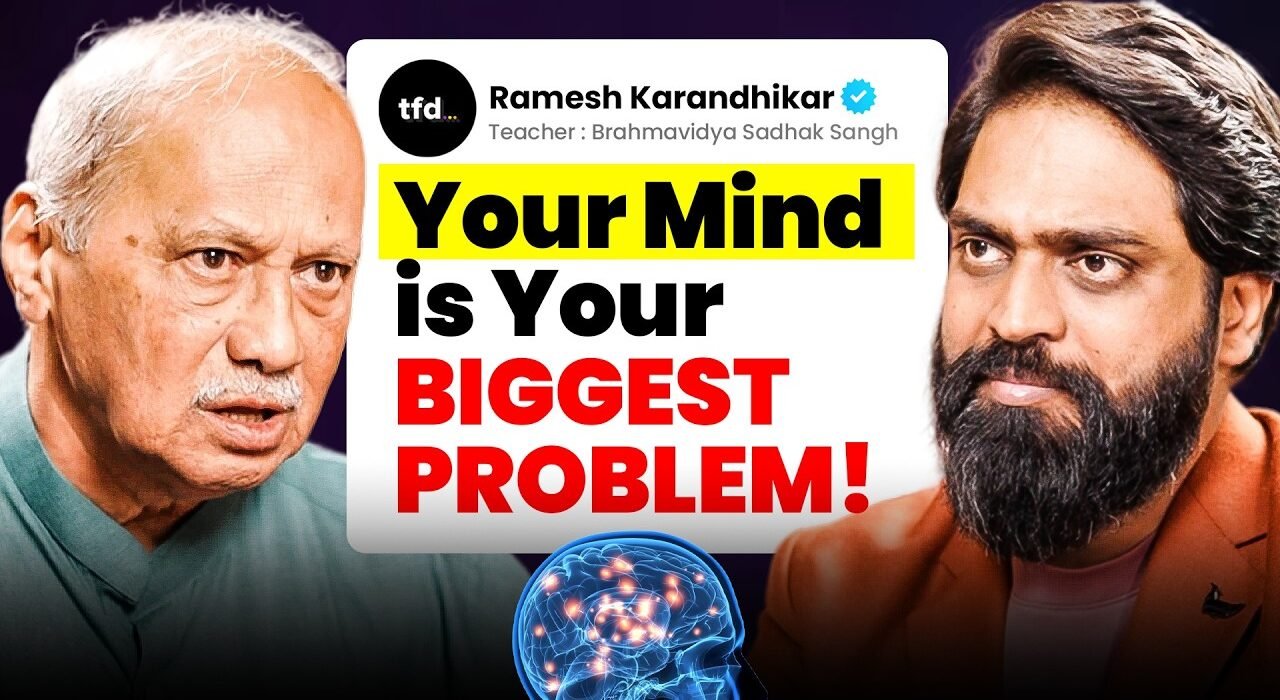
What if the reason you feel exhausted by evening has less to do with your workload and more to do with how you breathe? That is the question at the centre of this Ramesh Karandhikar interview on The Founder’s Dream, also known to regular listeners as the TFD podcast, where host Abhishek Vyas sits down with the founder-teacher of Brahmavidya Sadhak Sangh to unpack Brahm Vidya — a body of knowledge about breath, thought, and the invisible order that governs everything from planets to people.
Ramesh Karandhikar has been teaching Brahm Vidya for years through Brahmavidya Sadhak Sangh, and in this conversation he lays out why he believes most of what we call illness, stress, or bad luck is something we create ourselves — and something we can therefore undo ourselves.
What Is Brahm Vidya? Inside the Ramesh Karandhikar Interview
Ramesh Karandhikar opens with a simple but expansive definition: everything in the universe is connected to everything else, and to its creator.
Whatever exists in this universe is connected to each other, and it is also connected to the Creator.
He is careful to separate Brahma from any single religion. He calls it “that power which governs and controls everything that exists” — and argues that whether or not someone believes in God, they still have to accept that there is a perfect order in the universe, with something behind that order. He points to planetary motion, the behaviour of plants, and animal life as proof that order runs through everything except, as he puts it, the one place we feel it missing most: the human kingdom.
The Breath-Existence Connection and Prana Energy
The most concrete part of the discussion is about breath. Ramesh Karandhikar says life begins the moment breath begins and ends the moment it stops, yet most people know almost nothing about their own breathing. He distinguishes between oxygen and what he calls prana — a cosmic energy that, in his words, travels to every cell not through blood vessels but directly through the nervous network.
He shares a claim that surprises most listeners: most adults over 20 or 30 use only around 10% of their lung capacity, which means their intake of both oxygen and prana energy is a fraction of what it could be. His advice for anyone feeling foggy or fatigued at a desk is immediate and practical.
Sit quietly for two minutes and do deep breathing — by the fifth minute you will feel recharged. We have that much power and we are simply not using it.
He also makes a distinction worth remembering: unlike the heartbeat, which is completely automatic, breath is only partly automatic — you can consciously slow it, deepen it, or hold it. That, he says, is exactly the door Brahm Vidya asks people to walk through.
Can Your Thoughts Really Affect Your Health?
One of the more direct claims in the episode is about the link between thought and physical health. Ramesh Karandhikar argues that childhood conditioning — a parent warning “you’ll fall sick if you go out in the rain” — is not a law of nature, but the mind treats it as one, and the body follows.
My entire metabolism runs on my thoughts.
He extends this to something more provocative: that even our fear of death is largely programmed, shaped by patterns like average family lifespan or social expectation. When Abhishek Vyas brings up the idea that every defeat except death is mental, Ramesh Karandhikar agrees and pushes it further.
Except for death, every kind of defeat is mental — and even death is largely mental.
He connects this directly to the idea of self-mastery: Brahm Vidya’s position, he says, is that “no one else — you are the master of your own life,” and that includes the mental patterns that quietly run your health.
Why Today’s Youth Are Carrying So Much Stress
The conversation turns to a theme that will resonate beyond spiritual circles: burnout among young people. Ramesh Karandhikar describes a pattern where people don’t even realise they are carrying stress until it manifests physically.
Young people today are carrying so much stress, and many times we don’t even know that we are carrying it. It is a silent killer.
He references news of executives collapsing and dying in their 40s and 50s as evidence that this has quietly become normalised, and he pushes back hard on the idea that this is simply how modern life has to be. In his framing, most disease is psychosomatic — around 90%, by his estimate — because we think first and the body follows later. He also flags something practical: he believes roughly 90% of people have some form of sleep disorder, and that peaceful, uninterrupted sleep is a better marker of a good life than money or possessions.
He is equally blunt about the trap of comparison, which he sees as a major driver of everyday unhappiness.
Why should his shirt be whiter than mine? We are always looking at other people’s plate rather than our own — if I look at my own plate, I will realise how much I have already been given.
From Nalanda to Tibet to a Classroom in Maharashtra
Perhaps the most interesting thread in this Ramesh Karandhikar interview is the lineage he traces for Brahm Vidya itself. He says this knowledge is entirely Indian in origin, taught at Nalanda University roughly 1,200 years ago through a guru-shishya tradition, before foreign invasions threatened its survival. According to Ramesh Karandhikar, the knowledge was then carried to Tibet, where it survived for generations.
The next link in the chain, he says, was an Englishman named Edwin John Dingle, who felt pulled toward Asiatic yoga systems, travelled through Singapore and India, and eventually reached Tibet, where he studied under Tibetan gurus and later wrote about the experience in a book titled “My Life in Tibet.” On returning, he took the name Guru Dingle Mi and eventually founded the Institute of Mental Physics in California’s Yucca Valley, where he is said to have taught close to 26,000 people across basic, advanced, and preceptor-level courses.
From there, Ramesh Karandhikar credits an Indian student, K.S. Ramanathan — known as Guru Jyotirmanand — with learning under Dingle Mi by correspondence for over 30 years before bringing the teaching to India under the name Brahm Vidya. Jyotirmanand translated the full three-level course into Marathi, and the organisation today, Brahmavidya Sadhak Sangh, teaches in Marathi, Hindi, Gujarati, and English.
How the Brahm Vidya Course Actually Works
For listeners wondering whether this is a lifestyle overhaul or a short workshop, Ramesh Karandhikar is specific about the format. The basic course runs six months, with one and a half hours of class per week, built around three pillars: breath, thought, and universal law. He is clear that results depend on daily practice, not passive listening.
- Roughly 20 minutes a day of breathing exercises
- Roughly 20 minutes a day of meditation
- Weekly classroom sessions with printed lesson material to revisit at home
- A minimum age of 8, with a dedicated children’s track for ages 8–16
- An intensive residential option — a six-day stay at their Aarohan Ashram near Kamshet that compresses the six-month syllabus
He is upfront that gym workouts don’t guarantee health, but positions consistent Brahm Vidya practice differently, tying the organisation’s own tagline to it directly — “learn the science of Brahm Vidya for health and success.” He also notes there is no fee for teachers within the trust structure; Brahmavidya Sadhak Sangh operates as a charitable trust, and instructors teach because they experienced the benefit themselves, not for remuneration.
What This Means Beyond the Spiritual Framing
Even for listeners who aren’t drawn to the spiritual vocabulary, this Ramesh Karandhikar interview sits squarely at the intersection of spirituality and personal growth: shallow breathing, unexamined stress, and inherited fears quietly shape daily energy and decision-making. Ramesh Karandhikar’s core argument is that awareness — of breath, of thought patterns, of comparison — is available to everyone for free, and that most people never realise its value until much later.
Whatever is free is actually the most valuable — we just don’t realise it, and by the time we do, it’s later than we’d like.
If you’re building out your own understanding of what makes founders and high performers sustainable rather than just productive, it’s worth browsing the wider catalogue on The Founder’s Dream Guests page, where conversations range from business strategy to mindset and wellbeing. And if this episode’s format — a single, deep, unhurried conversation — appeals to you, the site’s piece on why focused, niche podcasts are winning right now explains the thinking behind shows built exactly this way.
Watch the full conversation with host Abhishek Vyas on The Founder’s Dream YouTube channel and subscribe for new founder interviews every week.
Frequently asked questions
What is Brahm Vidya according to Ramesh Karandhikar?
Ramesh Karandhikar describes Brahm Vidya as the knowledge that everything in the universe is connected to a supreme governing power he calls Brahma, and that learning this connection through breath and thought is the base of a healthy, successful life.
How is breath connected to prana energy in Brahm Vidya?
He explains that oxygen reaches the body through blood, but prana energy, a cosmic energy, reaches every cell directly through the nervous network, and most adults use only about 10 percent of their lung capacity.
Can thoughts really affect health and metabolism?
Ramesh Karandhikar says his entire metabolism runs on his thoughts, and that illnesses and tensions are created by the person’s own mind, not by God, which is why he considers most disease psychosomatic.
Where did Brahm Vidya originally come from?
He traces the knowledge to ancient Nalanda University, from where it was carried to Tibet, learned by an Englishman named Edwin John Dingle who became Guru Dingle Mi, and later brought to India by Guru Jyotirmanand, who translated it into Marathi, Hindi, Gujarati and English.
Why does Ramesh Karandhikar say youth stress is a silent killer?
He points out that young people are carrying enormous stress without even realising it, calling it a silent killer behind the rising cases of executives collapsing in their 40s and 50s.
1 Comment